Stengel Anna, Shahswar Rabia, Haferlach Torsten, Walter Wencke, Hutter Stephan, Meggendorfer Manja, Kern Wolfgang, Haferlach Claudia
MLL Munich Leukemia Laboratory, Munich, Germany; and.
Department of Hematology, Hemostasis, Oncology, and Stem Cell Transplantation, Hannover Medical School, Hannover, Germany.
Blood Adv. 2020 Nov 10;4(21):5393-5401. doi: 10.1182/bloodadvances.2020003007.
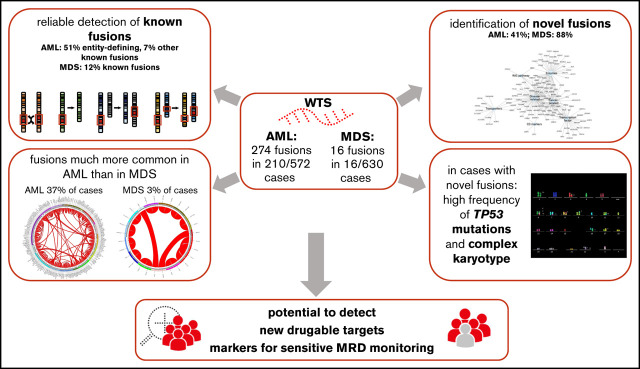
Fusion transcripts are frequent genetic abnormalities in myeloid malignancies and are often the basis for risk stratification, minimal residual disease (MRD) monitoring, and targeted therapy. We comprehensively analyzed the fusion transcript landscape in 572 acute myeloid leukemia (AML) and 630 myelodysplastic syndrome (MDS) patients by whole transcriptome sequencing (WTS). Totally, 274 fusion events (131 unique fusions) were identified in 210/572 AML patients (37%). In 16/630 MDS patients, 16 fusion events (15 unique fusions) were detected (3%). In AML, 141 cases comprised entity-defining rearrangements (51% of all detected fusions) and 21 (8%) additional well-known fusions, all detected by WTS (control group). In MDS, only 1 fusion was described previously (NRIP1-MECOM, n = 2). Interestingly, a high number of so-far unreported fusions were found (41% [112/274] in AML, 88% [14/16] in MDS), all validated by cytogenetic and/or whole genome sequencing data. With 1 exception (CTDSP1-CFLAR, n = 2), all novel fusions were observed in 1 patient each. In AML, cases with novel fusions showed concomitantly a high frequency of TP53 mutations (67%) and of a complex karyotype (71%), which was also observed in MDS, but less pronounced (TP53, 26%; complex karyotype, 21%). A functional annotation of genes involved in novel fusions revealed many functional relevant genes (eg, transcription factors; n = 28 in AML, n = 2 in MDS) or enzymes (n = 42 in AML, n = 9 in MDS). Taken together, new genomic alterations leading to fusion transcripts were much more common in AML than in MDS. Any novel fusions might be of use for developing markers (eg, for MRD monitoring), particularly in cases without an entity-defining abnormality.
融合转录本是髓系恶性肿瘤中常见的基因异常,通常是风险分层、微小残留病(MRD)监测和靶向治疗的基础。我们通过全转录组测序(WTS)对572例急性髓系白血病(AML)患者和630例骨髓增生异常综合征(MDS)患者的融合转录本图谱进行了全面分析。在572例AML患者中的210例(37%)中共鉴定出274个融合事件(131种独特融合)。在630例MDS患者中的16例(3%)中检测到16个融合事件(15种独特融合)。在AML中,141例包含定义实体的重排(占所有检测到的融合的51%)以及另外21个(8%)已知融合,均通过WTS检测到(对照组)。在MDS中,之前仅描述过1种融合(NRIP1 - MECOM,n = 2)。有趣的是,发现了大量此前未报道的融合(AML中占41% [112/274],MDS中占88% [14/16]),所有这些均通过细胞遗传学和/或全基因组测序数据得到验证。除1例(CTDSP1 - CFLAR,n = 2)外,所有新融合均在各1例患者中观察到。在AML中,有新融合的病例同时显示出高频率的TP53突变(67%)和复杂核型(71%),MDS中也观察到这种情况,但程度较轻(TP53,26%;复杂核型,21%)。对涉及新融合的基因进行功能注释发现了许多功能相关基因(如转录因子;AML中n = 28,MDS中n = 2)或酶(AML中n = 42,MDS中n = 9)。总体而言,导致融合转录本的新基因组改变在AML中比在MDS中更为常见。任何新融合可能都有助于开发标志物(如用于MRD监测),特别是在没有定义实体异常的病例中。