Scutera Sara, Musso Tiziana, Cavalla Paola, Piersigilli Giorgia, Sparti Rosaria, Comini Sara, Vercellino Marco, Cuffini Anna Maria, Banche Giuliana, Allizond Valeria
Department of Public Health and Pediatrics, University of Torino, 10126 Turin, Italy.
Department of Neuroscience, University of Torino, 10126 Turin, Italy.
J Clin Med. 2020 Nov 2;9(11):3542. doi: 10.3390/jcm9113542.
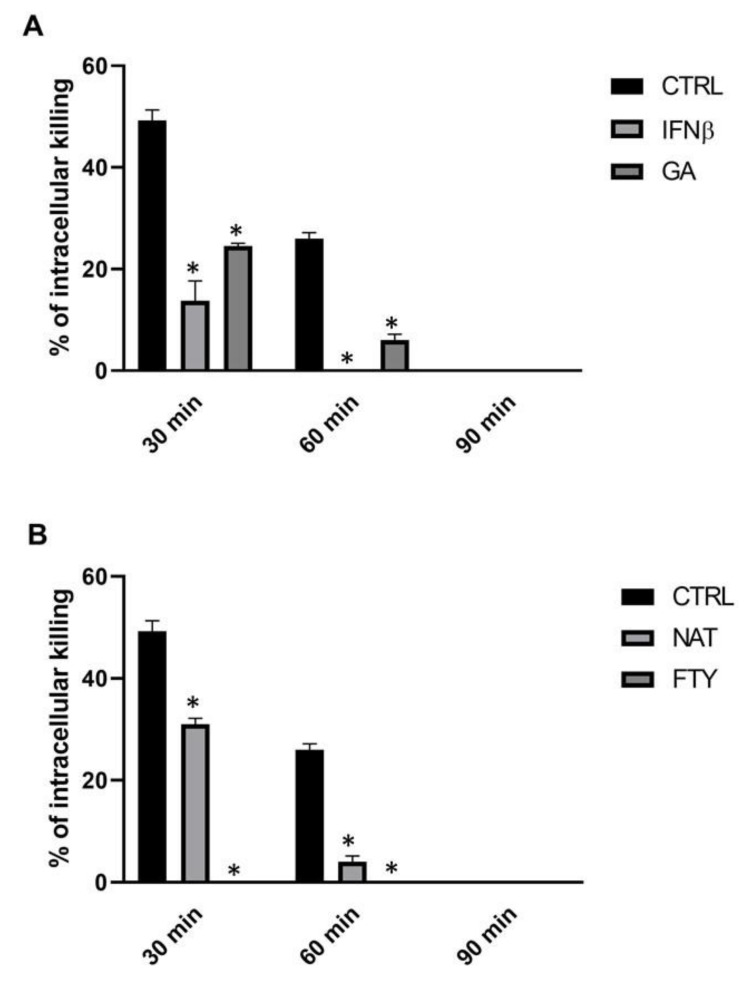
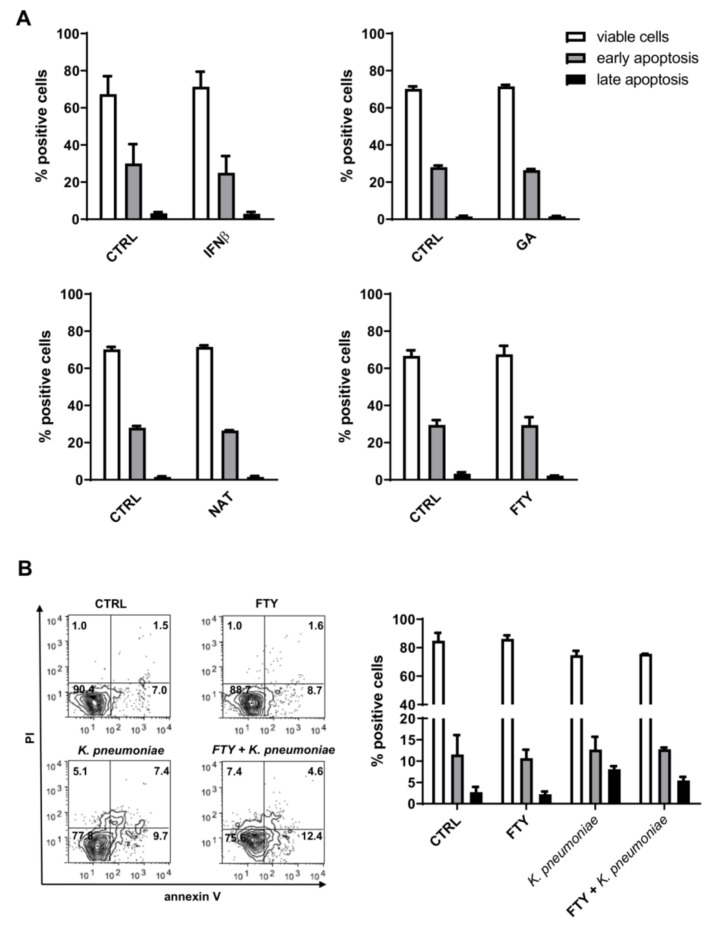
There is a growing optimism about the potential of new disease-modifying therapies (DMTs) in the management of relapsing-remitting multiple sclerosis (RRMS) patients. However, this initial enthusiasm has been tempered by evidence indicating that multiple sclerosis (MS) patients undergoing DMT may be at higher risk of developing infections through incompletely understood mechanisms. As neutrophils provide the first line of defense against pathogens, here we have compared the effects of some of the commonly used MS DMTs (i.e., moderate-efficacy injective, first-line: interferonβ-1b (IFNβ-1b), glatiramer acetate (GA); and high-efficacy, second-line: fingolimod (FTY) and natalizumab (NAT)) on the in vitro viability and functions of neutrophils isolated from healthy subjects. All the DMTs tested impaired the ability of neutrophils to kill , whereas none of them affected the rate of neutrophil apoptosis or CD11b and CD62L cell surface expression. Intriguingly, only FTY exposure negatively affected -induced production of reactive oxygen species (ROS) in polymorphonuclear leukocytes (PMNs). Furthermore, neutrophils exposed to secreted enhanced amounts of CXCL8, IL-1β and TNF-α, which were differentially regulated following DMT pretreatment. Altogether, these findings suggest that DMTs may increase the susceptibility of MS patients to microbial infections, in part, through inhibition of neutrophil functions. In light of these data, we recommend that the design of personalized therapies for RRMS patients should take into account not just the mechanism of action of the chosen DMT but also the potential risk of infection associated with the administration of such therapeutic compounds to this highly vulnerable population.
对于新型疾病修正疗法(DMTs)在复发缓解型多发性硬化症(RRMS)患者管理中的潜力,人们越来越乐观。然而,有证据表明接受DMT治疗的多发性硬化症(MS)患者可能通过尚未完全了解的机制面临更高的感染风险,这使得最初的热情有所降温。由于中性粒细胞是抵御病原体的第一道防线,在此我们比较了一些常用的MS DMTs(即中等疗效注射剂,一线药物:干扰素β-1b(IFNβ-1b)、醋酸格拉替雷(GA);以及高效二线药物:芬戈莫德(FTY)和那他珠单抗(NAT))对从健康受试者分离的中性粒细胞体外活力和功能的影响。所有测试的DMTs均损害了中性粒细胞的杀伤能力,而它们均未影响中性粒细胞的凋亡率或CD11b和CD62L细胞表面表达。有趣的是,仅FTY暴露对多形核白细胞(PMN)中诱导的活性氧(ROS)产生有负面影响。此外,暴露于的中性粒细胞分泌的CXCL8、IL-1β和TNF-α量增加,在DMT预处理后这些物质受到不同程度的调节。总之,这些发现表明DMTs可能部分通过抑制中性粒细胞功能增加MS患者对微生物感染的易感性。鉴于这些数据,我们建议RRMS患者个性化治疗方案的设计不仅应考虑所选DMT的作用机制,还应考虑向这一高度脆弱人群施用此类治疗化合物相关的潜在感染风险。