Fuentes Blanca, Pastor-Yborra Silvia, Gutiérrez-Zúñiga Raquel, González-Pérez de Villar Noemí, de Celis Elena, Rodríguez-Pardo Jorge, Gómez-de Frutos Mari Carmen, Laso-García Fernando, Gutiérrez-Fernández María, Ortega-Casarrubios MÁngeles, Soto Alfonso, López-Fernández María, Santamaría María, Díez-González Noemí, Freijo Mar M, Zandio Beatriz, Delgado-Mederos Raquel, Calleja Ana, Portilla-Cuenca Juan Carlos, Lisbona Arturo, Otero-Ortega Laura, Díez-Tejedor Exuperio
Department of Neurology and Stroke Centre, Hospital La Paz Institute for Health Research-IdiPAZ (La Paz University Hospital, Universidad Autónoma de Madrid), Paseo de la Castellana 261, 28046, Madrid, Spain.
Department of Endocrinology, Hospital La Paz Institute for Health Research-IdiPAZ (La Paz University Hospital, Universidad Autónoma de Madrid), Paseo de la Castellana 261, 28046, Madrid, Spain.
J Transl Med. 2020 Nov 4;18(1):414. doi: 10.1186/s12967-020-02586-4.
Glycemic variability (GV) represents the amplitude of oscillations in glucose levels over time and is associated with higher mortality in critically ill patients. Our aim is to evaluate the impact of GV on acute ischemic stroke (IS) outcomes in humans and explore the impact of two different insulin administration routes on GV in an animal model.
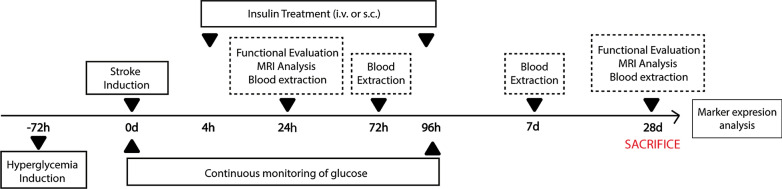
This translational study consists of two studies conducted in parallel: The first study is an observational, multicenter, prospective clinical study in which 340 patients with acute IS will be subcutaneously implanted a sensor to continuously monitor blood glucose levels for 96 h. The second study is a basic experimental study using an animal model (rats) with permanent occlusion of the middle cerebral artery and induced hyperglycemia (through an intraperitoneal injection of nicotinamide and streptozotocin). The animal study will include the following 6 groups (10 animals per group): sham; hyperglycemia without IS; IS without hyperglycemia; IS and hyperglycemia without treatment; IS and hyperglycemia and intravenous insulin; and IS and hyperglycemia and subcutaneous insulin. The endpoint for the first study is mortality at 3 months, while the endpoints for the animal model study are GV, functional recovery and biomarkers.
The GLIAS-III study will be the first translational approach analyzing the prognostic influence of GV, evaluated by the use of subcutaneous glucose monitors, in acute stroke. Trial registration https://www.clinicaltrials.gov (NCT04001049).
血糖变异性(GV)代表葡萄糖水平随时间波动的幅度,与危重症患者的较高死亡率相关。我们的目的是评估GV对人类急性缺血性卒中(IS)结局的影响,并在动物模型中探索两种不同胰岛素给药途径对GV的影响。
这项转化研究由两项平行开展的研究组成:第一项研究是一项观察性、多中心、前瞻性临床研究,将对340例急性IS患者皮下植入传感器,持续监测血糖水平96小时。第二项研究是一项基础实验研究,使用大脑中动脉永久性闭塞并诱导高血糖(通过腹腔注射烟酰胺和链脲佐菌素)的动物模型(大鼠)。动物研究将包括以下6组(每组10只动物):假手术组;无IS的高血糖组;无高血糖的IS组;未治疗的IS和高血糖组;IS和高血糖及静脉注射胰岛素组;以及IS和高血糖及皮下注射胰岛素组。第一项研究的终点是3个月时的死亡率,而动物模型研究的终点是GV、功能恢复和生物标志物。
GLIAS-III研究将是第一项通过使用皮下葡萄糖监测仪评估GV对急性卒中预后影响的转化研究。试验注册:https://www.clinicaltrials.gov(NCT04001049)。