Department of Urology, Peking University First Hospital and Institute of Urology, Peking University, 100034 Beijing, China.
National Research Center for Genitourinary Oncology, 100034 Beijing, China.
Biol Open. 2020 Nov 12;9(11):bio053447. doi: 10.1242/bio.053447.
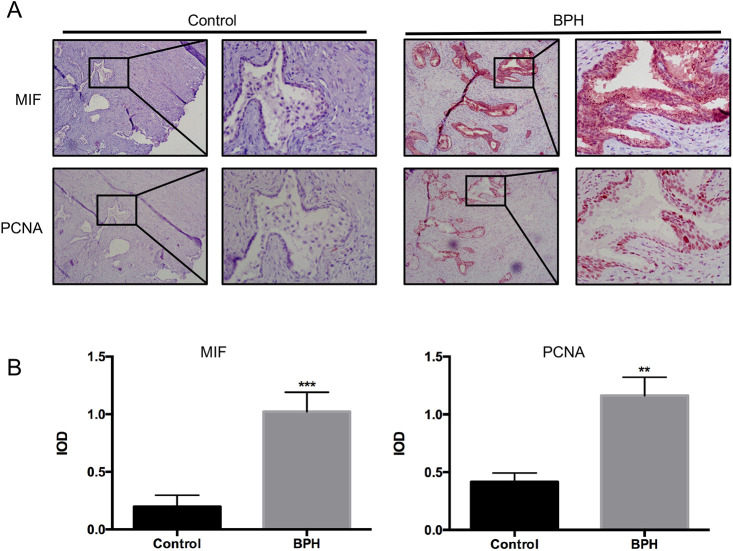
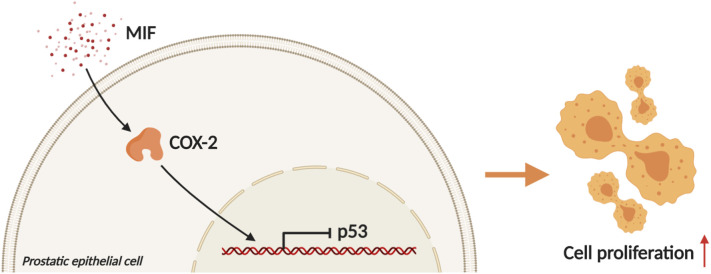
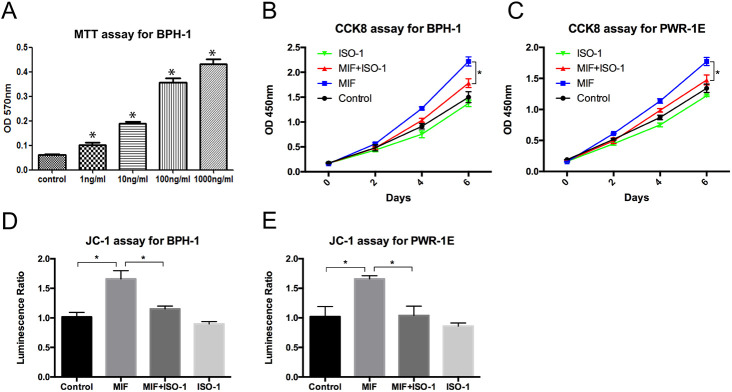
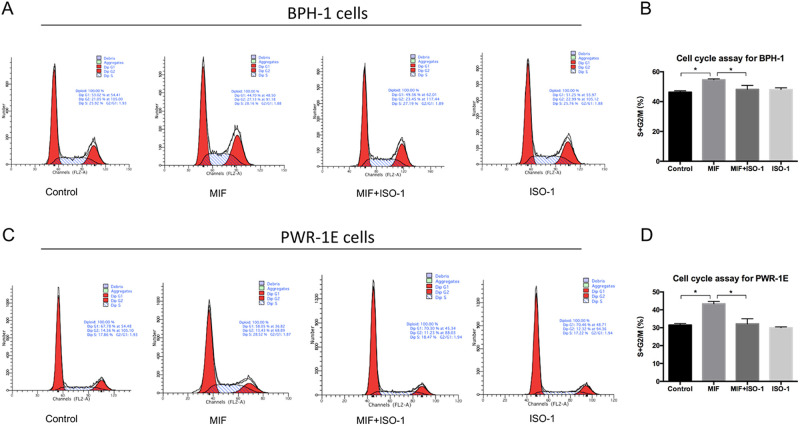
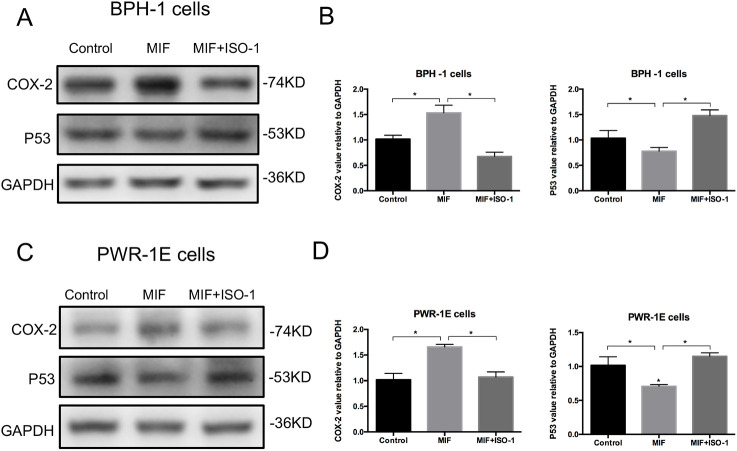
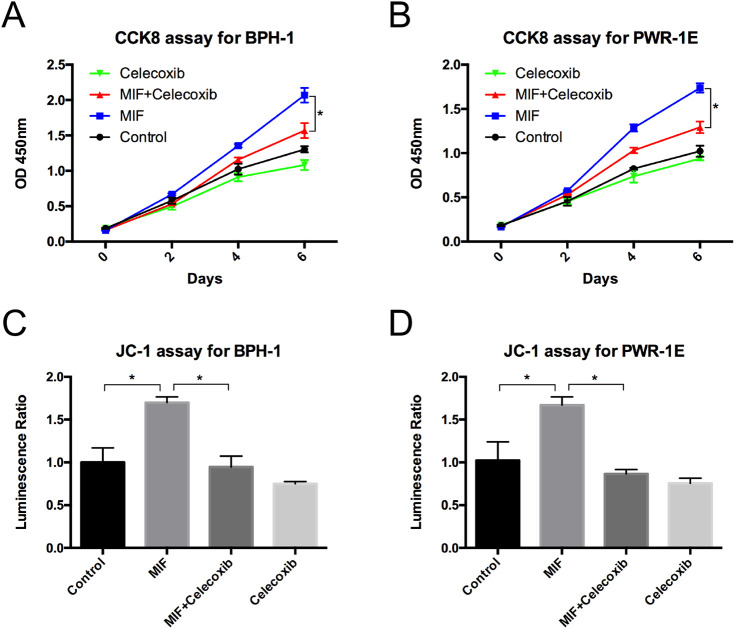
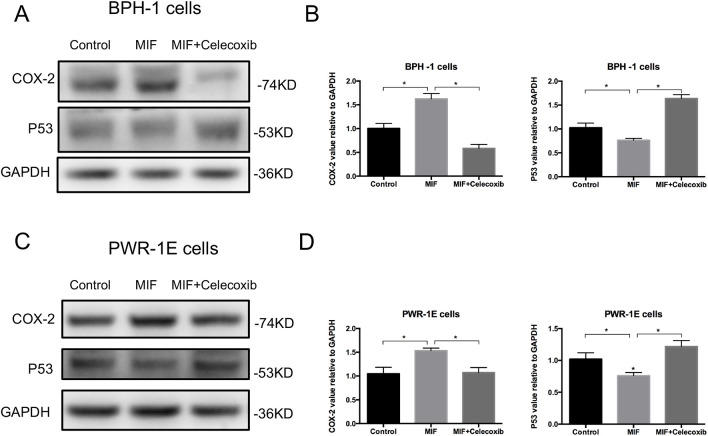
Inflammation and proinflammatory cytokines have been implicated in the progression of benign prostatic hyperplasia (BPH). Macrophage migration inhibitory factor (MIF) is a proinflammatory cytokine. Our previous study found that MIF is highly expressed in BPH epithelium. It has been reported that there is a correlation between MIF and clinical BPH progression. However, whether MIF has an effect on BPH epithelial cells is not clear. The aim of this study was to explore whether MIF has a role in BPH. Our results showed that immunohistochemistry (IHC) showed that MIF is highly expressed in the epithelium and that MIF and PCNA expression levels are higher in BPH samples than in control. CCK8 and flow cytometry assays showed that recombinant human MIF (rMIF) promoted the proliferation of BPH-1 and PWR-1E cells, while ISO-1 partially reversed this effect on proliferation. JC-1 assays showed that rMIF inhibited the apoptosis of BPH-1 and PWR-1E cells, and ISO-1 could partially reverse this inhibition. Moreover, western blotting indicated that rMIF downregulated P53 and upregulated COX-2. Furthermore, MIF-induced proliferation could be inhibited by celecoxib in the CCK8 and flow cytometry assay. MIF-inhibited apoptosis could be partially reversed by celecoxib in the JC-1 assay. Western blotting showed that celecoxib could partially reverse MIF-induced COX-2 upregulation and P53 downregulation. Together, MIF is highly expressed in BPH epithelium. , MIF promoted BPH epithelial cell growth by regulating COX-2 and P53 signaling. Targeting MIF may provide a new option for the improved treatment of BPH in the future.
炎症和促炎细胞因子与良性前列腺增生 (BPH) 的进展有关。巨噬细胞移动抑制因子 (MIF) 是一种促炎细胞因子。我们之前的研究发现,MIF 在 BPH 上皮中高度表达。有报道称,MIF 与临床 BPH 进展之间存在相关性。然而,MIF 是否对 BPH 上皮细胞有影响尚不清楚。本研究旨在探讨 MIF 是否在 BPH 中起作用。我们的结果表明,免疫组织化学 (IHC) 显示 MIF 在 BPH 上皮中高度表达,并且 MIF 和 PCNA 的表达水平在 BPH 样本中高于对照。CCK8 和流式细胞术检测表明,重组人 MIF (rMIF) 促进了 BPH-1 和 PWR-1E 细胞的增殖,而 ISO-1 部分逆转了这种对增殖的影响。JC-1 检测表明,rMIF 抑制了 BPH-1 和 PWR-1E 细胞的凋亡,而 ISO-1 可以部分逆转这种抑制作用。此外,Western blot 表明 rMIF 下调了 P53 并上调了 COX-2。此外,CCK8 和流式细胞术检测中的塞来昔布可抑制 rMIF 诱导的增殖。JC-1 检测中的塞来昔布可部分逆转 MIF 诱导的凋亡。Western blot 表明塞来昔布可部分逆转 MIF 诱导的 COX-2 上调和 P53 下调。总之,MIF 在 BPH 上皮中高度表达。rMIF 通过调节 COX-2 和 P53 信号通路促进 BPH 上皮细胞生长。针对 MIF 可能为未来改善 BPH 的治疗提供新的选择。