Institute for Physical Activity and Nutrition, Deakin University, Geelong, Melbourne, Australia
Institute for Physical Activity and Nutrition, Deakin University, Geelong, Melbourne, Australia.
BMJ Open. 2020 Nov 3;10(11):e038789. doi: 10.1136/bmjopen-2020-038789.
To assess differences in weight status and movement behaviour guideline compliance among children aged 5-12 years with and without a family history of non-communicable diseases (NCDs).
Prospective.
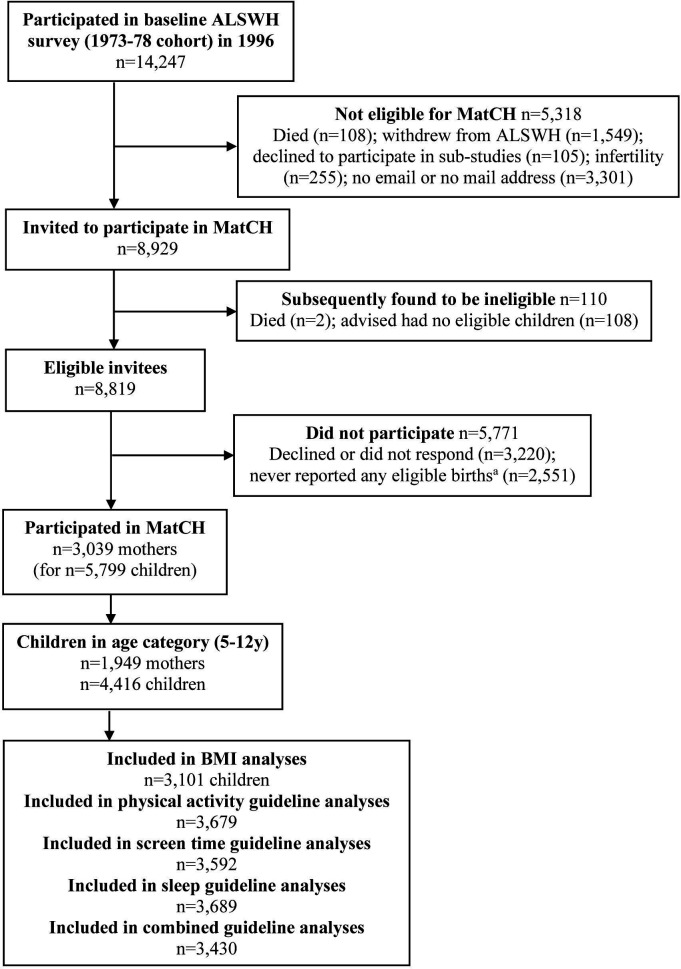
Women born between 1973 and 1978 were recruited to the Australian Longitudinal Study on Women's Health (ALSWH) via the database of the Health Insurance Commission (now Medicare; Australia's universal health insurance scheme). In 2016-2017, women in that cohort were invited to participate in the Mothers and their Children's Health Study and reported on their three youngest children (aged <13 years). Data from children aged 5-12 years (n=4416) were analysed.
Mothers reported their children's height and weight, used to calculate body mass index (kg/m), physical activity, screen time and sleep. In the 2015 ALSWH Survey, women reported diagnoses and family history of type 2 diabetes, heart disease and hypertension. Logistic regression models determined differences between outcomes for children with and without a family history of NCDs.
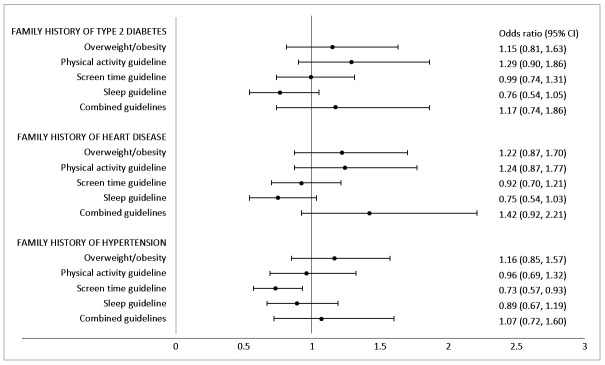
Boys with a family history of type 2 diabetes had 30% (95% CI: 0.51%-0.97%) and 43% lower odds (95% CI: 0.37%-0.88%) of meeting the sleep and combined guidelines, respectively, and 40% higher odds (95% CI: 1.01%- 1.95%) of being overweight/obese. Girls with a family history of hypertension had 27% lower odds (95% CI: 0.57%-0.93%) of meeting the screen time guidelines. No associations were observed for family history of heart disease.
Children who have a family history of type 2 diabetes and hypertension may be at risk of poorer health behaviours from a young age. Mothers with a diagnosis or a family history of these NCDs may need additional support to help their children develop healthy movement behaviours and maintain healthy weight.
评估有和无非传染性疾病(NCD)家族史的 5-12 岁儿童体重状况和运动行为指南遵循情况的差异。
前瞻性研究。
通过健康保险委员会(现为全民医疗保险;澳大利亚全民健康保险计划)数据库,招募了澳大利亚女性健康纵向研究(ALSWH)中出生于 1973 年至 1978 年的女性。在 2016-2017 年,该队列中的女性受邀参加了母亲及其子女健康研究,并报告了她们三个最小的孩子(年龄<13 岁)的情况。分析了年龄在 5-12 岁的儿童(n=4416)的数据。
母亲报告了孩子的身高和体重,用于计算体重指数(kg/m)、身体活动、屏幕时间和睡眠。在 2015 年的 ALSWH 调查中,女性报告了 2 型糖尿病、心脏病和高血压的诊断和家族史。逻辑回归模型确定了有和无 NCD 家族史的儿童在结果上的差异。
有 2 型糖尿病家族史的男孩,分别有 30%(95%CI:0.51%-0.97%)和 43%(95%CI:0.37%-0.88%)的可能性较低,符合睡眠和综合指南,超重/肥胖的可能性高 40%(95%CI:1.01%-1.95%)。有高血压家族史的女孩,符合屏幕时间指南的可能性低 27%(95%CI:0.57%-0.93%)。心脏病家族史没有观察到关联。
有 2 型糖尿病和高血压家族史的儿童可能从很小的时候就有较差的健康行为风险。患有这些 NCD 或有家族史的母亲可能需要额外的支持,以帮助他们的孩子养成健康的运动行为和保持健康的体重。