Shen Yu Jia, Mishima Yuji, Shi Jiantao, Sklavenitis-Pistofidis Romanos, Redd Robert A, Moschetta Michele, Manier Salomon, Roccaro Aldo M, Sacco Antonio, Tai Yu-Tzu, Mercier Francois, Kawano Yawara, Su Nang Kham, Berrios Brianna, Doench John G, Root David E, Michor Franziska, Scadden David T, Ghobrial Irene M
Department of Medical Oncology, Dana-Farber Cancer Institute, Harvard Medical School, Boston, MA.
Broad Institute of Massachusetts Institute of Technology (MIT) and Harvard, Cambridge, MA.
Blood. 2021 Apr 29;137(17):2360-2372. doi: 10.1182/blood.2020005885.
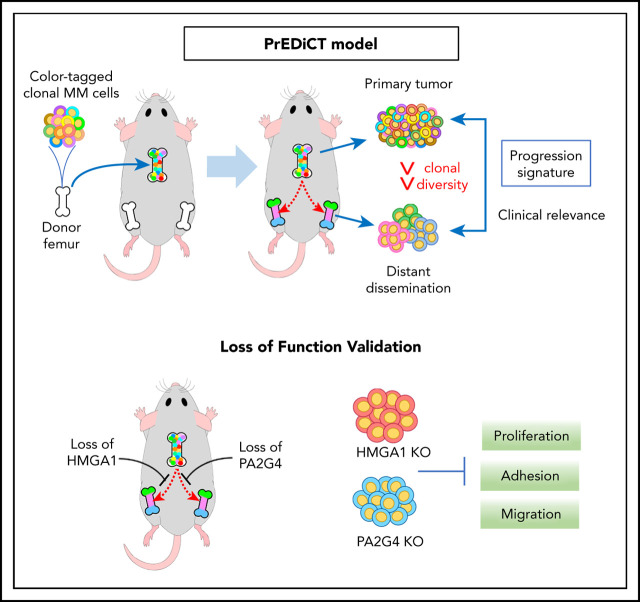
Clonal evolution drives tumor progression, dissemination, and relapse in multiple myeloma (MM), with most patients dying of relapsed disease. This multistage process requires tumor cells to enter the circulation, extravasate, and colonize distant bone marrow (BM) sites. Here, we developed a fluorescent or DNA-barcode clone-tracking system on MM PrEDiCT (progression through evolution and dissemination of clonal tumor cells) xenograft mouse model to study clonal behavior within the BM microenvironment. We showed that only the few clones that successfully adapt to the BM microenvironment can enter the circulation and colonize distant BM sites. RNA sequencing of primary and distant-site MM tumor cells revealed a progression signature sequentially activated along human MM progression and significantly associated with overall survival when evaluated against patient data sets. A total of 28 genes were then computationally predicted to be master regulators (MRs) of MM progression. HMGA1 and PA2G4 were validated in vivo using CRISPR-Cas9 in the PrEDiCT model and were shown to be significantly depleted in distant BM sites, indicating their role in MM progression and dissemination. Loss of HMGA1 and PA2G4 also compromised the proliferation, migration, and adhesion abilities of MM cells in vitro. Overall, our model successfully recapitulates key characteristics of human MM disease progression and identified potential new therapeutic targets for MM.
克隆进化驱动多发性骨髓瘤(MM)的肿瘤进展、扩散和复发,大多数患者死于复发性疾病。这个多阶段过程要求肿瘤细胞进入循环系统、渗出并在远处的骨髓(BM)部位定植。在此,我们在MM PrEDiCT(通过克隆肿瘤细胞的进化和扩散进行进展)异种移植小鼠模型上开发了一种荧光或DNA条形码克隆追踪系统,以研究BM微环境中的克隆行为。我们发现,只有少数成功适应BM微环境的克隆才能进入循环系统并在远处的BM部位定植。对原发性和远处部位的MM肿瘤细胞进行RNA测序,揭示了一种沿着人类MM进展顺序激活的进展特征,当根据患者数据集进行评估时,该特征与总生存期显著相关。然后通过计算预测共有28个基因是MM进展的主调节因子(MRs)。在PrEDiCT模型中使用CRISPR-Cas9在体内验证了HMGA1和PA2G4,结果显示它们在远处的BM部位显著减少,表明它们在MM进展和扩散中的作用。HMGA1和PA2G4的缺失也损害了MM细胞在体外的增殖、迁移和黏附能力。总体而言,我们的模型成功概括了人类MM疾病进展的关键特征,并确定了MM潜在的新治疗靶点。