
首次 ST 段抬高型心肌梗死(STEMI)与有既往 MI 的 STEMI 患者之间的治疗途径和生命历程比较:来自 OSCAR 登记研究的结果。
Comparison of the pathways of care and life courses between first-time ST-elevation myocardial infarction (STEMI) and STEMI with prior MI: findings from the OSCAR registry.
机构信息
RESCUe-RESUVal network, Hospital Center Lucien Hussel, Vienne, France
Laboratory Systemic Health Care, EA 4129, University of Lyon 1, Lyon, France.
出版信息
BMJ Open. 2020 Nov 5;10(11):e038773. doi: 10.1136/bmjopen-2020-038773.
OBJECTIVES
We hypothesised that patients having experienced one coronary event in their life were susceptible to present differences in their pathways of care and within 1 year of their life courses. We aimed to compare pathways between first-time ST-elevation myocardial infarction (STEMI) and STEMI with prior myocardial infarction (MI).
DESIGN
A retrospective observational study based on the Observatoire des Syndromes Coronariens Aigus du réseau RESCUe (OSCAR) registry collecting all suspected STEMI from 10 percutaneous coronary intervention centres in France.
SETTING
All patients with STEMI from 2013 to 2017 were included (N=6306 with 5423 first-time STEMI and 883 STEMI with prior MI). We provided a matching analysis by propensity score based on cardiovascular risk factors.
PARTICIPANTS
We defined first-time STEMI as STEMI occurring at the inclusion date, and STEMI with prior MI as STEMI with a history of MI prior to the inclusion date.
RESULTS
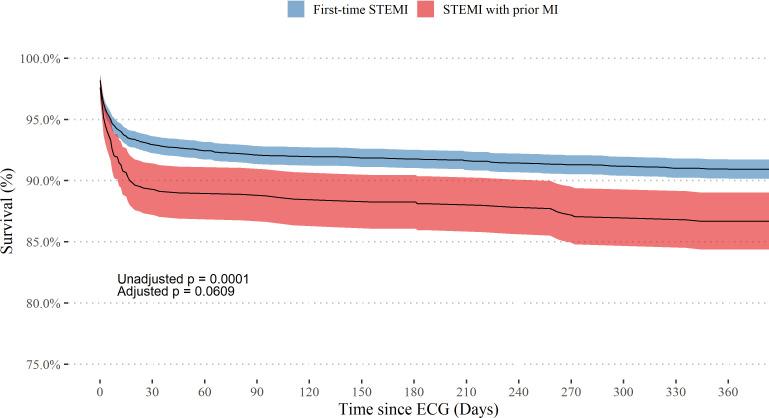
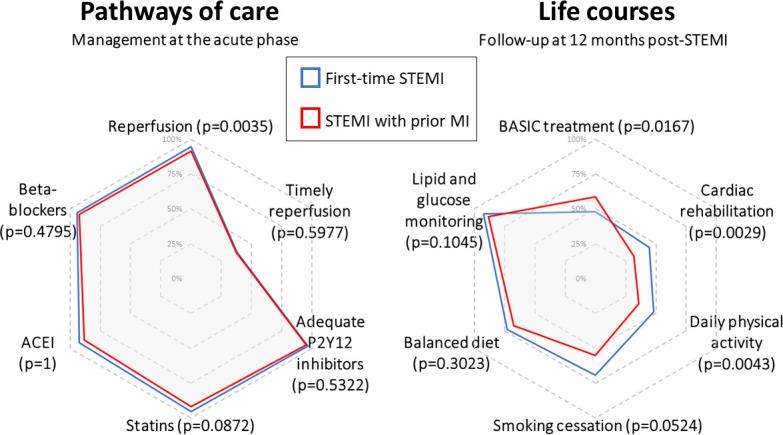
Patients with first-time STEMI and patients with STEMI with prior MI were equally treated during hospitalisation and at discharge. At 12 months, patients with first-time STEMI had a lower adherence to BASIC treatment (ie, beta-blocker, antiplatelet therapy, statin and converting enzyme inhibitor) (48.11% vs 58.58%, p=0.0167), more frequently completed the cardiac rehabilitation programme (44.33% vs 31.72%, p=0.0029), more frequently changed their lifestyle behaviours; more frequently practiced daily physical activity (48.11% vs 35.82%, p=0.0043) and more frequently stopped smoking at admission (69.39% vs 55.00%, p=0.0524). The estimated mortality was higher for patients with STEMI with prior MI at 1 month (p=0.0100), 6 months (p=0.0500) and 1 year (p=0.0600).
CONCLUSIONS
We provided an exhaustive overview of the real-life clinical practice conditions of STEMI management. The patients with STEMI with prior MI presented an optimised use of prehospital resources, which was probably due to their previous experience, and showed a better adherence to drug therapy compared with patients with first-time STEMI.
TRIAL REGISTRATION NUMBER
Commission Nationale de l'Informatique et des Libertés (number 2 013 090 v0).
目的
我们假设,一生中经历过一次冠状动脉事件的患者在其治疗途径上存在差异,并且在其生命历程的 1 年内存在差异。我们旨在比较首次 ST 段抬高型心肌梗死(STEMI)和 STEMI 合并既往心肌梗死(MI)患者的治疗途径。
设计
这是一项基于 Observatoire des Syndromes Coronariens Aigus du réseau RESCUe(OSCAR)登记处的回顾性观察性研究,该登记处收集了来自法国 10 个经皮冠状动脉介入治疗中心的所有疑似 STEMI 患者。
设置
纳入了 2013 年至 2017 年所有 STEMI 患者(N=6306 例,其中 5423 例为首次 STEMI,883 例为 STEMI 合并既往 MI)。我们基于心血管危险因素进行了倾向评分匹配分析。
参与者
我们将首次 STEMI 定义为纳入日期发生的 STEMI,将 STEMI 合并既往 MI 定义为纳入日期前有 MI 病史的 STEMI。
结果
首次 STEMI 患者和 STEMI 合并既往 MI 患者在住院和出院期间的治疗相同。在 12 个月时,首次 STEMI 患者接受 BASIC 治疗(即β受体阻滞剂、抗血小板治疗、他汀类药物和血管紧张素转换酶抑制剂)的比例较低(48.11% vs 58.58%,p=0.0167),更频繁地完成心脏康复计划(44.33% vs 31.72%,p=0.0029),更频繁地改变生活方式行为;更频繁地进行日常体力活动(48.11% vs 35.82%,p=0.0043),更频繁地在入院时戒烟(69.39% vs 55.00%,p=0.0524)。在 1 个月(p=0.0100)、6 个月(p=0.0500)和 1 年(p=0.0600)时,STEMI 合并既往 MI 患者的估计死亡率更高。
结论
我们提供了对 STEMI 管理真实临床实践情况的全面概述。STEMI 合并既往 MI 患者的院前资源利用得到了优化,这可能是由于他们之前的经验,并且与首次 STEMI 患者相比,他们对药物治疗的依从性更好。
试验注册
Commission Nationale de l'Informatique et des Libertés(编号 2013090v0)。


 Zotero 插件