Costanza Alessandra, Amerio Andrea, Aguglia Andrea, Serafini Gianluca, Amore Mario
Department of Psychiatry, Faculty of Medicine, University of Geneva (UNIGE), Geneva, Switzerland.
Department of Psychiatry, ASO Santi Antonio e Biagio e Cesare Arrigo Hospital, Alessandria, Italy.
Psychol Res Behav Manag. 2020 Oct 29;13:855-858. doi: 10.2147/PRBM.S279829. eCollection 2020.
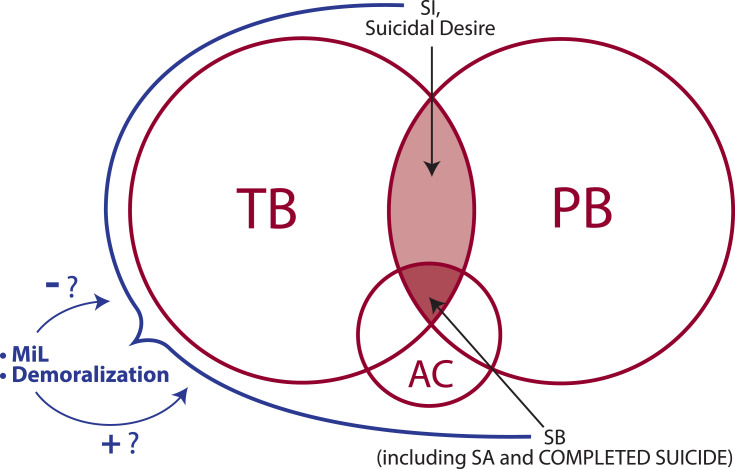
Following V. Frankl's (in the 1950s) and J. Frank's (in the 1970s) historical definitions of the constructs Meaning in Life (MiL) and demoralization, there have been a multitude of studies which have described them from different theoretical perspectives. These constructs are closely linked, with the lack of MiL as one of the subconstructs underlying the definition of demoralization. Numerous studies have shown that MiL and demoralization affect suicidality, as protective and risk factors, respectively. The Interpersonal Theory of Suicide (IPTS) is a more recent framework conceptualized by T. Joiner (in the 2000s) to provide an additional possible reading key in the effort to better understand suicidality. By analogy to a previous study by E. Kleiman & J. Beaver (2013), examining MiL and demoralization in suicidality through a perspective of the IPTS framework can be of considerable interest. This study showed, in a cohort of undergraduate students, that MiL mediated the relationship between two variables associated with IPTS (perceived burdensomeness and thwarted belongingness) and suicidal ideation (SI). Taking into consideration future studies that these latter authors advocated, our aim is to verify this finding using a cross-sectional study. Differences in our approach would include a) studying a clinical population (suicidal patients attending an emergency department), b) analyzing relationships not only with SI but also with suicidal attempts (SA), and c) in consideration of the interconnection between MiL and demoralization, exploring also the possible role of demoralization as a mediator. The clinical implication lies in identifying multi-faceted targets that may be useful to mitigate suicidality risk in individuals, both in prevention and therapy intervention.
继V. 弗兰克(20世纪50年代)和J. 弗兰克(20世纪70年代)对“生命意义”(MiL)和失范的历史性定义之后,有大量研究从不同理论视角对它们进行了描述。这些概念紧密相连,缺乏生命意义是失范定义的潜在子结构之一。众多研究表明,生命意义和失范分别作为保护因素和风险因素影响自杀倾向。自杀人际理论(IPTS)是T. 乔伊纳(21世纪初)提出的一个更新的框架,旨在为更好地理解自杀倾向提供另一种可能的解读关键。与E. 克莱曼和J. 比弗(2013年)之前的一项研究类似,通过IPTS框架视角研究自杀倾向中的生命意义和失范可能会很有意义。这项研究在一组本科生中表明,生命意义介导了与IPTS相关的两个变量(感知到的负担感和归属感受挫)与自杀意念(SI)之间的关系。考虑到后两位作者倡导的未来研究,我们的目标是通过横断面研究来验证这一发现。我们方法的不同之处将包括:a)研究临床人群(到急诊科就诊的自杀患者);b)不仅分析与自杀意念的关系,还分析与自杀未遂(SA)的关系;c)考虑到生命意义和失范之间的相互联系,还探讨失范作为中介的可能作用。临床意义在于确定多方面的目标,这些目标可能有助于在预防和治疗干预中降低个体的自杀风险。