Department of Radiation Oncology, Affiliated Hospital of Jiangnan University, Wuxi, China.
Wuxi Cancer Institute, Affiliated Hospital of Jiangnan University, Wuxi, China.
Cancer Sci. 2021 Jan;112(1):265-274. doi: 10.1111/cas.14724. Epub 2020 Nov 29.
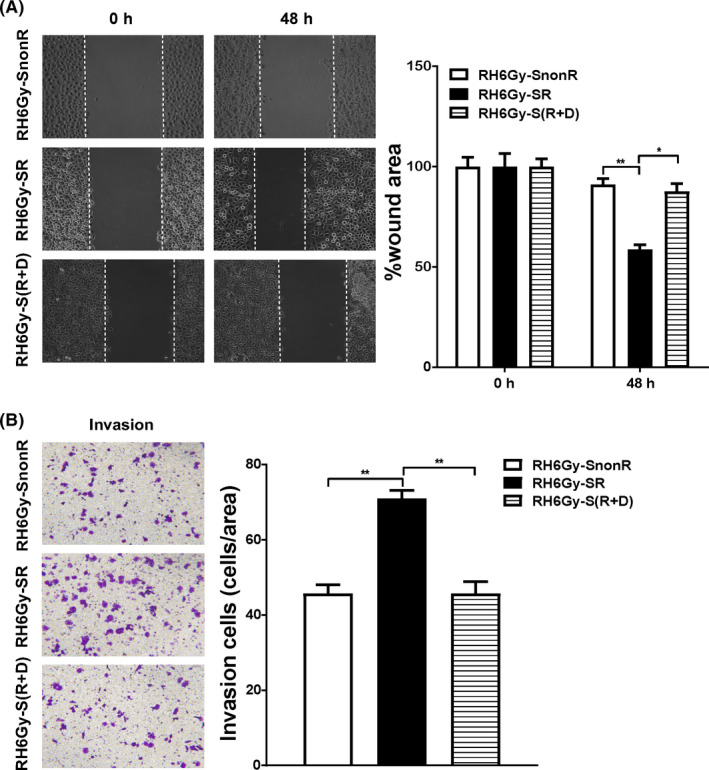
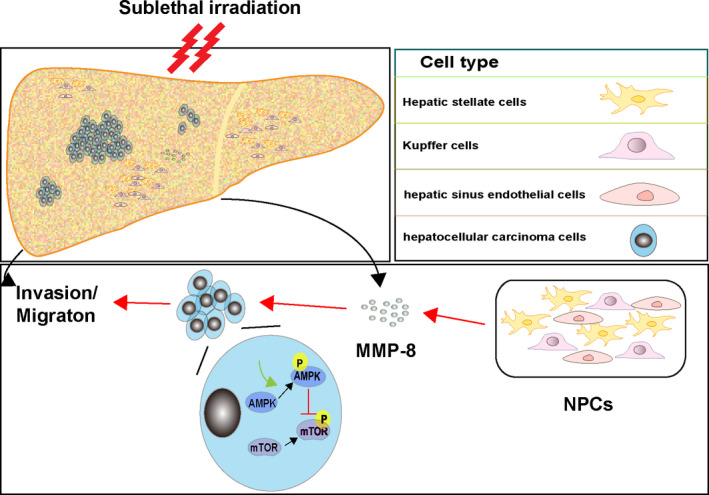
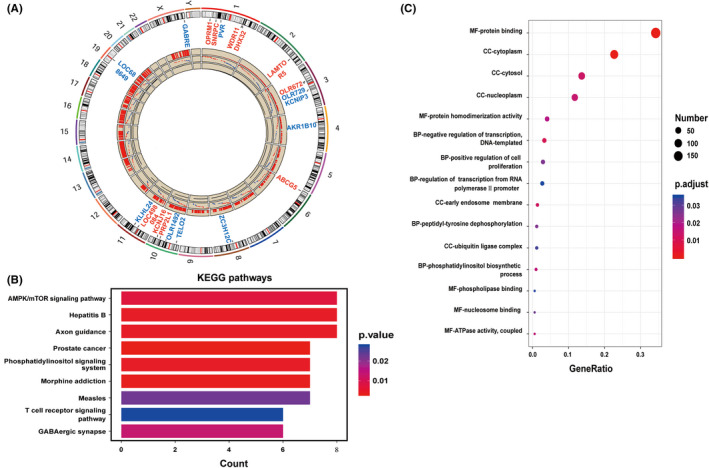
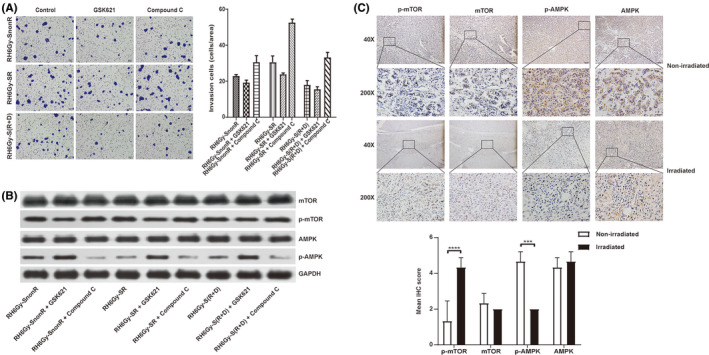
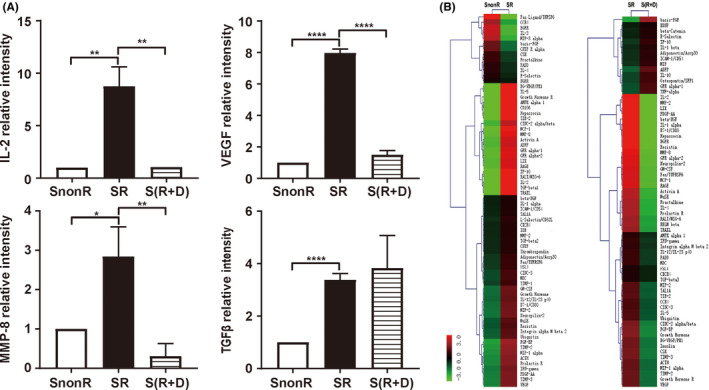
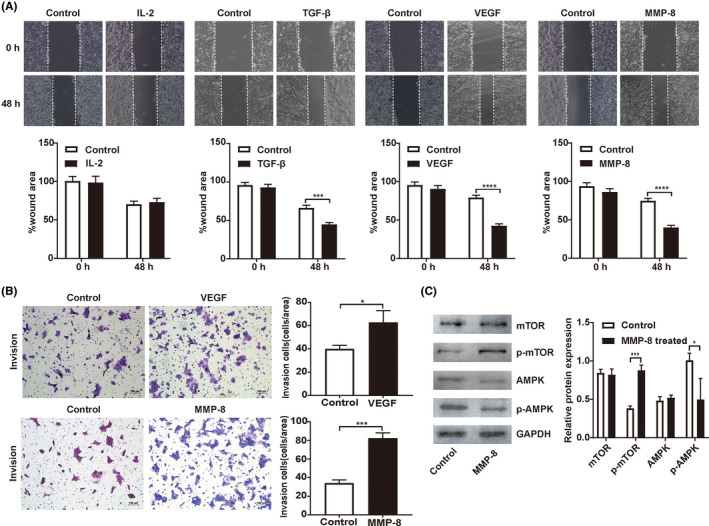
Radiotherapy (RT) represents one of the major treatment methods for cancers. However, many studies have observed that in descendant surviving tumor cells, sublethal irradiation can promote metastatic ability, which is closely related to the tumor microenvironment. We therefore investigated the functions and mechanisms of sublethal irradiated liver nonparenchymal cells (NPCs) in hepatocellular carcinoma (HCC). In this study, primary rat NPCs and McA-RH7777 hepatoma cells were irradiated with 6 Gy X-ray. Conditioned media (CM) from nonirradiated (SnonR), irradiated (SR), or irradiated plus radiosensitizer celecoxib-treated (S[R + D]) NPCs were collected and added to sublethal irradiated McA-RH7777 cells. We showed that CM from sublethal irradiated NPCs significantly promoted the migration and invasion ability of sublethal irradiated McA-RH7777 cells, which was reversed by celecoxib. The differentially expressed genes in differently treated McA-RH7777 cells were enriched mostly in the AMP-activated protein kinase/mammalian target of rapamycin (AMPK/mTOR) signaling pathway. SR increased the migration and invasion ability of HCC cells by inhibiting AMPK/mTOR signaling, which was enhanced by the AMPK inhibitor compound C and blocked by the AMPK activator GSK-621. Analyses of HCC tissues after neoadjuvant radiotherapy confirmed the effects of radiation on the AMPK/mTOR pathway. Cytokine antibody arrays and further functional investigations showed that matrix metalloproteinase-8 (MMP-8) partly mediates the promotion effects of SR on the migration and invasion ability of HCC cells by regulating AMPK/mTOR signaling. In summary, our data indicate that MMP-8 secreted by irradiated NPCs enhanced the migration and invasion of HCC by regulating AMPK/mTOR signaling, revealing a novel mechanism mediating sublethal irradiation-induced HCC metastasis at the level of the tumor microenvironment.
放射治疗(RT)是癌症的主要治疗方法之一。然而,许多研究观察到,在后代存活的肿瘤细胞中,亚致死剂量的照射可以促进转移能力,这与肿瘤微环境密切相关。因此,我们研究了亚致死剂量照射的肝非实质细胞(NPC)在肝细胞癌(HCC)中的功能和机制。在这项研究中,用 6GyX 射线照射原代大鼠 NPC 和 McA-RH7777 肝癌细胞。收集来自未照射(SnonR)、照射(SR)或照射加放射增敏剂塞来昔布处理(S[R+D])NPC 的条件培养基(CM),并添加到亚致死剂量照射的 McA-RH7777 细胞中。结果表明,亚致死剂量照射的 NPC 来源的 CM 显著促进了亚致死剂量照射的 McA-RH7777 细胞的迁移和侵袭能力,而塞来昔布可逆转这一作用。在不同处理的 McA-RH7777 细胞中差异表达的基因主要富集在 AMP 激活的蛋白激酶/哺乳动物雷帕霉素靶蛋白(AMPK/mTOR)信号通路中。SR 通过抑制 AMPK/mTOR 信号通路来增加 HCC 细胞的迁移和侵袭能力,该作用可被 AMPK 抑制剂化合物 C 增强,并被 AMPK 激活剂 GSK-621 阻断。对新辅助放疗后的 HCC 组织进行分析证实了放疗对 AMPK/mTOR 通路的影响。细胞因子抗体阵列和进一步的功能研究表明,基质金属蛋白酶-8(MMP-8)部分通过调节 AMPK/mTOR 信号通路来介导 SR 对 HCC 细胞迁移和侵袭能力的促进作用。综上所述,我们的数据表明,照射 NPC 分泌的 MMP-8 通过调节 AMPK/mTOR 信号增强 HCC 的迁移和侵袭能力,揭示了肿瘤微环境水平介导亚致死照射诱导 HCC 转移的新机制。