Wang Jinyu, Li Sheng
School of Basic Medical Science, Lanzhou University.
The First People's Hospital of Lanzhou City, Lanzhou, PR China.
Medicine (Baltimore). 2020 Nov 6;99(45):e23007. doi: 10.1097/MD.0000000000023007.
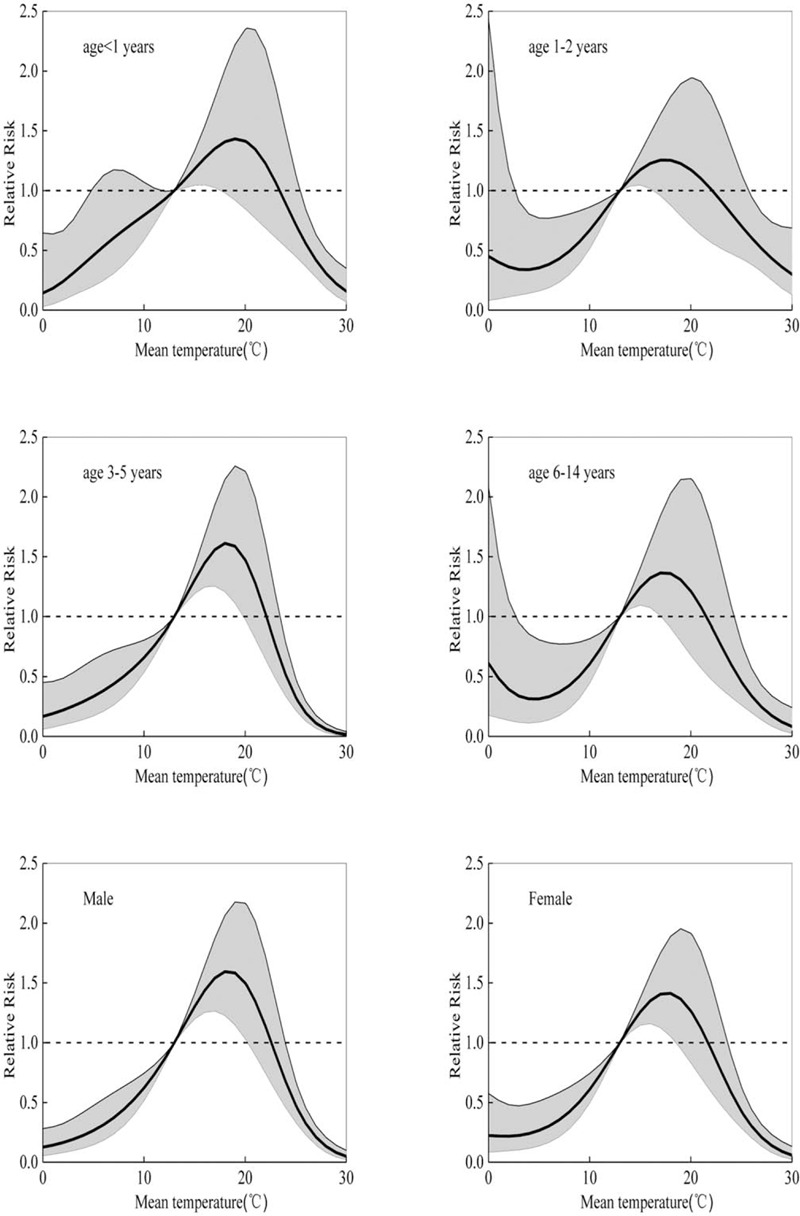
To examine the effects of temperature on the daily cases of hand, foot, and mouth disease (HFMD).Data on the daily cases of HFMD in Lanzhou from 2008 to 2015 were obtained, and meteorological data from the same period were collected. A distributed lag nonlinear model was fitted to reveal the relationship between the daily mean temperature and the daily cases of HFMD.From 2008 to 2015, 25,644 cases were reported, of which children under 5 years of age accounted for 78.68% of cases. The highest peak of HFMD cases was usually reported between April to July each year. An inverse V-shaped relationship was observed between daily mean temperature and HFMD cases; a temperature of 18°C was associated with a maximum risk of HFMD. The relative risk (RR) was 1.57 (95% confidence interval: 1.23-1.23), and boys and children aged 3 to 5 years were populations with the highest risk. The cumulative risks of high temperature (20.2°C and 25.2°C) in the total, age-specific, and gender-specific groups peaked on lag 14 days; RR was higher in girls than in boys and in children aged 1 to 2 years than in other age groups. However, the effects of low temperature (-5.3°C, 2.0°C, and 12.8°C) were not significant for both gender-specific and age-specific patients.High temperature may increase the risk of HFMD, and boys and children aged 3 to 5 years were at higher risks on lag 0 day; however, the cumulative risks in girls and children aged 1 to 2 years increased with the increasing number of lag days.
为研究温度对手足口病(HFMD)每日发病例数的影响。获取了兰州市2008年至2015年HFMD每日发病数据,并收集了同期的气象数据。拟合了分布滞后非线性模型以揭示日平均温度与HFMD每日发病例数之间的关系。2008年至2015年,共报告25644例病例,其中5岁以下儿童占病例数的78.68%。HFMD病例的最高峰通常出现在每年4月至7月。日平均温度与HFMD病例之间呈现倒V形关系;18°C的温度与HFMD的最高风险相关。相对风险(RR)为1.57(95%置信区间:1.23 - 1.23),男孩以及3至5岁儿童是风险最高的人群。总人群、特定年龄组和特定性别组中高温(20.2°C和25.2°C)的累积风险在滞后14天时达到峰值;女孩的RR高于男孩,1至2岁儿童的RR高于其他年龄组。然而,低温(-5.3°C、2.0°C和12.8°C)对特定性别和特定年龄的患者影响不显著。高温可能增加HFMD的发病风险,男孩以及3至5岁儿童在滞后0天时风险较高;然而,女孩和1至2岁儿童的累积风险随着滞后天数的增加而增加。