Papadimitriou Konstantinos, Tsakirakis Nikolaos, Malandrakis Panagiotis, Vitsos Panagiotis, Metousis Andreas, Orologas-Stavrou Nikolaos, Ntanasis-Stathopoulos Ioannis, Kanellias Nikolaos, Eleutherakis-Papaiakovou Evangelos, Pothos Panagiotis, Fotiou Despina, Gavriatopoulou Maria, Kastritis Efstathios, Dimopoulos Meletios-Athanasios, Terpos Evangelos, Tsitsilonis Ourania E, Kostopoulos Ioannis V
Department of Biology, School of Sciences, National and Kapodistrian University of Athens, 15784 Athens, Greece.
Department of Clinical Therapeutics, School of Medicine, National and Kapodistrian University of Athens, 11528 Athens, Greece.
Cancers (Basel). 2020 Nov 4;12(11):3245. doi: 10.3390/cancers12113245.
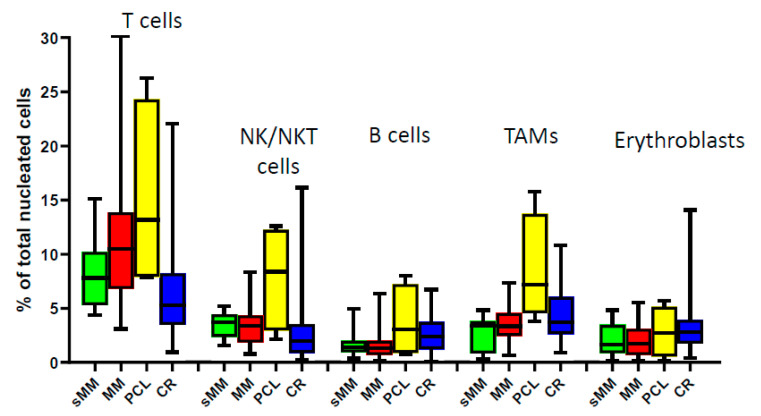
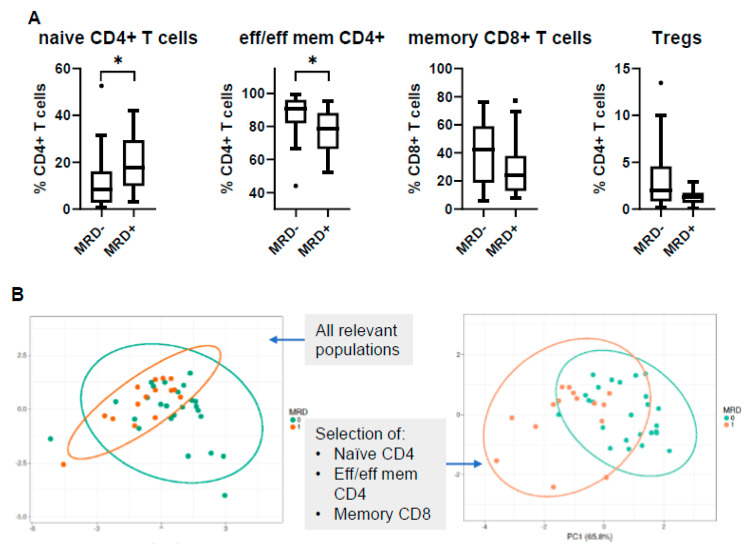
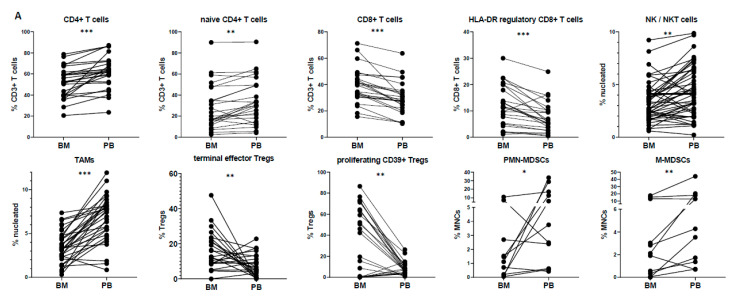
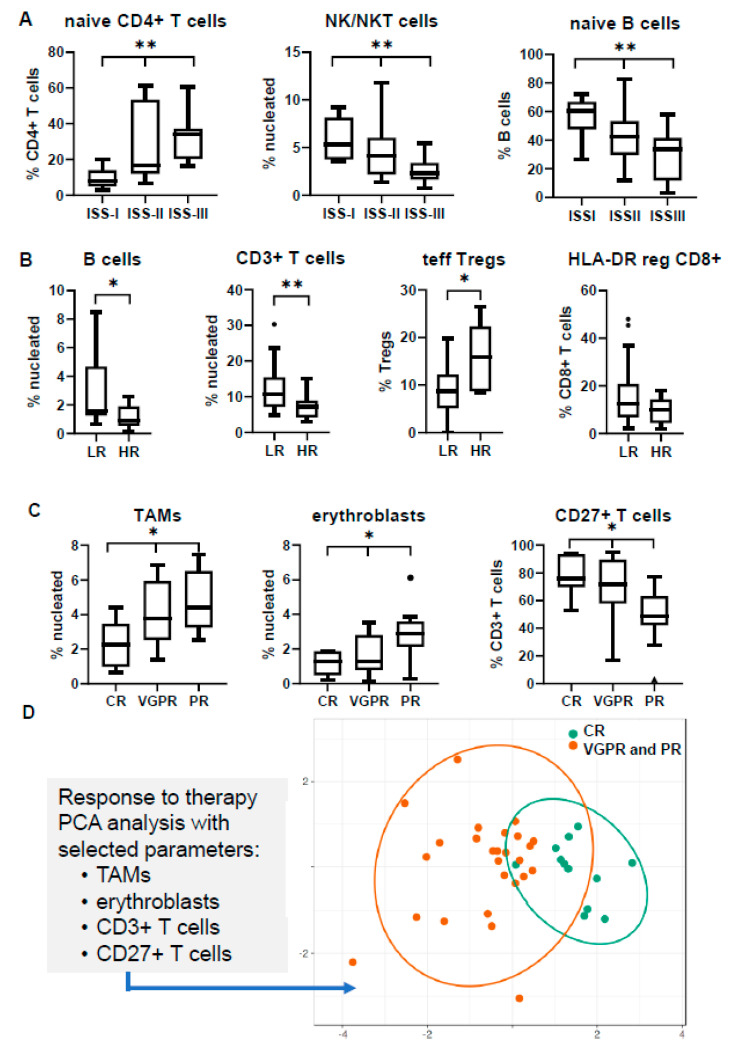
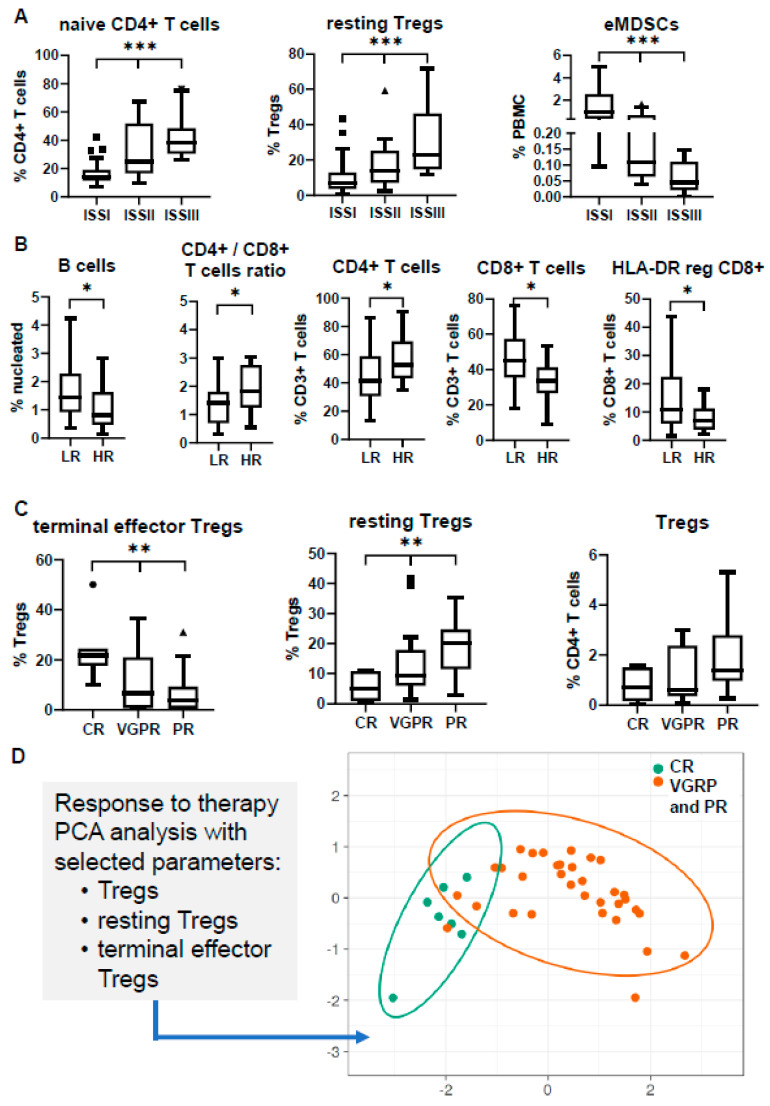
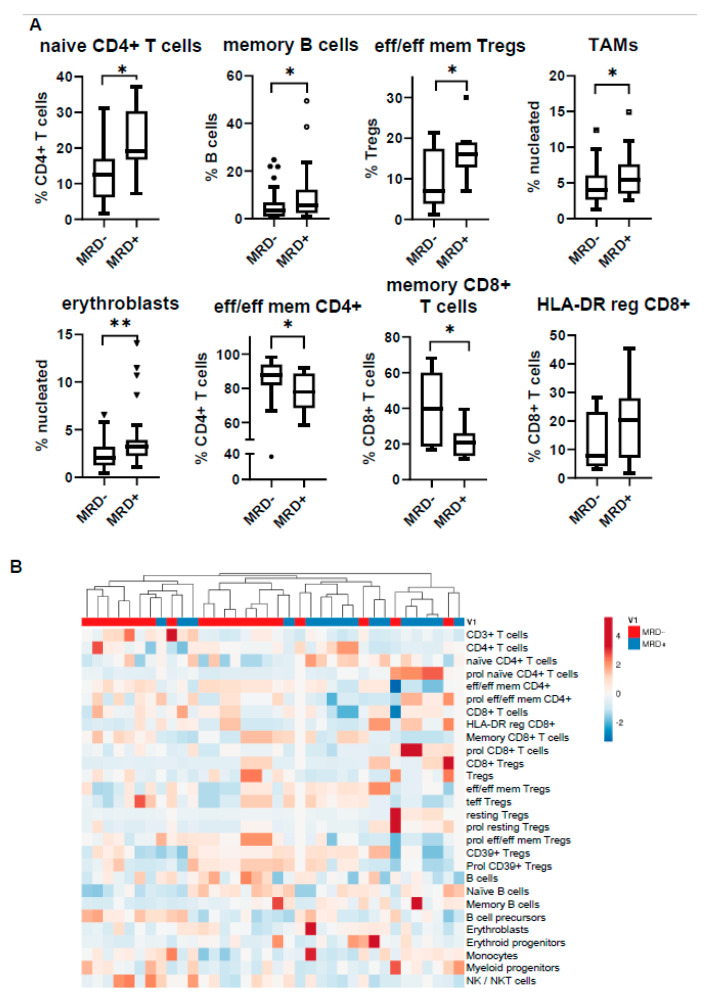
Despite recent advances, Multiple Myeloma (MM) remains an incurable disease with apparent heterogeneity that may explain patients' variable clinical outcomes. While the phenotypic, (epi)genetic, and molecular characteristics of myeloma cells have been thoroughly examined, there is limited information regarding the role of the bone marrow (BM) microenvironment in the natural history of the disease. In the present study, we performed deep phenotyping of 32 distinct immune cell subsets in a cohort of 94 MM patients to reveal unique immune profiles in both BM and peripheral blood (PB) that characterize distinct prognostic groups, responses to induction treatment, and minimal residual disease (MRD) status. Our data show that PB cells do not reflect the BM microenvironment and that the two sites should be studied independently. Adverse ISS stage and high-risk cytogenetics were correlated with distinct immune profiles; most importantly, BM signatures comprised decreased tumor-associated macrophages (TAMs) and erythroblasts, whereas the unique Treg signatures in PB could discriminate those patients achieving complete remission after VRd induction therapy. Moreover, MRD negative status was correlated with a more experienced CD4- and CD8-mediated immunity phenotype in both BM and PB, thus highlighting a critical role of by-stander cells linked to MRD biology.
尽管最近取得了进展,但多发性骨髓瘤(MM)仍然是一种无法治愈的疾病,具有明显的异质性,这可能解释了患者不同的临床结局。虽然骨髓瘤细胞的表型、(表观)遗传和分子特征已得到充分研究,但关于骨髓(BM)微环境在该疾病自然史中的作用的信息有限。在本研究中,我们对94例MM患者队列中的32个不同免疫细胞亚群进行了深度表型分析,以揭示BM和外周血(PB)中独特的免疫谱,这些免疫谱可表征不同的预后组、诱导治疗反应和微小残留病(MRD)状态。我们的数据表明,PB细胞不能反映BM微环境,这两个部位应独立研究。不良的国际分期系统(ISS)分期和高危细胞遗传学与不同的免疫谱相关;最重要的是,BM特征包括肿瘤相关巨噬细胞(TAM)和成红细胞减少,而PB中独特的调节性T细胞(Treg)特征可以区分那些在VRd诱导治疗后实现完全缓解的患者。此外,MRD阴性状态与BM和PB中更有经验的CD4和CD8介导的免疫表型相关,从而突出了与MRD生物学相关的旁观者细胞的关键作用。