Department of Molecular Biophysics, Faculty of Biology and Environmental Protection, University of Łódź, 141/143 Pomorska st., 90-236 Łódź, Poland.
Department of Medical Biophysics, Faculty of Biology and Environmental Protection, University of Łódź, 141/143 Pomorska st., 90-236 Łódź, Poland.
Molecules. 2020 Nov 4;25(21):5138. doi: 10.3390/molecules25215138.
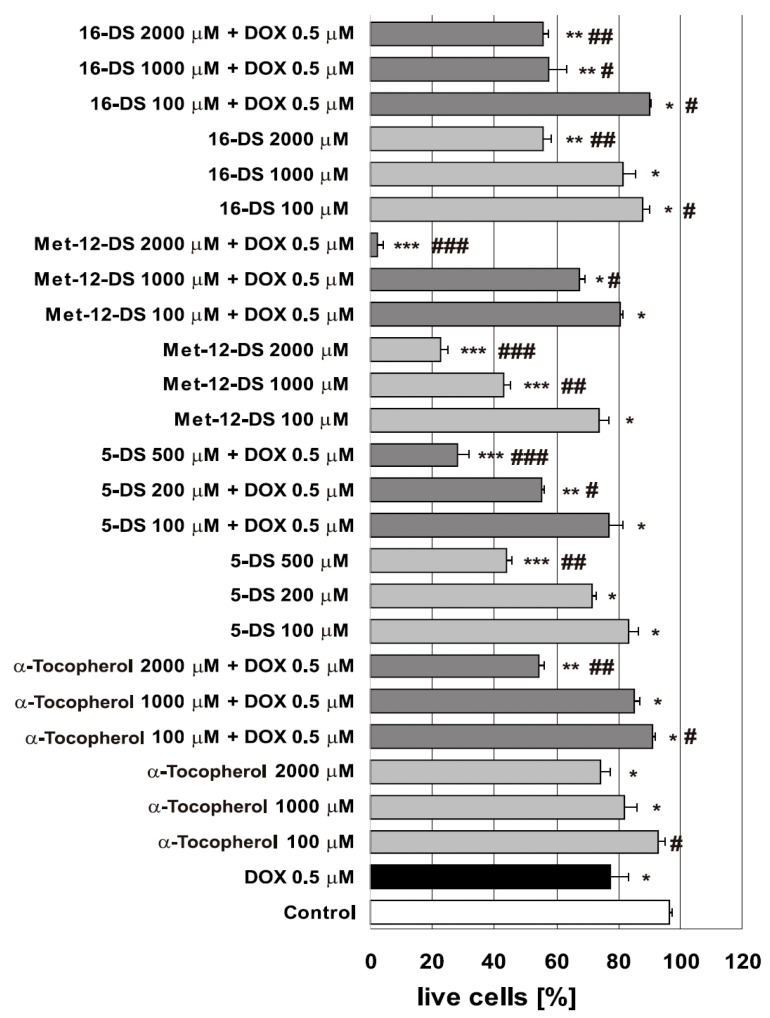
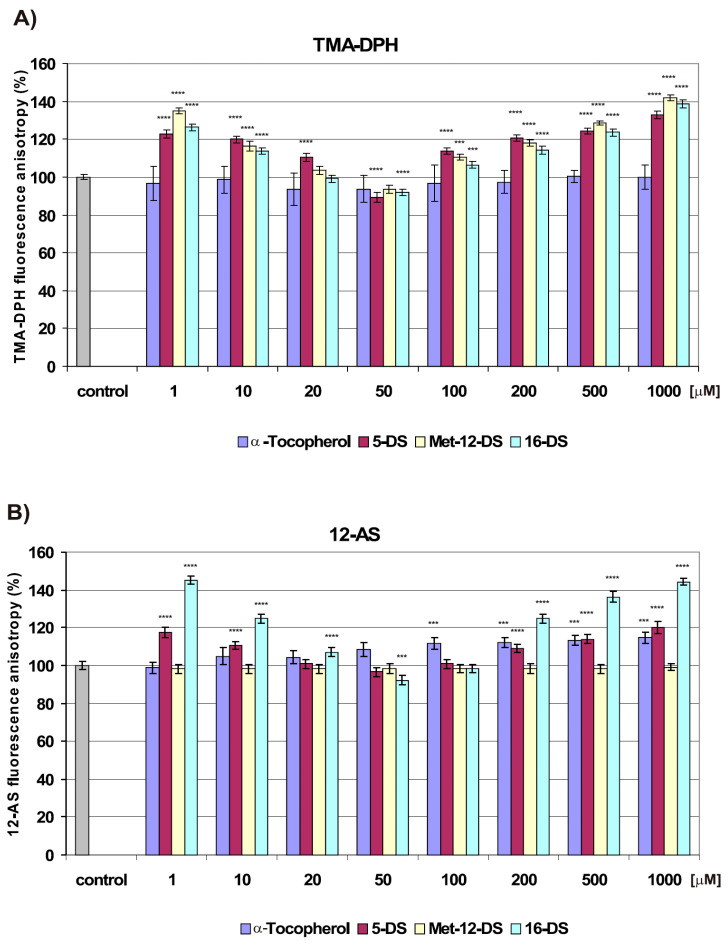
The biological properties of doxyl stearate nitroxides (DSs): 5-DS, Met-12-DS, and 16-DS, commonly used as spin probes, have not been explored in much detail so far. Furthermore, the influence of DSs on the cellular changes induced by the anticancer drug doxorubicin (DOX) has not yet been investigated. Therefore, we examined the cytotoxicity of DSs and their ability to induce cell death and to influence on fluidity and lipid peroxidation (LPO) in the plasma membrane of immortalised B14 fibroblasts, used as a model neoplastic cells, susceptible to DOX-induced changes. The influence of DSs on DOX toxicity was also investigated and compared with that of a natural reference antioxidant α-Tocopherol. By employing the trypan blue exclusion test and double fluorescent staining, we found a significant level of cytotoxicity for DSs and showed that their ability to induce apoptosis and modify plasma membrane fluidity (measured fluorimetrically) is more potent than for α-Tocopherol. The most cytotoxic nitroxide was 5-DS. The electron paramagnetic resonance (EPR) measurements revealed that 5-DS was reduced in B14 cells at the fastest and Met-12-DS at the slowest rate. In the presence of DOX, DSs were reduced slower than alone. The investigated compounds, administered with DOX, enhanced DOX-induced cell death and demonstrated concentration-dependent biphasic influence on membrane fluidity. A-Tocopherol showed weaker effects than DSs, regardless the mode of its application-alone or with DOX. High concentrations of α-Tocopherol and DSs decreased DOX-induced LPO. Substantial cytotoxicity of the DSs suggests that they should be used more carefully in the investigations performed on sensitive cells. Enhancement of DOX toxicity by DSs showed their potential to act as chemosensitizers of cancer cells to anthracycline chemotherapy.
doxyl 硬脂酸酯氮氧化物(DSs)的生物学特性:5-DS、Met-12-DS 和 16-DS,通常用作自旋探针,迄今为止尚未进行详细研究。此外,DSs 对阿霉素(DOX)等抗癌药物诱导的细胞变化的影响尚未进行研究。因此,我们研究了 DSs 的细胞毒性及其诱导细胞死亡的能力,并研究了它们对永生 B14 成纤维细胞(作为易受 DOX 诱导变化影响的肿瘤细胞模型)质膜流动性和脂质过氧化(LPO)的影响。还研究了 DSs 对 DOX 毒性的影响,并与天然参考抗氧化剂 α-生育酚进行了比较。通过采用台盼蓝排斥试验和双重荧光染色,我们发现 DSs 具有显著的细胞毒性,并表明其诱导细胞凋亡和改变质膜流动性(荧光法测量)的能力比 α-生育酚更强。最具细胞毒性的氮氧化物是 5-DS。电子顺磁共振(EPR)测量显示,5-DS 在 B14 细胞中的还原速度最快,Met-12-DS 最慢。在存在 DOX 的情况下,DSs 的还原速度比单独存在时慢。在所研究的化合物中,与 DOX 一起给药时,增强了 DOX 诱导的细胞死亡,并表现出浓度依赖性的双相膜流动性影响。α-生育酚的作用比 DSs 弱,无论其单独应用还是与 DOX 一起应用的方式如何。高浓度的 α-生育酚和 DSs 降低了 DOX 诱导的 LPO。DSs 的显著细胞毒性表明,在对敏感细胞进行的研究中,应更小心地使用它们。DSs 增强 DOX 毒性表明它们有潜力作为癌细胞对蒽环类化疗的化学增敏剂。