Department of Earth Sciences (Palaeobiology), Uppsala University, Villavägen 16, SE-752 36, Uppsala, Sweden.
Geological Survey of Denmark and Greenland, Øster Voldgade 10, DK-1350, Copenhagen K, Denmark.
Commun Biol. 2020 Nov 6;3(1):647. doi: 10.1038/s42003-020-01381-7.
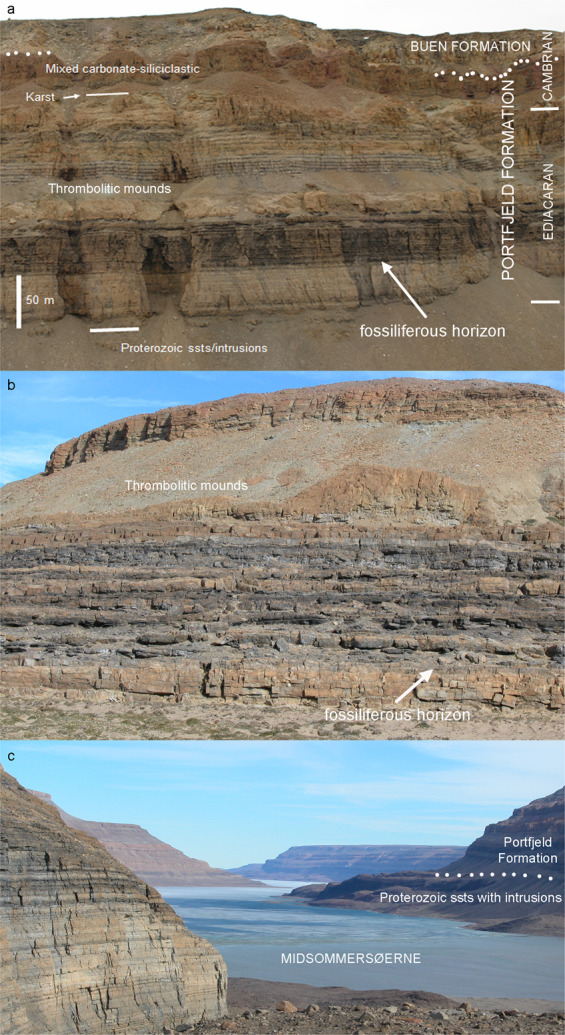
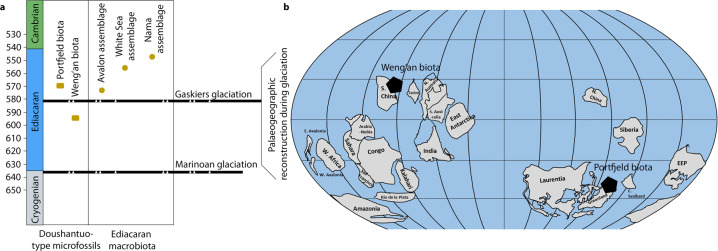
The Ediacaran period (635-541 Ma) was a time of major environmental change, accompanied by a transition from a microbial world to the animal world we know today. Multicellular, macroscopic organisms preserved as casts and molds in Ediacaran siliciclastic rocks are preserved worldwide and provide snapshots of early organismal, including animal, evolution. Remarkable evolutionary advances are also witnessed by diverse cellular and subcellular phosphatized microfossils described from the Doushantuo Formation in China, the only source showing a diversified assemblage of microfossils. Here, we greatly extend the known distribution of this Doushantuo-type biota in reporting an Ediacaran Lagerstätte from Laurentia (Portfjeld Formation, North Greenland), with phosphatized animal-like eggs, embryos, acritarchs, and cyanobacteria, the age of which is constrained by the Shuram-Wonoka anomaly (c. 570-560 Ma). The discovery of these Ediacaran phosphatized microfossils from outside East Asia extends the distribution of the remarkable biota to a second palaeocontinent in the other hemisphere of the Ediacaran world, considerably expanding our understanding of the temporal and environmental distribution of organisms immediately prior to the Cambrian explosion.
埃迪卡拉纪(635-541Ma)是一个重大环境变化的时期,伴随着从微生物世界向我们今天所知的动物世界的过渡。在埃迪卡拉纪硅质碎屑岩中保存的作为铸型和模具的多细胞、宏观生物体在全球范围内保存下来,为早期生物包括动物的进化提供了快照。在中国陡山沱组中描述的各种细胞和亚细胞磷化微化石也见证了非凡的进化进步,这是唯一显示多样化微化石组合的来源。在这里,我们通过报告劳伦西亚(北格陵兰的波特菲尔德组)的一个埃迪卡拉层位,极大地扩展了这种陡山沱型生物群的已知分布,其中有磷化的类似动物的卵、胚胎、疑源类和蓝藻,其年龄受舒兰-沃诺克异常(约 570-560Ma)的限制。这些来自东亚以外的埃迪卡拉纪磷化微化石的发现,将这一显著生物群的分布扩展到了埃迪卡拉世界另一个半球的第二个古大陆,极大地扩展了我们对寒武纪大爆发前生物的时间和环境分布的理解。