Program in Health Services and Systems Research, Duke-NUS Medical School, Singapore, Singapore.
Department of Pharmacy, National University of Singapore, Singapore, Singapore.
BMC Complement Med Ther. 2020 Nov 9;20(1):335. doi: 10.1186/s12906-020-03127-8.
Medical professionalism is important for establishing public trust in doctors. Its definition is culture-sensitive. However, no research has explored medical professionalism in Traditional Chinese Medicine (TCM) practitioners. This study aims to (a) establish the domains of professionalism in TCM practitioners in Singapore, and to (b) compare the domains of professionalism of practitioners trained in TCM and practitioners trained in conventional medicine.
Data for this qualitative study was collected through in-depth interviews (IDIs) with TCM practitioners. IDIs were audio-recorded and transcribed verbatim. Thematic analysis was conducted by two independent coders using the Professionalism Mini-Evaluation Exercise (P-MEX) as a framework. The domains of professionalism in TCM and conventional medicine were then compared, using data from a similar study on professionalism in practitioners trained in conventional medicine.
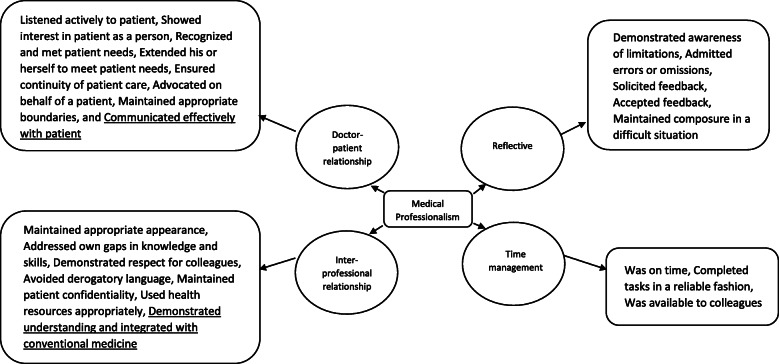
A total of 27 TCM practitioners (40.7% male) participated in this study. The four domains of professionalism in the P-MEX, namely doctor-patient relationship skills, reflective skills, time management and inter-professional relationship skills, and two new sub-domains, "communicated effectively with patient" and "demonstrated understanding and integrated with conventional medicine", were relevant to TCM practitioners. This is largely similar to that of practitioners trained in conventional medicine, with a few differences, including "ensured continuity of care" and "used health resources appropriately".
The domains of professionalism in TCM practitioners were established and they are similar to that of practitioners trained in conventional medicine. This study is the first to define medical professionalism in TCM practitioners. Findings will provide guidance on the education of professionalism in TCM practitioners.
医学专业精神对于建立公众对医生的信任至关重要。其定义具有文化敏感性。然而,目前还没有研究探索中医从业者的医学专业精神。本研究旨在:(a)确定新加坡中医从业者的专业精神领域;并(b)比较中医和常规医学从业者的专业精神领域。
本定性研究的数据通过对中医从业者的深入访谈(IDIs)收集。IDIs 被录音并逐字转录。两位独立的编码员使用专业精神微型评估练习(P-MEX)作为框架进行主题分析。然后,使用来自关于常规医学从业者专业精神的类似研究的数据,比较中医和常规医学从业者的专业精神领域。
共有 27 名中医从业者(40.7%为男性)参与了这项研究。P-MEX 的四个专业精神领域,即医患关系技巧、反思技巧、时间管理和跨专业关系技巧,以及两个新的子领域,“与患者有效沟通”和“表现出理解并与常规医学相结合”,与中医从业者相关。这与常规医学从业者的专业精神领域大致相似,但也存在一些差异,包括“确保连续性护理”和“合理使用卫生资源”。
确定了中医从业者的专业精神领域,它们与常规医学从业者的专业精神领域相似。这项研究首次定义了中医从业者的医学专业精神。研究结果将为中医从业者的专业精神教育提供指导。