Interdisciplinary Laboratory of Clinical Pathology, Interlab-UMU, University of Murcia, 30100, Murcia, Spain.
Department of Internal Medicine, Faculty of Veterinary Medicine, Bursa Uludag University, 16059, Bursa, Turkey.
BMC Vet Res. 2020 Nov 10;16(1):433. doi: 10.1186/s12917-020-02650-7.
Heart failure (HF) is associated with changes in inflammatory and oxidative stress biomarkers. This study aimed to evaluate the changes of a panel of inflammatory and oxidative stress biomarkers in dogs with different stages of HF and its relation with the severity of the disease and echocardiographic changes. A total of 29 dogs with HF as a result of myxomatous mitral valve degeneration or dilated cardiomyopathy were included and classified as stage-A (healthy), B (asymptomatic dogs), C (symptomatic dogs) and D (dogs with end-stage HF) according to the ACVIM staging system. In these dogs an ecnhocardiographic examination was performed and cytokines, and inflammatory and oxidative stress markers were evaluated in serum.
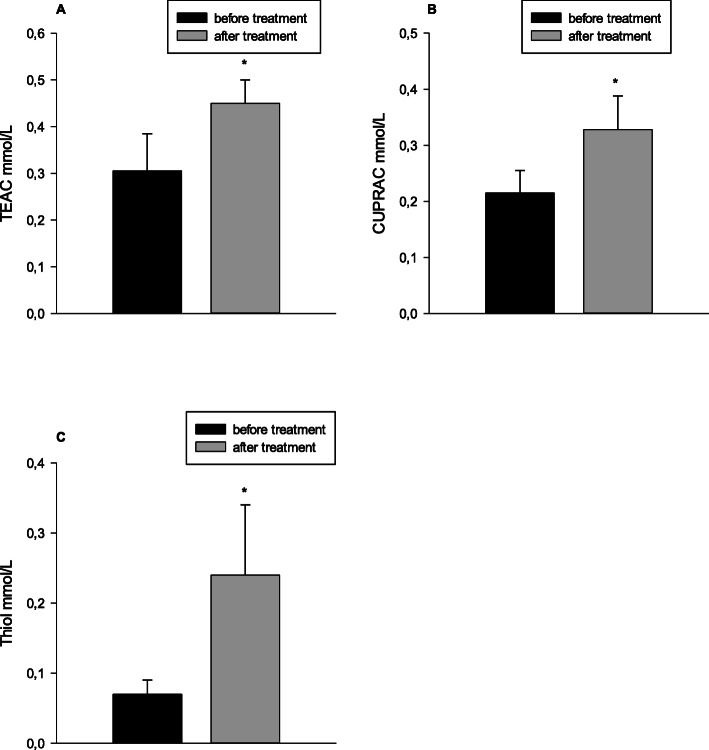
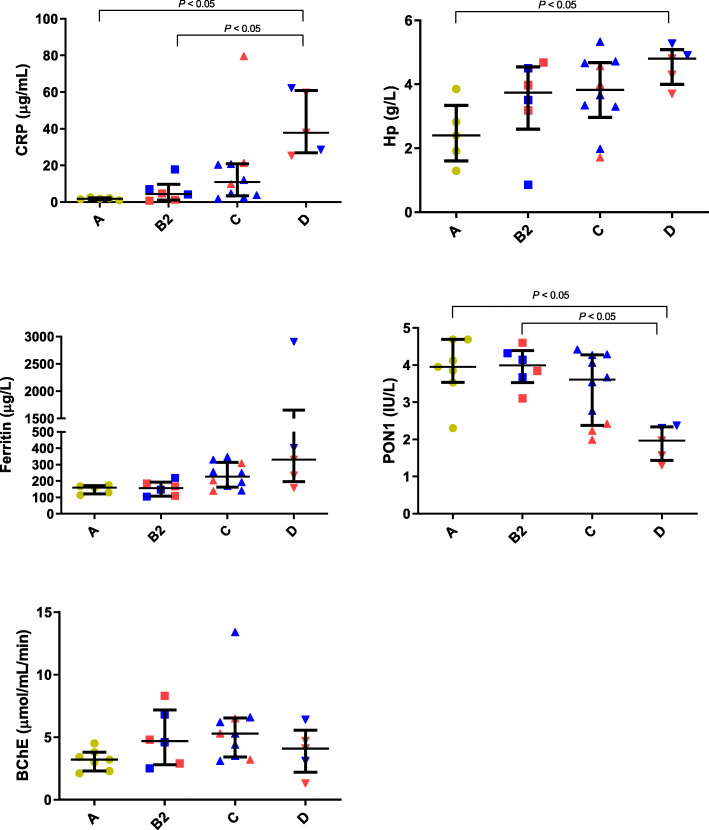
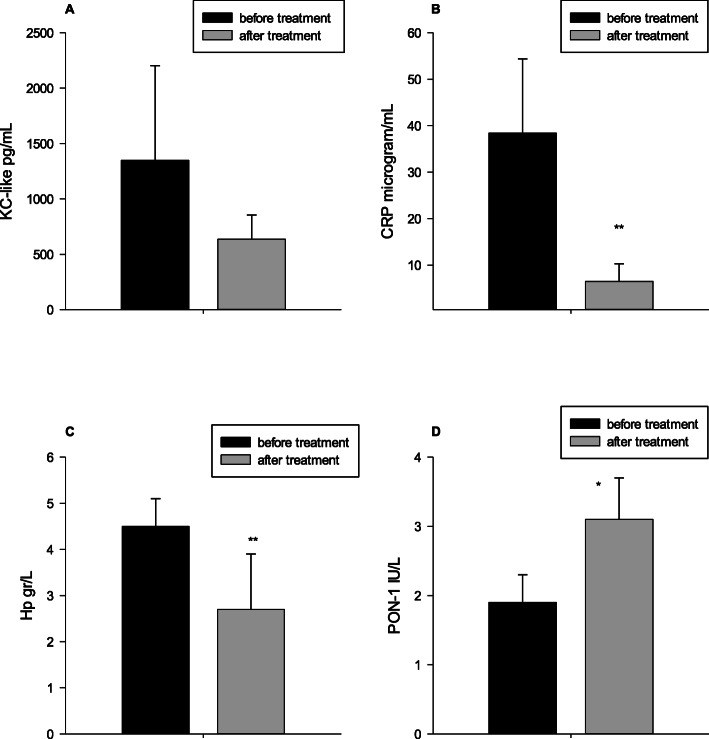
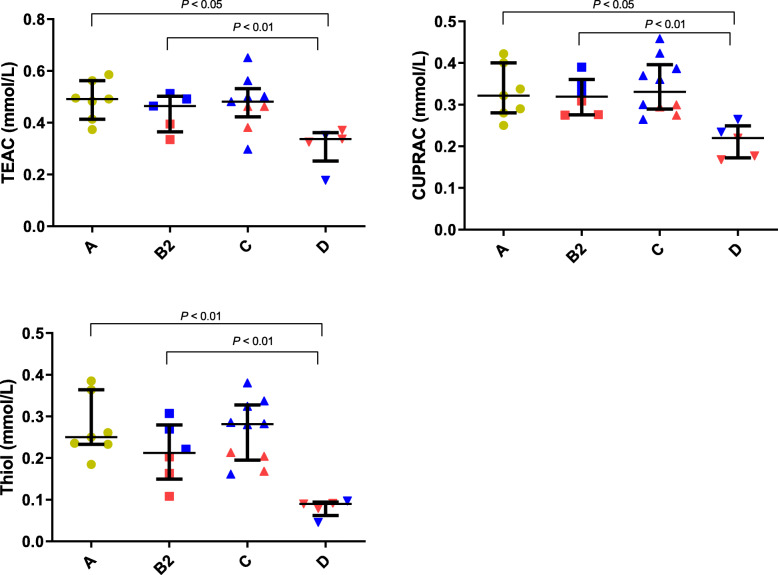
KC-like was significantly increased in dogs of stage-C (P < 0.01) and -D (P < 0.05) compared with stage-A and -B. Stage-D dogs showed significantly higher serum CRP and Hp (P < 0.05) but lower serum antioxidant capacity (PON1, TEAC, CUPRAC, and thiol) compared to stage-A and -B (P < 0.05). After the treatment, serum levels of CRP, Hp and KC-like decreased and serum antioxidant levels increased compared to their pre-treatment values. Left ventricular dimension and LA/Ao ratio correlated positively with CRP, MCP-1, and KC-like but negatively with PON1, GM-CSF, IL-7 and antioxidant biomarkers (P < 0.01).
Our results showed that dogs with advanced HF show increases in positive acute-phase proteins and selected inflammatory cytokines such as KC-like, and decreases in antioxidant biomarkers, indicating that inflammation and oxidative stress act as collaborative partners in the pathogenesis of HF. Some of these biomarkers of inflammation and oxidative stress could have the potential to be biomarkers to monitor the severity of the disease and the effect of treatment.
心力衰竭(HF)与炎症和氧化应激生物标志物的变化有关。本研究旨在评估不同阶段 HF 犬模型中一系列炎症和氧化应激生物标志物的变化,及其与疾病严重程度和超声心动图变化的关系。共纳入 29 只因黏液样二尖瓣变性或扩张型心肌病导致 HF 的犬,并根据 ACVIM 分期系统分为 A 期(健康)、B 期(无症状犬)、C 期(有症状犬)和 D 期(终末期 HF 犬)。对这些犬进行了超声心动图检查,并检测了血清中的细胞因子和炎症及氧化应激标志物。
与 A 期和 B 期相比,C 期(P<0.01)和 D 期(P<0.05)犬的 KC-like 明显升高。D 期犬的血清 CRP 和 Hp 明显升高(P<0.05),但血清抗氧化能力(PON1、TEAC、CUPRAC 和硫醇)明显低于 A 期和 B 期(P<0.05)。与治疗前相比,治疗后 CRP、Hp 和 KC-like 血清水平降低,抗氧化水平升高。左心室尺寸和 LA/Ao 比值与 CRP、MCP-1 和 KC-like 呈正相关,与 PON1、GM-CSF、IL-7 和抗氧化生物标志物呈负相关(P<0.01)。
我们的研究结果表明,患有晚期 HF 的犬表现出急性期蛋白和选定的炎症细胞因子(如 KC-like)的增加,以及抗氧化生物标志物的减少,表明炎症和氧化应激在 HF 的发病机制中起协同作用。这些炎症和氧化应激生物标志物中的一些可能有潜力成为监测疾病严重程度和治疗效果的生物标志物。