National Colorectal Disease Center of Nanjing Hospital of Chinese Medicine Affiliated to Nanjing University of Chinese Medicine, Nanjing, 210022, Jiangsu Province, China.
Graduate School of Nanjing University of Chinese Medicine, Nanjing, 210029, Jiangsu Province, China.
Stem Cell Res Ther. 2020 Nov 10;11(1):475. doi: 10.1186/s13287-020-01995-y.
Complex cryptoglandular perianal fistula (CPAF) is a kind of anal fistula that may cause anal incontinence after surgery. Minimally invasive surgery of anal fistula is constantly emerging. Over the past 20 years, there are several sphincter-sparing surgeries, one of which is autologous adipose-derived stem cell (ADSC) transplantation. However, to date, there is no study regarding the treatment of complex CPAF with ADSC in China. This is the first study in China on the treatment of complex CPAF with ADSC to evaluate its safety and efficacy.
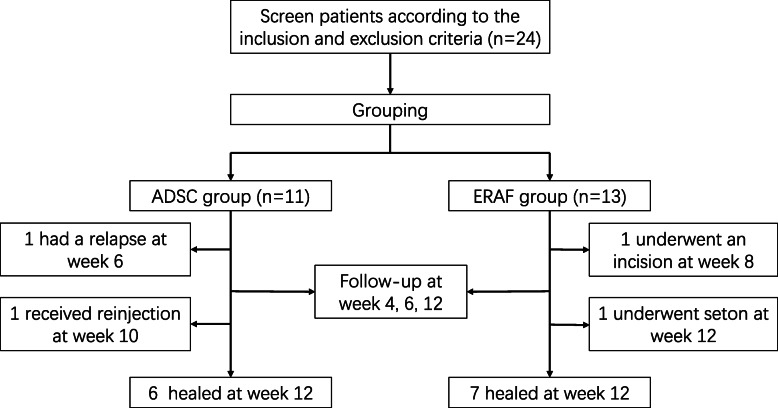
Totally, 24 patients with complex CPAF were enrolled in this prospective case-control study from January 2018 to December 2019 in the National Colorectal Disease Center of Nanjing Hospital of Chinese Medicine Affiliated to Nanjing University of Chinese Medicine. Patients were divided into ADSC group and endorectal advancement flap (ERAF) group according to their desire. The healing of fistulas (healing of all treated fistulas at baseline, confirmed by doctor's clinical assessment and magnetic resonance imaging or transrectal ultrasonography) was evaluated at week 12 after treatment. In addition to their safety evaluation based on adverse events monitored at each follow-up, the patients were also asked to complete some scoring scales at each follow-up including pain score with visual analog score (VAS) and anal incontinence score with Wexner score.
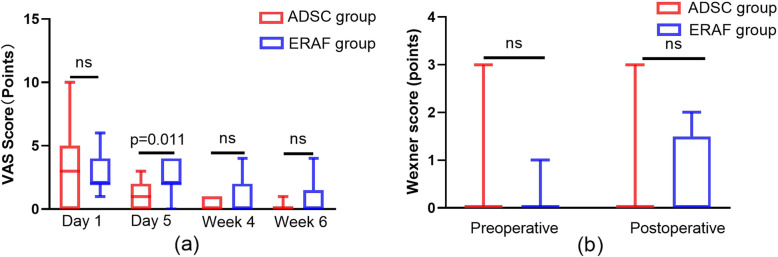
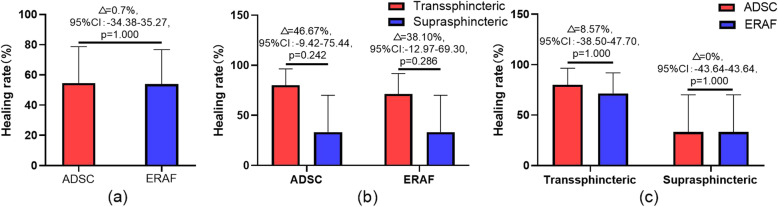
The closure rates within ADSC group and ERAF group at week 12 were 54.55% (6/11) and 53.85% (7/13), respectively, without significant difference between them. VAS score in ADSC group was significantly lower than that in ERAF group at the 5th day postoperatively [1(0,2) VS 2(2,4), p = 0.011], but no differences were observed at the other time. Wexner score of all patients was not increased with no significant differences between the two groups. Adverse events were observed fewer in ADSC group (27.27%) than that in ERAF group (53.85%), but there was no significant difference between them.
This study indicated safety and efficiency of ADSC for the treatment of complex CPAF in the short term, which is not inferior to that of ERAF. ADSC may provide a promised and potential treatment for complex CPAF conforming to the future of the treatment, which is reconstruction and regeneration.
ChiCTR, ChiCTR1800014599. Registered 23 January 2018-retrospectively registered, http://www.chictr.org.cn/showproj.aspx?proj=24548.
复杂肛隐窝型肛瘘(CPAF)是一种可能导致术后肛门失禁的肛瘘。肛瘘的微创治疗不断涌现。在过去的 20 年里,有几种保留括约肌的手术,其中一种是自体脂肪源性干细胞(ADSC)移植。然而,迄今为止,中国尚无关于 ADSC 治疗复杂 CPAF 的研究。这是中国首例采用 ADSC 治疗复杂 CPAF 的研究,旨在评估其安全性和疗效。
本前瞻性病例对照研究于 2018 年 1 月至 2019 年 12 月在南京中医药大学附属南京医院全国肛肠疾病诊疗中心纳入 24 例复杂 CPAF 患者。根据患者意愿将其分为 ADSC 组和经直肠内前位推进皮瓣(ERAF)组。治疗后第 12 周,通过医生的临床评估、磁共振成像或经直肠超声检查确认所有治疗瘘管均愈合(所有基线治疗瘘管愈合)来评估瘘管的愈合情况。除了根据每次随访时监测到的不良事件进行安全性评估外,患者还在每次随访时完成了一些评分量表,包括视觉模拟评分(VAS)疼痛评分和 Wexner 失禁评分。
ADSC 组和 ERAF 组在第 12 周的闭合率分别为 54.55%(6/11)和 53.85%(7/13),两组间无显著差异。ADSC 组术后第 5 天的 VAS 评分明显低于 ERAF 组[1(0,2)比 2(2,4),p=0.011],但其他时间无差异。两组患者的 Wexner 评分均未增加,差异无统计学意义。ADSC 组不良事件发生率(27.27%)低于 ERAF 组(53.85%),但差异无统计学意义。
本研究表明,ADSC 治疗复杂 CPAF 的短期安全性和疗效不劣于 ERAF。ADSC 可能为符合未来治疗方向(重建和再生)的复杂 CPAF 提供一种有前景的治疗方法。
ChiCTR,ChiCTR1800014599。注册于 2018 年 1 月 23 日-回顾性注册,网址:http://www.chictr.org.cn/showproj.aspx?proj=24548。