Division of Life Science and the Biotechnology Research Institute, Hong Kong University of Science and Technology, Clear Water Bay, Kowloon, Hong Kong 999077, China.
State Key Laboratory of Molecular Neuroscience, Hong Kong University of Science and Technology, Clear Water Bay, Kowloon, Hong Kong 999077, China.
Molecules. 2020 Nov 6;25(21):5169. doi: 10.3390/molecules25215169.
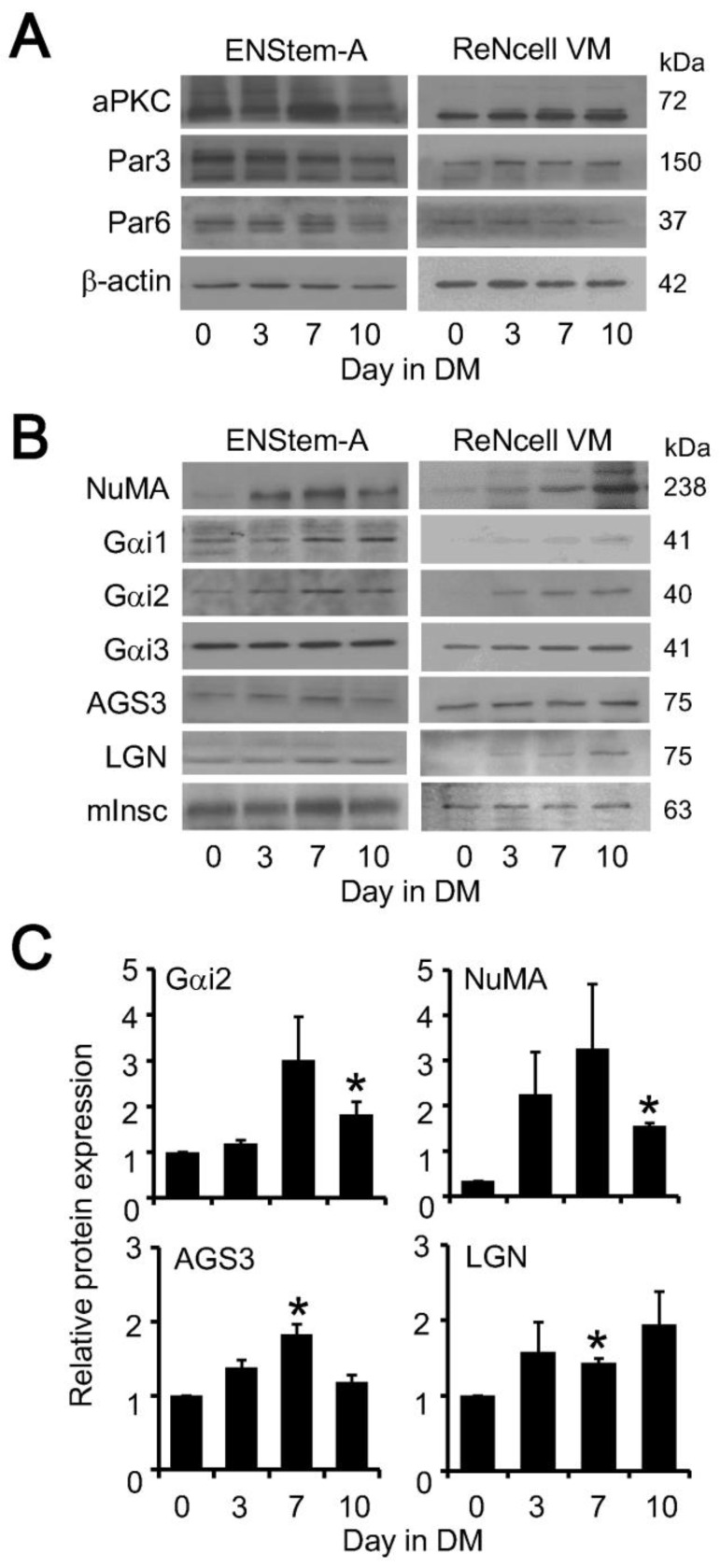
Adult neurogenesis is modulated by many G-coupled receptors but the precise mechanism remains elusive. A key step for maintaining the population of neural stem cells in the adult is asymmetric cell division (ACD), a process which entails the formation of two evolutionarily conserved protein complexes that establish the cell polarity and spindle orientation. Since ACD is extremely difficult to monitor in stratified tissues such as the vertebrate brain, we employed human neural progenitor cell lines to examine the regulation of the polarity and spindle orientation complexes during neuronal differentiation. Several components of the spindle orientation complex, but not those of the polarity complex, were upregulated upon differentiation of ENStem-A and ReNcell VM neural progenitor cells. Increased expression of nuclear mitotic apparatus (NuMA), Gα subunit, and activators of G protein signaling (AGS3 and LGN) coincided with the appearance of a neuronal marker (β-III tubulin) and the concomitant loss of neural progenitor cell markers (nestin and Sox-2). Co-immunoprecipitation assays demonstrated that both Gα and NuMA were associated with AGS3 in differentiated ENStem-A cells. Interestingly, AGS3 appeared to preferentially interact with Gα in ENStem-A cells, and this specificity for Gα was recapitulated in co-immunoprecipitation experiments using HEK293 cells transiently overexpressing GST-tagged AGS3 and different Gα subunits. Moreover, the binding of Gα to AGS3 was suppressed by GTPγS and pertussis toxin. Disruption of AGS3/Gα interaction by pertussis toxin indicates that AGS3 may recognize the same site on the Gα subunit as G protein-coupled receptors. Regulatory mechanisms controlling the formation of spindle orientation complex may provide novel means to manipulate ACD which in turn may have an impact on neurogenesis.
成人神经发生受许多 G 蛋白偶联受体调控,但确切机制尚不清楚。维持成年神经干细胞群体的关键步骤是不对称细胞分裂(ACD),这一过程涉及形成两个进化上保守的蛋白质复合物,建立细胞极性和纺锤体取向。由于 ACD 在分层组织(如脊椎动物大脑)中极难监测,我们利用人神经祖细胞系来研究神经元分化过程中极性和纺锤体取向复合物的调节。在 ENStem-A 和 ReNcell VM 神经祖细胞分化过程中,纺锤体取向复合物的几个成分上调,而不是极性复合物的成分。核有丝分裂装置(NuMA)、Gα亚基和 G 蛋白信号激活剂(AGS3 和 LGN)的表达增加与神经元标志物(β-III 微管蛋白)的出现以及神经祖细胞标志物(巢蛋白和 Sox-2)的同时丧失相吻合。共免疫沉淀试验表明,AGS3 和 NuMA 在分化的 ENStem-A 细胞中均与 Gα 相关。有趣的是,AGS3 似乎在 ENStem-A 细胞中优先与 Gα相互作用,并且在使用瞬时过表达 GST 标记的 AGS3 和不同 Gα 亚基的 HEK293 细胞进行的共免疫沉淀实验中再现了这种特异性。此外,GTPγS 和百日咳毒素抑制 Gα与 AGS3 的结合。百日咳毒素对 AGS3/Gα 相互作用的破坏表明,AGS3 可能识别 G 蛋白偶联受体上 Gα 亚基的相同位点。控制纺锤体取向复合物形成的调节机制可能为操纵 ACD 提供新的方法,从而可能对神经发生产生影响。