Sgro Michael, Campbell Douglas M, Mellor Kaitlyn L, Hollamby Kathleen, Bodani Jaya, Shah Prakesh S
Keenan Research Centre of the Li Ka Shing Knowledge Institute, St Michael's Hospital, Toronto, Ontario.
Department of Pediatrics, St. Michael's Hospital, Toronto, Ontario.
Paediatr Child Health. 2019 Aug 9;25(7):425-431. doi: 10.1093/pch/pxz073. eCollection 2020 Nov.
To evaluate trends in organisms causing early-onset neonatal sepsis (EONS). Congruent with recent reports, we hypothesized there would be an increase in EONS caused by
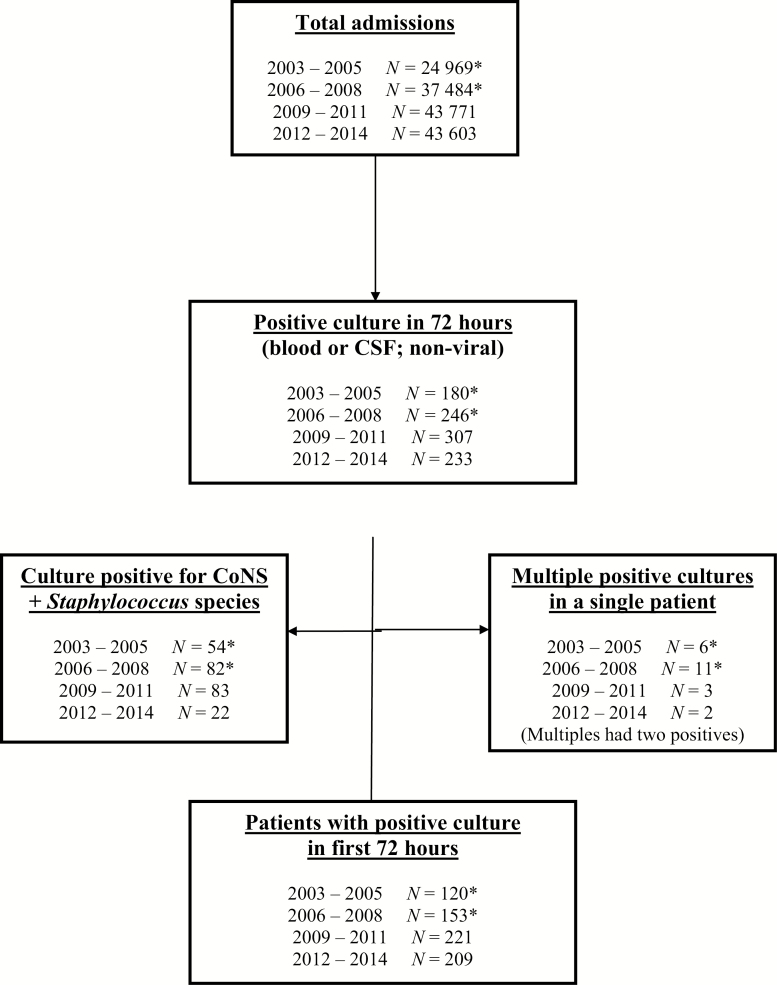
National data on infants admitted to neonatal intensive care units from 2009 to 2014 were compared to previously reported data from 2003 to 2008. We report 430 cases of EONS from 2009 to 2014. Bivariate analyses were used to analyze the distribution of causative organisms over time and differences by gestational age. Linear regression was used to estimate trends in causative organisms.
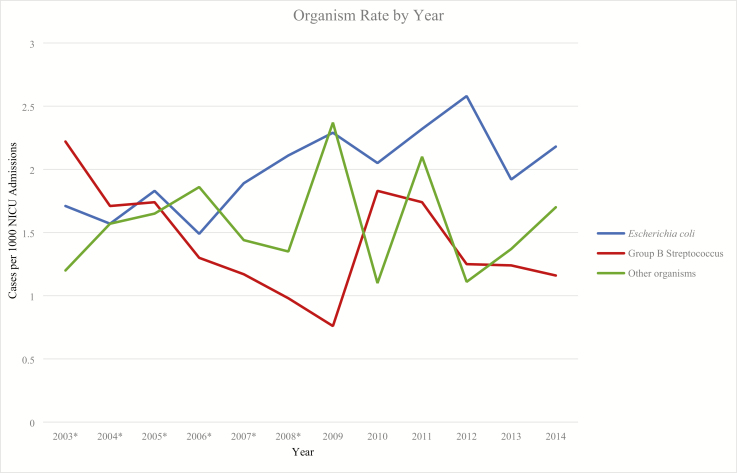
Since 2003, there has been a trend of increasing numbers of cases caused by (P<0.01). The predominant organism was in preterm infants and Group B Streptococcus in term infants.
With the majority of EONS cases now caused by , our findings emphasize the importance of continued surveillance of causative organism patterns and developing approaches to reduce cases caused by .
评估引起早发型新生儿败血症(EONS)的病原体趋势。与近期报告一致,我们假设由[未提及具体病原体]引起的EONS会增加。
将2009年至2014年入住新生儿重症监护病房的婴儿的全国数据与先前报告的2003年至2008年的数据进行比较。我们报告了2009年至2014年的430例EONS病例。采用双变量分析来分析致病病原体随时间的分布以及不同胎龄的差异。使用线性回归来估计致病病原体的趋势。
自2003年以来,由[未提及具体病原体]引起的病例数呈增加趋势(P<0.01)。主要病原体在早产儿中是[未提及具体病原体],在足月儿中是B族链球菌。
由于现在大多数EONS病例是由[未提及具体病原体]引起的,我们的研究结果强调了持续监测致病病原体模式以及开发减少由[未提及具体病原体]引起的病例的方法的重要性。