Department of Ophthalmology, Changhai Hospital, Second Military Medical University, Shanghai, China.
Shanghai Key Lab of Cell Engineering, Shanghai, China.
Transl Vis Sci Technol. 2020 Oct 27;9(11):30. doi: 10.1167/tvst.9.11.30. eCollection 2020 Oct.
To establish a method of laser capture microdissection (LCM) and RNA microsequencing for exploring optic nerve crush (ONC)-related early mRNA alterations in retinal ganglion cell (RGC) layer.
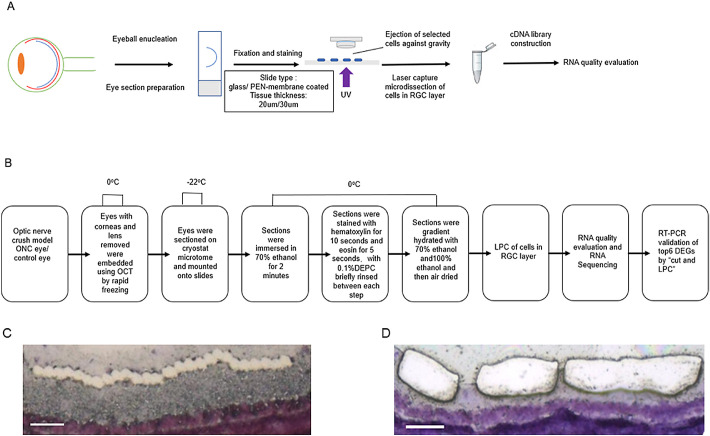
An LCM protocol was developed using retinal tissue sections to obtain high-quality RNA for microsequencing. Cells in the RGC layer were collected by laser pressure catapulting (LPC) using a PALM Zeiss UV LCM system. The effect of section thickness and slide type on tissue capture success and RNA yield and the integrity after LCM were evaluated. The optimal LCM protocol was used to explore ONC-related early mRNA alterations in the RGC layer. Candidate genes were validated by real-time polymerase chain reaction of the RGC layer tissue dissected by "cut and LPC" using the same LCM system.
We successfully established an optimal LCM protocol using 30-µm-thick retinal tissue sections mounted on glass slides and laser pressure catapulting (LPC) to collect cells in the RGC layer and to obtain high-quality RNA for microsequencing. On the basis of our protocol, we identified 8744 differentially expressed genes that were involved in ONC-related early mRNA alterations in the RGC layer. Candidate genes included Atf3, Lgals3, LOC102551701, Plaur, Tmem140, and Maml1.
The LCM-based single-cell RNA sequencing allowed a new sight into the early mRNA changes of RGCs highlighting new molecules associated to ONC.
This technique will be helpful for more accurate transcriptome analysis of clinical pathological samples of ophthalmology and provide important reference for the discovery of new pathological diagnosis indicators and drug development targets.
建立激光捕获显微切割(LCM)和 RNA 微测序方法,以探索视神经挤压(ONC)相关的早期 RGC 层 mRNA 变化。
使用视网膜组织切片开发了一种 LCM 方案,以获得用于微测序的高质量 RNA。使用 PALM Zeiss UV LCM 系统通过激光压力弹射(LPC)收集 RGC 层中的细胞。评估切片厚度和载玻片类型对组织捕获成功率、RNA 产量和 LCM 后 RNA 完整性的影响。使用最佳的 LCM 方案探索 RGC 层中与 ONC 相关的早期 mRNA 变化。使用相同的 LCM 系统对“切割和 LPC”分离的 RGC 层组织进行实时聚合酶链反应,验证候选基因。
我们成功地使用 30-µm 厚的载玻片上的视网膜组织切片和激光压力弹射(LPC)建立了最佳的 LCM 方案,以收集 RGC 层中的细胞并获得用于微测序的高质量 RNA。在此方案的基础上,我们鉴定了 8744 个差异表达基因,这些基因参与了 RGC 层中与 ONC 相关的早期 mRNA 变化。候选基因包括 Atf3、Lgals3、LOC102551701、Plaur、Tmem140 和 Maml1。
基于 LCM 的单细胞 RNA 测序为 RGC 早期 mRNA 变化提供了新的视角,突出了与 ONC 相关的新分子。
目的:建立激光捕获显微切割(LCM)和 RNA 微测序方法,以探索视神经挤压(ONC)相关的早期 RGC 层 mRNA 变化。
使用视网膜组织切片开发了一种 LCM 方案,以获得用于微测序的高质量 RNA。使用 PALM Zeiss UV LCM 系统通过激光压力弹射(LPC)收集 RGC 层中的细胞。评估切片厚度和载玻片类型对组织捕获成功率、RNA 产量和 LCM 后 RNA 完整性的影响。使用最佳的 LCM 方案探索 RGC 层中与 ONC 相关的早期 mRNA 变化。使用相同的 LCM 系统对“切割和 LPC”分离的 RGC 层组织进行实时聚合酶链反应,验证候选基因。
我们成功地使用 30-µm 厚的载玻片上的视网膜组织切片和激光压力弹射(LPC)建立了最佳的 LCM 方案,以收集 RGC 层中的细胞并获得用于微测序的高质量 RNA。在此方案的基础上,我们鉴定了 8744 个差异表达基因,这些基因参与了 RGC 层中与 ONC 相关的早期 mRNA 变化。候选基因包括 Atf3、Lgals3、LOC102551701、Plaur、Tmem140 和 Maml1。
基于 LCM 的单细胞 RNA 测序为 RGC 早期 mRNA 变化提供了新的视角,突出了与 ONC 相关的新分子。