Graduate Institute of Toxicology, College of Medicine, National Taiwan University, No.1, Section 4, Ren-Ai Rd, Taipei, 100, Taiwan.
Institute of Statistical Sciences, Academia Sinica, Taipei, Taiwan.
Cancer Immunol Immunother. 2021 May;70(5):1435-1450. doi: 10.1007/s00262-020-02781-8. Epub 2020 Nov 11.
Malignant pleural effusion (MPE)-macrophage (Mφ) of lung cancer patients within unique M1/M2 spectrum showed plasticity in M1-M2 transition. The M1/M2 features of MPE-Mφ and their significance to patient outcomes need to be clarified; furthermore, whether M1-repolarization could benefit treatment remains unclear.
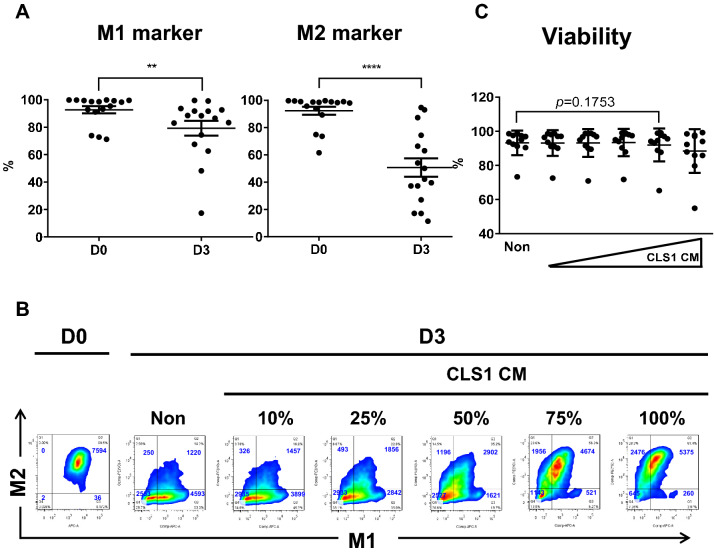
Total 147 stage-IV lung adenocarcinoma patients undergoing MPE drainage were enrolled for profiling and validation of their M1/M2 spectrum. In addition, the MPE-Mφ signature on overall patient survival was analyzed. The impact of the M1-polarization strategy of patient-derived MPE-Mφ on anti-cancer activity was examined.
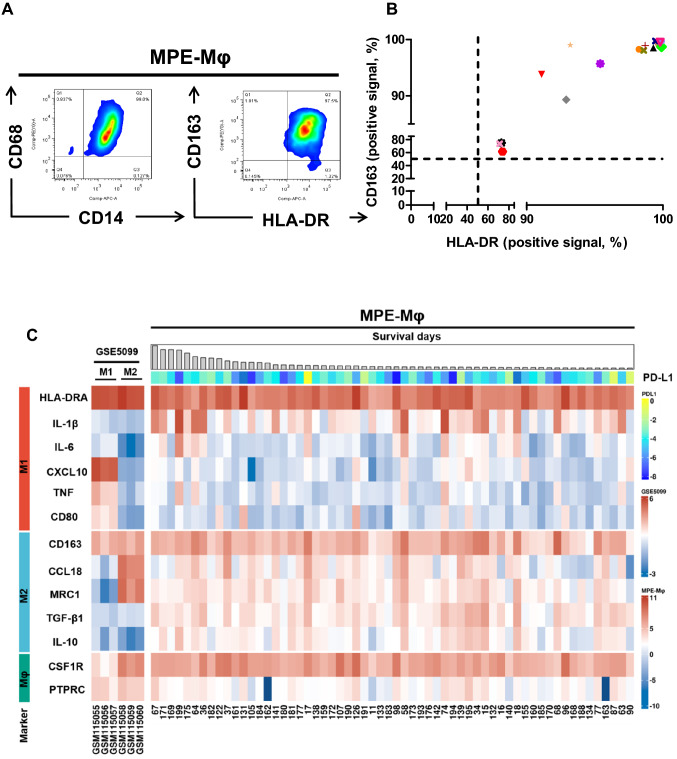
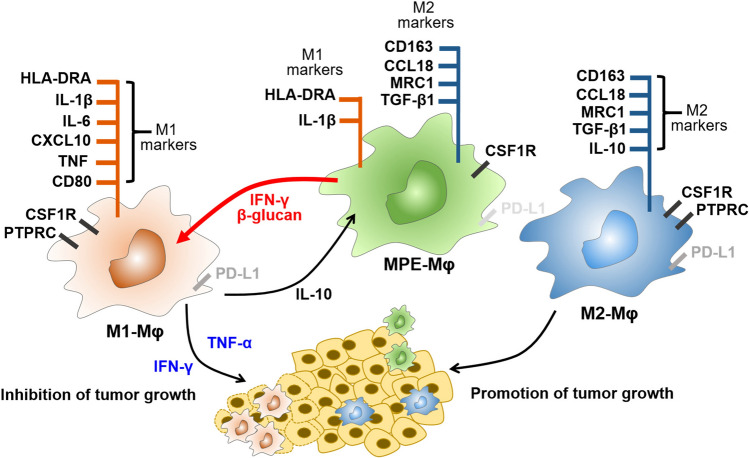
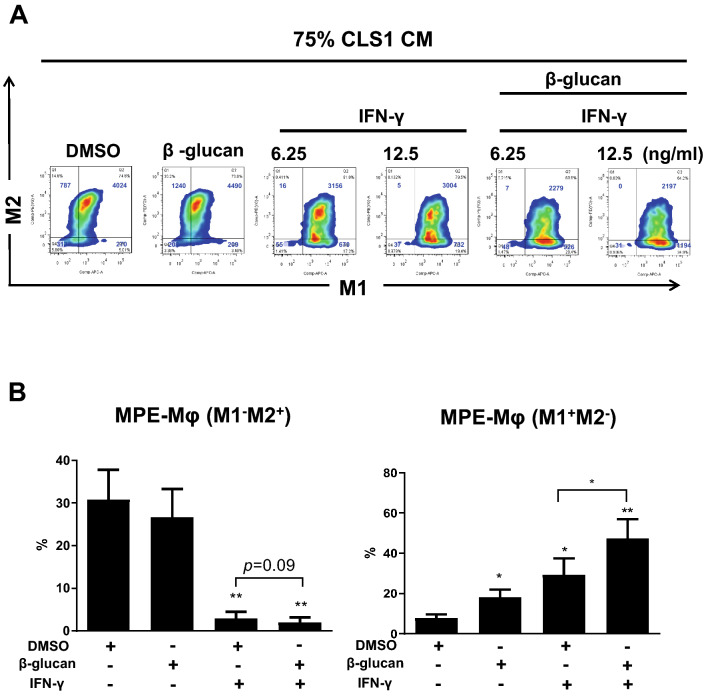
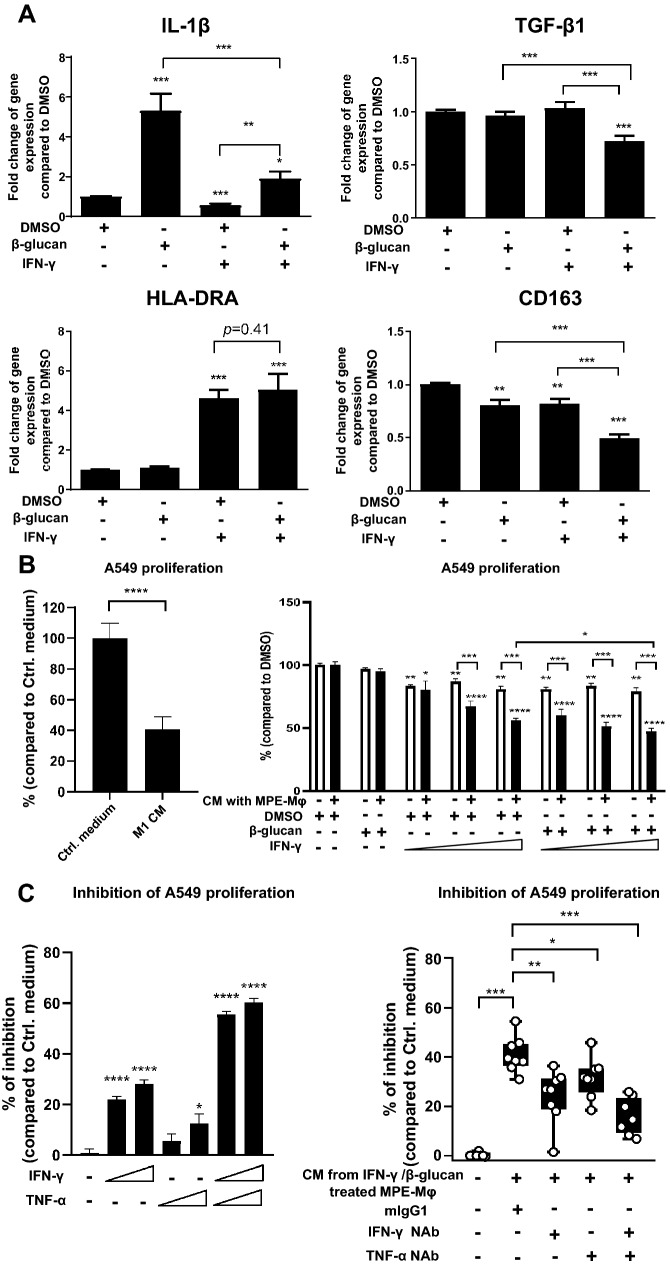
We found that MPE-Mφ expressed both traditional M1 (HLA-DRA) and M2 (CD163) markers and showed a wide range of M1/M2 spectrum. Most of the MPE-Mφ displayed diverse PD-L1 expression patterns, while the low PD-L1 expression group was correlated with higher levels of IL-10. Among these markers, we identified a novel two-gene MPE-Mφ signature, IL-1β and TGF-β1, representing the M1/M2 tendency, which showed a strong predictive power in patient outcomes in our MPE-Mφ patient cohort (N = 60, p = 0.013) and The Cancer Genome Atlas Lung Adenocarcinoma dataset (N = 478, p < 0.0001). Significantly, β-glucan worked synergistically with IFN-γ to reverse the risk signature by repolarizing the MPE-Mφ toward the M1 pattern, enhancing anti-cancer activity.
We identified MPE-Mφ on the M1/M2 spectrum and plasticity and described a two-gene M1/M2 signature that could predict the outcome of late-stage lung cancer patients. In addition, we found that "re-education" of these MPE-Mφ toward anti-cancer M1 macrophages using clinically applicable strategies may overcome tumor immune escape and benefit anti-cancer therapies.
肺癌患者的恶性胸腔积液(MPE)-巨噬细胞(Mφ)在独特的 M1/M2 谱内显示出 M1-M2 转变的可塑性。MPE-Mφ 的 M1/M2 特征及其对患者预后的意义尚需阐明;此外,M1 再极化是否对治疗有益尚不清楚。
共纳入 147 例接受 MPE 引流的 IV 期肺腺癌患者,对其 M1/M2 谱进行分析和验证。此外,还分析了 MPE-Mφ 对总患者生存的影响。检查患者来源的 MPE-Mφ 的 M1 极化策略对抗癌活性的影响。
我们发现 MPE-Mφ 表达传统的 M1(HLA-DRA)和 M2(CD163)标志物,并表现出广泛的 M1/M2 谱。大多数 MPE-Mφ 显示出不同的 PD-L1 表达模式,而低 PD-L1 表达组与较高水平的 IL-10 相关。在这些标志物中,我们确定了一个新的双基因 MPE-Mφ 特征,IL-1β 和 TGF-β1,代表 M1/M2 倾向,在我们的 MPE-Mφ 患者队列(N=60,p=0.013)和癌症基因组图谱肺腺癌数据集(N=478,p<0.0001)中,该特征对患者预后具有很强的预测能力。重要的是,β-葡聚糖与 IFN-γ 协同作用,通过将 MPE-Mφ 向 M1 模式再极化来逆转风险特征,增强抗癌活性。
我们确定了 M1/M2 谱上的 MPE-Mφ 及其可塑性,并描述了一个双基因 M1/M2 特征,可预测晚期肺癌患者的结局。此外,我们发现使用临床适用的策略将这些 MPE-Mφ 向抗癌 M1 巨噬细胞“再教育”可能克服肿瘤免疫逃逸,有益于抗癌治疗。