Fish and Wildlife Research Institute, Florida Fish and Wildlife Conservation Commission, Marathon, Florida, United States of America.
Fish and Wildlife Research Institute, Florida Fish and Wildlife Conservation Commission, St. Petersburg, Florida, United States of America.
PLoS One. 2020 Nov 11;15(11):e0241871. doi: 10.1371/journal.pone.0241871. eCollection 2020.
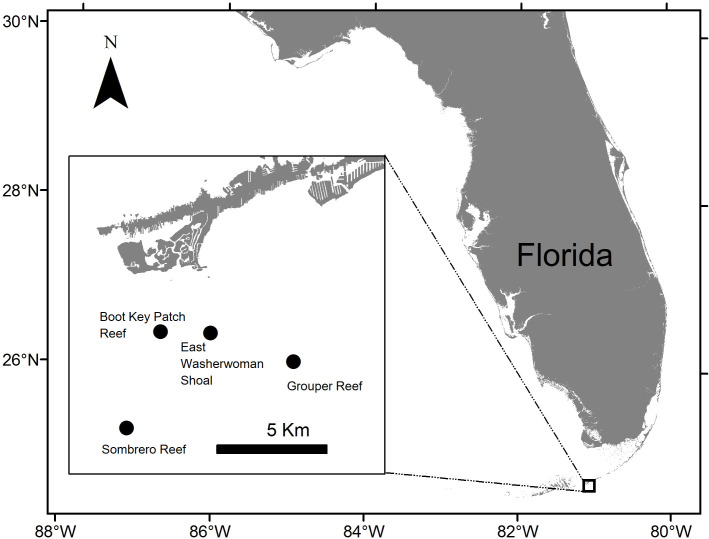
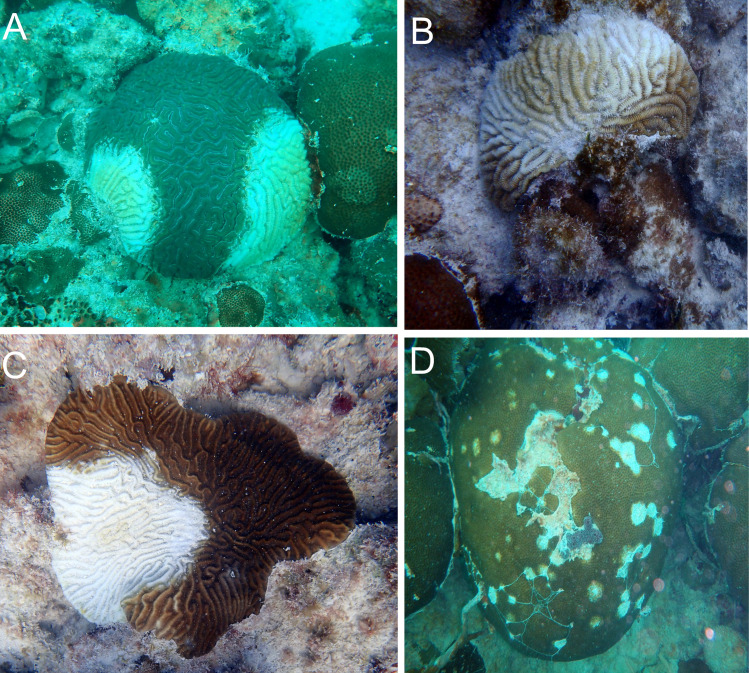
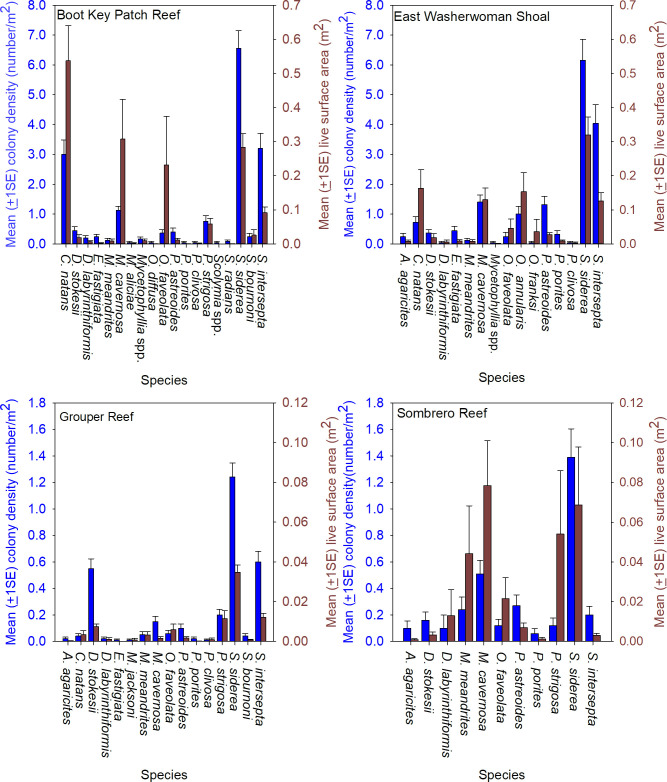
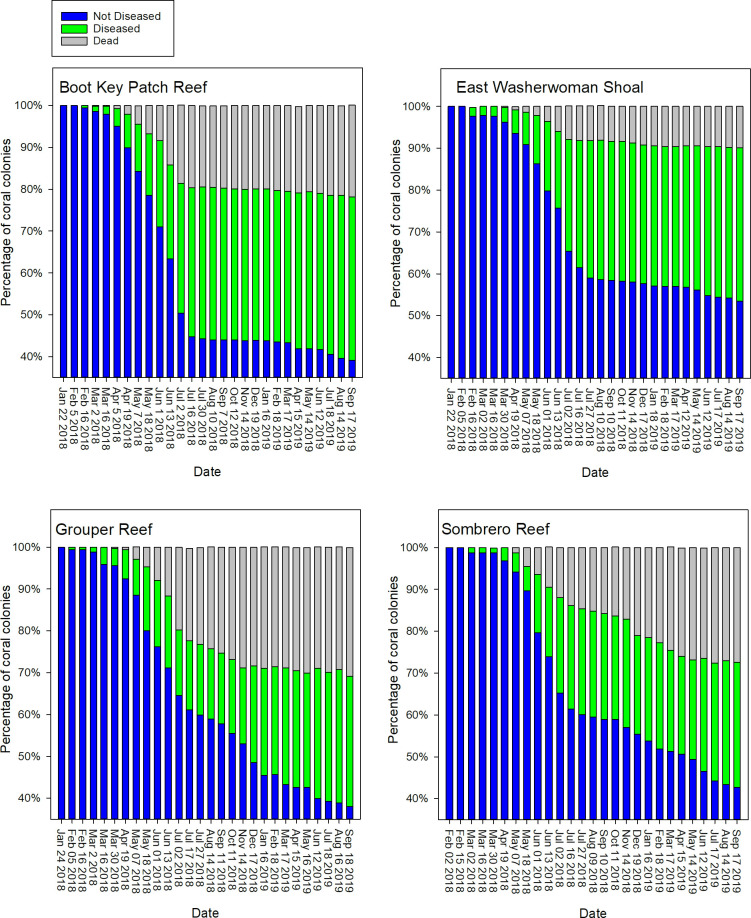
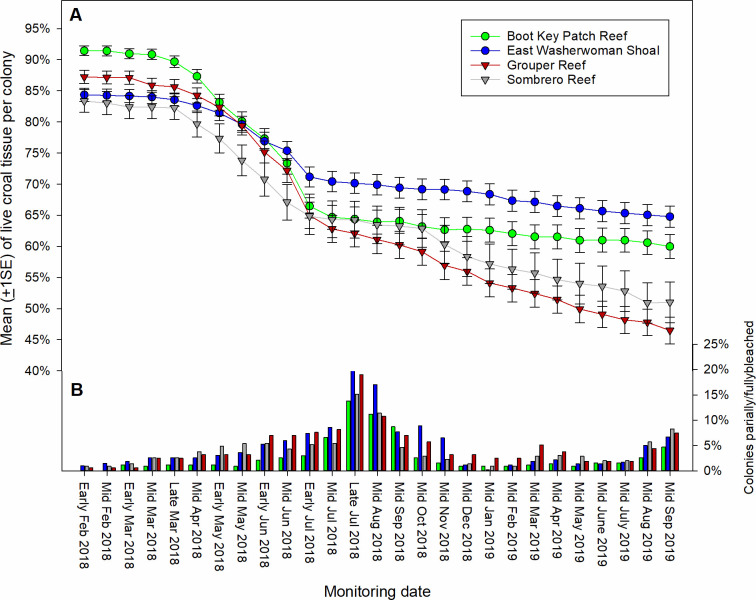
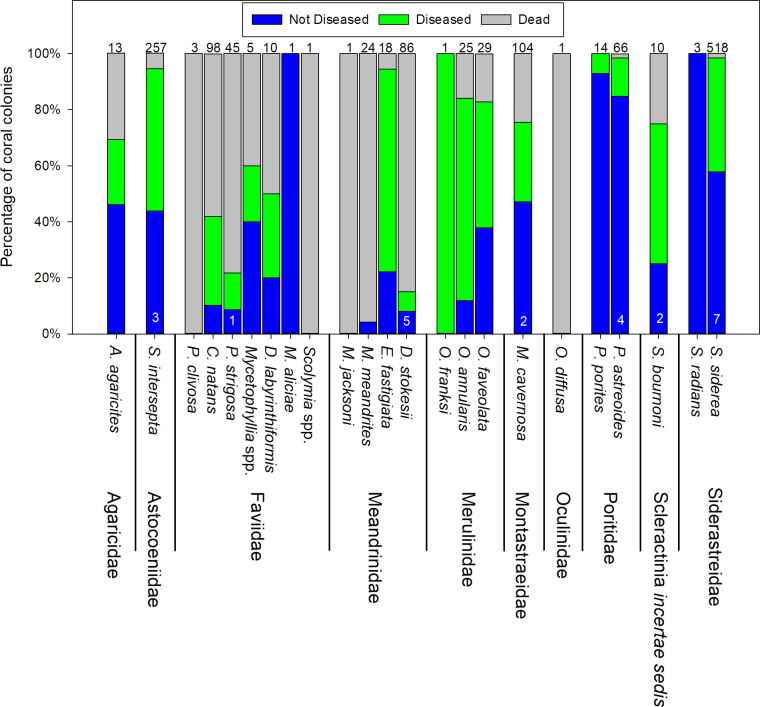
Along the Florida reef tract, stony-coral-tissue-loss disease (SCTLD) has caused extensive mortality of more than 20 scleractinian coral species. The pathogen is unknown, but its epizoology indicates that the disease, facilitated by water currents, has progressed linearly along the tract, affecting reefs at the scale of hundreds of kilometers. To inform ongoing disease mitigation efforts, we examined the small-scale spatial and temporal epidemiology of SCTLD. We established a series of sites in the middle Florida Keys at offshore and inshore locations that had not yet shown signs of SCTLD. We then conducted high-frequency monitoring from February 2018 through September 2019 and documented the onset of SCTLD and its progression through the sites. SCTLD was first observed at one site during early February 2018 and by early March 2018 all sites showed signs of the disease. A dynamic multistate model suggested that disease transmission was independent of coral density and found little evidence of a positive association between a colony showing signs of SCTLD and the condition or distance to its neighboring colonies. The model did, however, indicate that the probability of a colony showing signs of SCTLD increased with increasing colony surface area. These results are consistent with the water-borne transmission of a pathogen that progressed rapidly through the survey area. However, by the end of our survey the progression of SCTLD had slowed, particularly at inshore sites. Many affected colonies no longer exhibited progressive tissue mortality typical of the disease, suggesting the existence of differentially resilient colonies or coral communities, meriting their use for future coral rescue and propagation and disease research. These results are useful for refining ongoing SCTLD mitigation strategies, particularly by determining when disease rates are sufficiently low for direct intervention efforts designed to arrest disease progression on individual coral colonies will be most effective.
沿着佛罗里达暗礁带,石珊瑚组织损失疾病(SCTLD)已经导致了 20 多种硬珊瑚物种的大量死亡。病原体尚不清楚,但它的生态学表明,这种疾病在水流的作用下,已经沿着暗礁带线性发展,影响了数百公里范围内的珊瑚礁。为了提供正在进行的疾病缓解工作的信息,我们研究了 SCTLD 的小尺度时空流行病学。我们在佛罗里达群岛中部的近海和近岸地点建立了一系列尚未出现 SCTLD 迹象的地点。然后,我们从 2018 年 2 月到 2019 年 9 月进行了高频监测,并记录了 SCTLD 的发病和在这些地点的进展情况。SCTLD 于 2018 年 2 月初首次在一个地点出现,到 2018 年 3 月初,所有地点都出现了这种疾病的迹象。一个动态多状态模型表明,疾病传播与珊瑚密度无关,并且几乎没有证据表明一个出现 SCTLD 迹象的珊瑚殖民地的状况或与其相邻殖民地的距离与其出现疾病的可能性之间存在正相关关系。该模型确实表明,一个出现 SCTLD 迹象的珊瑚殖民地的概率随着其殖民地表面积的增加而增加。这些结果与一种快速在调查区域传播的水传播病原体一致。然而,在我们的调查结束时,SCTLD 的进展速度已经放缓,尤其是在近岸地点。许多受影响的殖民地不再表现出疾病典型的进行性组织死亡,这表明存在不同的弹性殖民地或珊瑚群落,值得用于未来的珊瑚拯救和繁殖以及疾病研究。这些结果对于完善正在进行的 SCTLD 缓解策略是有用的,特别是通过确定疾病发生率何时足够低,以便直接干预措施在单个珊瑚殖民地阻止疾病进展将是最有效的。