
产前皮质类固醇:药物制剂和剂量的再评估。
Antenatal corticosteroids: a reappraisal of the drug formulation and dose.
机构信息
Division of Obstetrics and Gynecology, The University of Western Australia, Perth, WA, Australia.
Perinatal Institute, Department of Pediatrics, Cincinnati Children's Hospital Medical Center, University of Cincinnati, Cincinnati, OH, USA.
出版信息
Pediatr Res. 2021 Jan;89(2):318-325. doi: 10.1038/s41390-020-01249-w. Epub 2020 Nov 11.
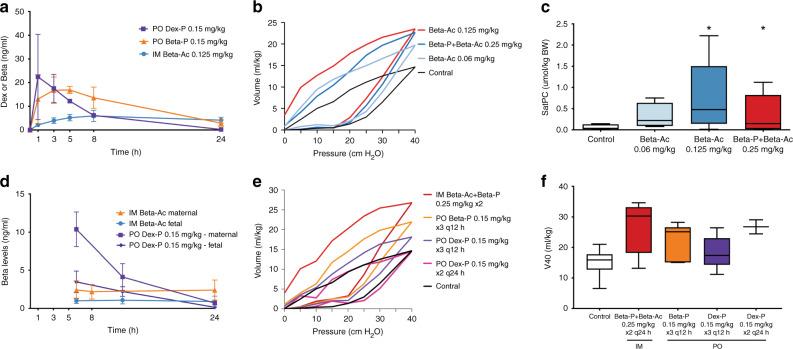
We review the history of antenatal corticosteroid therapy (ACS) and present recent experimental data to demonstrate that this, one of the pillars of perinatal care, has been inadequately evaluated to minimize fetal exposure to these powerful medications. There have been concerns since 1972 that fetal exposures to ACS convey risk. However, this developmental modulator, with its multiple widespread biologic effects, has not been evaluated for drug choice, dose, or duration of treatment, despite over 30 randomized trials. The treatment used in the United States is two intramuscular doses of a mixture of 6 mg betamethasone phosphate (Beta P) and 6 mg betamethasone acetate (Beta Ac). To optimize outcomes with ACS, the goal should be to minimize fetal drug exposure. We have determined that the minimum exposure needed for fetal lung maturation in sheep, monkeys, and humans (based on published cord blood corticosteroid concentrations) is about 1 ng/ml for a 48-h continuous exposure, far lower than the concentration reached by the current dosing. Because the slowly released Beta Ac results in prolonged fetal exposure, a drug containing Beta Ac is not ideal for ACS use. IMPACT: Using sheep and monkey models, we have defined the minimum corticosteroid exposure for a fetal lung maturation. These results should generate new clinical trials of antenatal corticosteroids (ACS) at much lower fetal exposures to ACS, possibly given orally, with fewer risks for the fetus.
我们回顾了产前皮质类固醇治疗 (ACS) 的历史,并呈现了最近的实验数据,以证明作为围产期护理支柱之一的 ACS 治疗,其胎儿暴露于这些强效药物的风险评估并不充分。自 1972 年以来,人们一直担心 ACS 会对胎儿造成风险。然而,这种具有多种广泛生物学效应的发育调节剂,尽管已经进行了 30 多项随机试验,但尚未针对药物选择、剂量或治疗持续时间进行评估。美国使用的治疗方法是肌内注射两次含有 6mg 磷酸倍他米松 (Beta P) 和 6mg 醋酸倍他米松 (Beta Ac) 的混合物。为了优化 ACS 的治疗效果,目标应该是尽量减少胎儿的药物暴露。我们已经确定,绵羊、猴子和人类胎儿肺成熟所需的最小暴露量(基于已发表的脐带血皮质类固醇浓度)约为 48 小时连续暴露 1ng/ml,远低于当前剂量所达到的浓度。由于缓慢释放的 Beta Ac 会导致胎儿暴露时间延长,因此含有 Beta Ac 的药物并不适合 ACS 使用。
影响
我们使用绵羊和猴子模型,定义了胎儿肺成熟所需的最小皮质类固醇暴露量。这些结果应该会引发新的临床试验,以更低的胎儿 ACS 暴露量(可能通过口服途径)使用 ACS,从而降低胎儿的风险。


 Zotero 插件