Kätzel Dennis, Wolff Amy R, Bygrave Alexei M, Bannerman David M
Institute for Applied Physiology, Ulm University, Ulm, Germany.
Department of Neuroscience, University of Minnesota, Minneapolis, MN, United States.
Front Pharmacol. 2020 Oct 16;11:486811. doi: 10.3389/fphar.2020.486811. eCollection 2020.
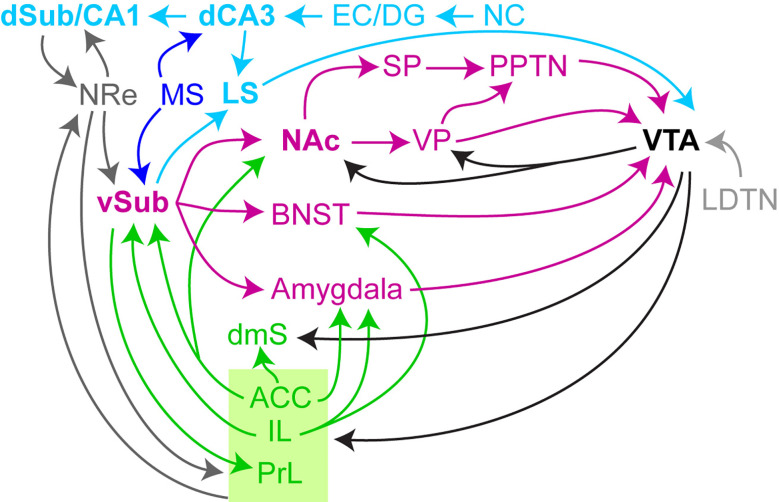
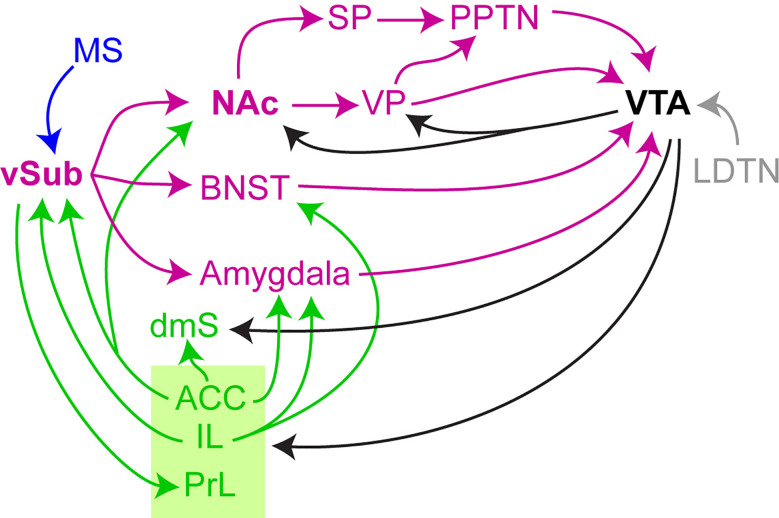
The development of current neuroleptics was largely aiming to decrease excessive dopaminergic signaling in the striatum. However, the notion that abnormal dopamine creates psychotic symptoms by causing an aberrant assignment of salience that drives maladaptive learning chronically during disease development suggests a therapeutic value of early interventions that correct salience-related neural processing. The mesolimbic dopaminergic output is modulated by several interconnected brain-wide circuits centrally involving the hippocampus and key relays like the ventral and associative striatum, ventral pallidum, amygdala, bed nucleus of the stria terminalis, nucleus reuniens, lateral and medial septum, prefrontal and cingulate cortex, among others. Unraveling the causal relationships between these circuits using modern neuroscience techniques holds promise for identifying novel cellular-and ultimately molecular-treatment targets for reducing transition to psychosis and symptoms of schizophrenia. Imaging studies in humans have implicated a hyperactivity of the hippocampus as a robust and early endophenotype in schizophrenia. Experiments in rodents, in turn, suggested that the activity of its output region-the ventral subiculum-may modulate dopamine release from ventral tegmental area (VTA) neurons in the ventral striatum. Even though these observations suggested a novel circuit-level target for anti-psychotic action, no therapy has yet been developed along this rationale. Recently evaluated treatment strategies-at least in part-target excess glutamatergic activity, e.g. N-acetyl-cysteine (NAC), levetiracetam, and mGluR2/3 modulators. We here review the evidence for the central implication of the hippocampus-VTA axis in schizophrenia-related pathology, discuss its symptom-related implications with a particular focus on aberrant assignment of salience, and evaluate some of its short-comings and prospects for drug discovery.
当前抗精神病药物的研发主要旨在减少纹状体中过度的多巴胺能信号传导。然而,异常多巴胺通过导致显著性的异常分配从而在疾病发展过程中长期驱动适应不良学习进而产生精神病性症状这一观点表明,纠正与显著性相关的神经加工的早期干预措施具有治疗价值。中脑边缘多巴胺能输出受到几个相互连接的全脑回路的调节,这些回路主要涉及海马体以及诸如腹侧和联合纹状体、腹侧苍白球、杏仁核、终纹床核、 reunien 核、外侧和内侧隔区、前额叶和扣带回皮质等关键中继站。利用现代神经科学技术阐明这些回路之间的因果关系,有望识别出用于减少向精神病转变和精神分裂症症状的新的细胞乃至分子治疗靶点。人类的影像学研究表明,海马体的过度活跃是精神分裂症中一种强烈且早期的内表型。反过来,啮齿动物实验表明,其输出区域——腹侧下托——的活动可能调节腹侧纹状体中腹侧被盖区(VTA)神经元的多巴胺释放。尽管这些观察结果提示了抗精神病作用的一个新的回路水平靶点,但尚未基于这一原理开发出治疗方法。最近评估的治疗策略——至少部分——针对过量的谷氨酸能活性,例如 N - 乙酰半胱氨酸(NAC)、左乙拉西坦和 mGluR2/3 调节剂。我们在此回顾海马体 - VTA 轴在精神分裂症相关病理中的核心作用的证据,讨论其与症状相关的影响,特别关注显著性的异常分配,并评估其一些缺点以及药物发现的前景。