Hou Jianjing, Liu Jingting, Yuan Mengci, Meng Chunyan, Liao Jianhua
Department of Breast Surgery, Key Laboratory of Breast Cancer in Shanghai, Fudan University Shanghai Cancer Center.
Department of Oncology, Shanghai Medical College, Fudan University, Shanghai.
Medicine (Baltimore). 2020 Nov 13;99(46):e23248. doi: 10.1097/MD.0000000000023248.
Amplified in breast cancer 1 (AIB1) expression is known to be involved in the initiation and progression of malignant breast cancer (BC), but its prognostic role remains uncertain. This meta-analysis assessed reported studies to evaluate this relationship.
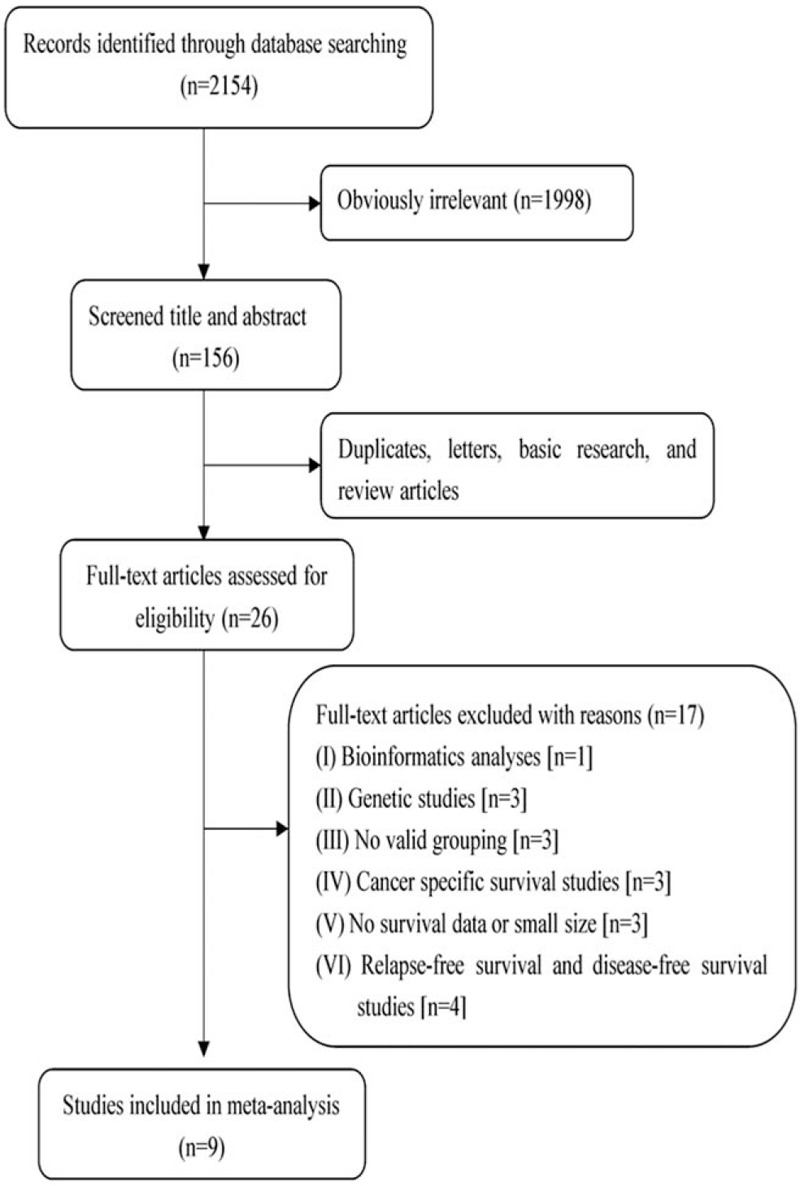
Electronic databases were systematically reviewed to collect eligible studies using pre-established criteria. Hazard ratios (HRs) or odds ratios (ORs) and 95% confidence intervals (CIs) were pooled to estimate the impact of AIB1 protein expression on overall survival (OS) and clinicopathologic properties of BC cases.
Nine eligible studies, including 6774 patients, were finally assessed by the current clinical meta-analysis. AIB1 positivity correlated with reduced OS (pooled HR = 1.409, 95% CI 1.159-1.714, P = .001). AIB1 overexpression also impacted prognosis as shown by univariate (pooled HR = 1.420, 95% CI 1.154-1.747, P = .001) and multivariate (pooled HR = 1.446, 95% CI 1.099-1.956; P = .009) analyses. Notably, subgroup analyses also revealed that AIB1 overexpression was associated with poor OS in some subgroups, such as ER-positive group (pooled HR = 1.511, 95% CI 1.138-2.006, P = .004), ER-positive without tamoxifen administration group (pooled HR = 2.338, 95% CI 1.489-3.627, P < .001), and premenopausal women group (pooled HR = 1.715, 95% CI 1.231-2.390, P = .001). Additionally, high AIB1 protein levels were associated with HER2 positivity (pooled OR = 0.331, 95% CI 0.245-0.448; P < .001), poorly differentiated histological grade (pooled OR = 0.377, 95% CI 0.317-0.448; P < .001), high Ki67 (pooled OR = 0.501, 95% CI 0.410-0.612; P < .001), presence of lymph node metastases (pooled OR = 0.866, 95% CI 0.752-0.997; P = .045), and absence of progesterone receptor (pooled OR = 1.447, 95% CI 1.190-1.759; P < .001).
This analysis demonstrated that AIB1 overexpression is related to aggressive phenotypes and unfavorable clinical outcomes in BC, and might involve in tamoxifen resistance. AIB1 may be a new prognostic biomarker and therapeutic target in BC.
已知乳腺癌1(AIB1)表达参与恶性乳腺癌(BC)的发生和进展,但其预后作用仍不确定。本荟萃分析评估了已发表的研究以评估这种关系。
系统检索电子数据库,根据预先设定的标准收集符合条件的研究。汇总风险比(HRs)或比值比(ORs)以及95%置信区间(CIs),以评估AIB1蛋白表达对BC患者总生存期(OS)和临床病理特征的影响。
本临床荟萃分析最终评估了9项符合条件的研究,共6774例患者。AIB1阳性与OS降低相关(汇总HR = 1.409,95% CI 1.159 - 1.714,P = 0.001)。单因素分析(汇总HR = 1.420,95% CI 1.154 - 1.747,P = 0.001)和多因素分析(汇总HR = 1.446,95% CI 1.099 - 1.956;P = 0.009)显示,AIB1过表达也影响预后。值得注意的是,亚组分析还显示,AIB1过表达在某些亚组中与较差的OS相关,如雌激素受体(ER)阳性组(汇总HR = 1.511,95% CI 1.138 - 2.006,P = 0.004)、未接受他莫昔芬治疗的ER阳性组(汇总HR = 2.338,95% CI 1.489 - 3.627,P < 0.001)和绝经前女性组(汇总HR = 1.715,95% CI 1.231 - 2.390,P = 0.001)。此外,AIB1蛋白水平高与HER2阳性(汇总OR = 0.331,95% CI 0.245 - 0.4448;P < 0.001)、组织学分级差(汇总OR = 0.377,95% CI 0.317 - 0.448;P < 0.001)、Ki67高(汇总OR = 0.501,95% CI 0.410 - 继612;P < 0.001)、存在淋巴结转移(汇总OR = 0.866,95% CI 0.752 - 0.997;P = 0.045)以及无孕激素受体(汇总OR = 1.447,95% CI 1.190 - 1.759;P < 0.001)相关。
本分析表明,AIB1过表达与BC的侵袭性表型和不良临床结局相关,可能与他莫昔芬耐药有关。AIB1可能是BC的一种新的预后生物标志物和治疗靶点。