Department of Environmental Sciences and Engineering, Gillings School of Global Public Health, University of North Carolina at Chapel Hill, Chapel Hill, NC, USA.
Biobehavioral Laboratory, School of Nursing, University of North Carolina at Chapel Hill, Chapel Hill, NC, USA.
Pediatr Res. 2021 Jan;89(2):326-335. doi: 10.1038/s41390-020-01236-1. Epub 2020 Nov 12.
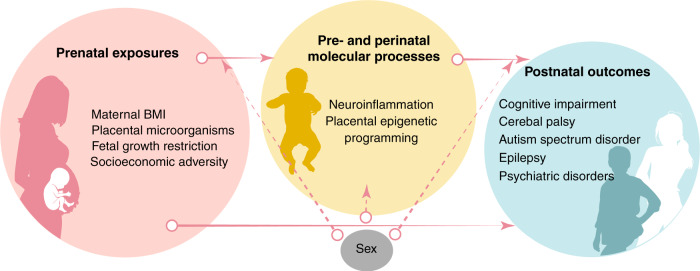
Individuals born extremely preterm are at significant risk for impaired neurodevelopment. After discharge from the neonatal intensive care, associations between the child's well-being and factors in the home and social environment become increasingly apparent. Mothers' prenatal health and socioeconomic status are associated with neurodevelopmental outcomes, and emotional and behavioral problems. Research on early life risk factors and on mechanisms underlying inter-individual differences in neurodevelopment later in life can inform the design of personalized approaches to prevention. Here, we review early life predictors of inter-individual differences in later life neurodevelopment among those born extremely preterm. Among biological mechanisms that mediate relationships between early life predictors and later neurodevelopmental outcomes, we highlight evidence for disrupted placental processes and regulated at least in part via epigenetic mechanisms, as well as perinatal inflammation. In relation to these mechanisms, we focus on four prenatal antecedents of impaired neurodevelopment, namely, (1) fetal growth restriction, (2) maternal obesity, (3) placental microorganisms, and (4) socioeconomic adversity. In the future, this knowledge may inform efforts to detect and prevent adverse outcomes in infants born extremely preterm. IMPACT: This review highlights early life risk factors and mechanisms underlying inter-individual differences in neurodevelopment later in life. The review emphasizes research on early life risk factors (fetal growth restriction, maternal obesity, placental microorganisms, and socioeconomic adversity) and on mechanisms (disrupted placental processes and perinatal inflammation) underlying inter-individual differences in neurodevelopment later in life. The findings highlighted here may inform efforts to detect and prevent adverse outcomes in infants born extremely preterm.
个体极早早产,神经发育受损风险显著。离开新生儿重症监护病房后,儿童的健康状况与家庭和社会环境中的因素之间的关联变得越来越明显。母亲的产前健康和社会经济地位与神经发育结果和情绪及行为问题相关。对生命早期危险因素和生命后期神经发育个体差异的潜在机制的研究可以为预防的个体化方法提供信息。在这里,我们综述了极早早产儿生命后期神经发育个体差异的早期生命预测因子。在介导早期生命预测因子与后期神经发育结果之间关系的生物学机制中,我们强调了胎盘过程中断的证据,以及至少部分通过表观遗传机制以及围产期炎症来调节,与这些机制相关,我们重点关注四个损害神经发育的产前前因,即(1)胎儿生长受限,(2)母体肥胖,(3)胎盘微生物,和(4)社会经济劣势。未来,这些知识可能有助于努力检测和预防极早早产儿的不良结局。影响:本综述强调了生命早期风险因素和生命后期神经发育个体差异的潜在机制。该综述强调了生命早期风险因素(胎儿生长受限、母体肥胖、胎盘微生物和社会经济劣势)和生命后期神经发育个体差异的潜在机制(胎盘过程中断和围产期炎症)的研究。这里强调的研究结果可能有助于努力检测和预防极早早产儿的不良结局。