Schabetsberger Robert, Miller Michael J, Dall'Olmo Giorgio, Kaiser Roland, Økland Finn, Watanabe Shun, Aarestrup Kim, Tsukamoto Katsumi
University of Salzburg, Department of Cell Biology, 5020 Salzburg, Austria.
College of Bioresource Sciences, Nihon University, Kanagawa 52-0880, Japan.
Mar Ecol Prog Ser. 2016 Jul 28;554:141-155. doi: 10.3354/meps11824.
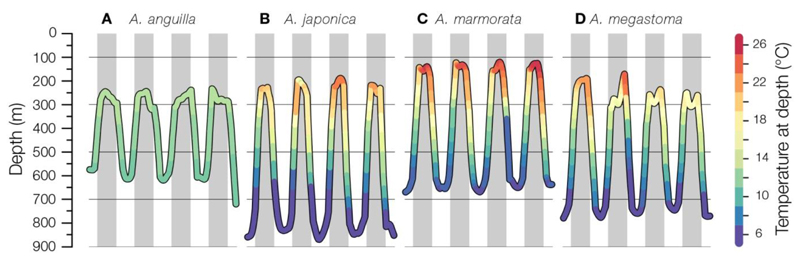
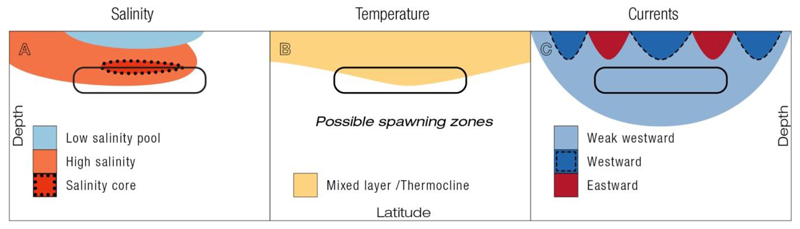
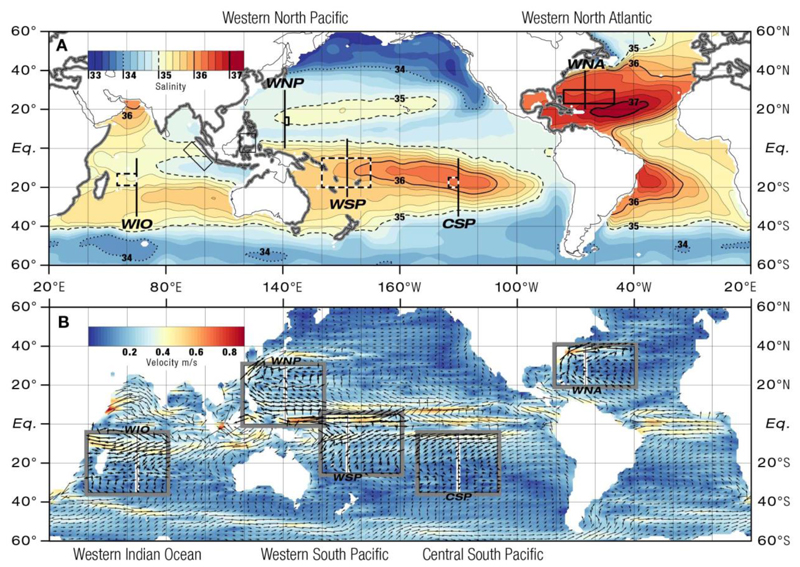
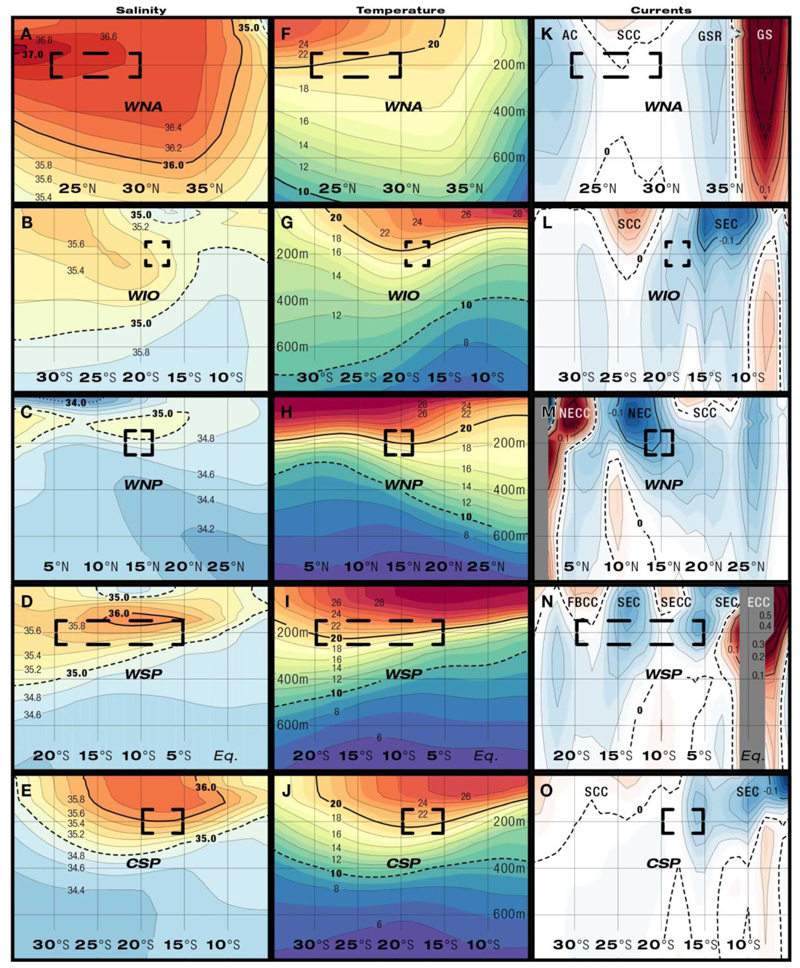
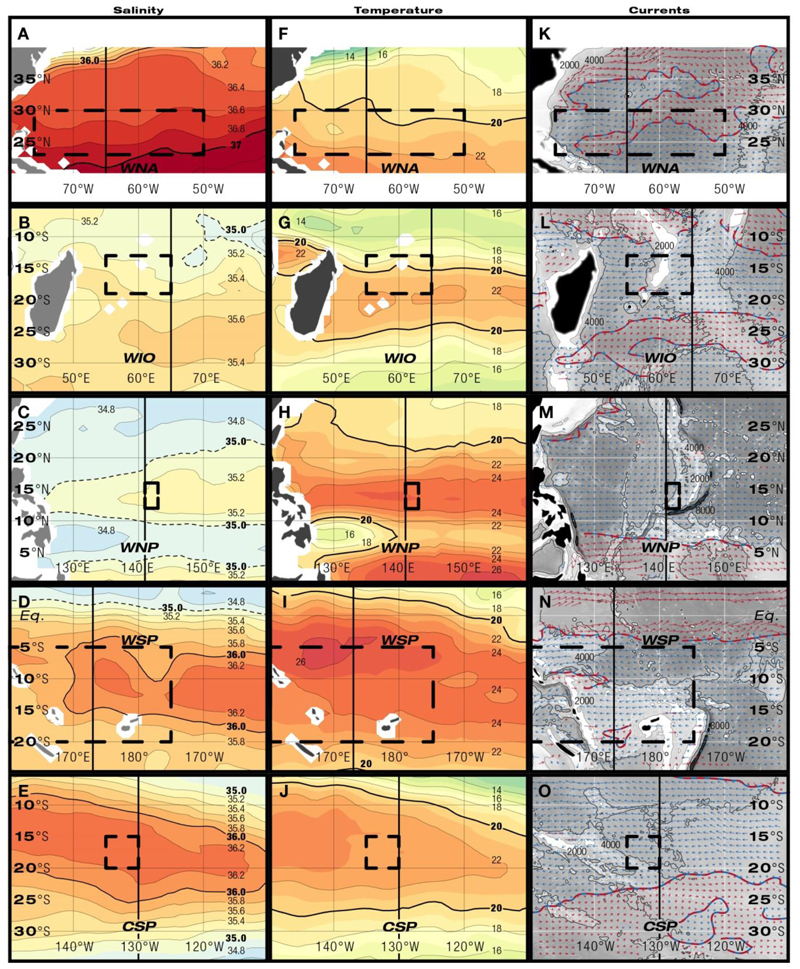
Catadromous anguillid eels (Genus ) migrate from their freshwater or estuarine habitats to marine spawning areas. Evidence from satellite tagging studies indicates that tropical and temperate eel species exhibit pronounced diel vertical migrations between 150 to 300 m nighttime depths to 600 to 800 m during the day. Collections of eggs and larvae of Japanese eels ( ) show they may spawn at these upper nighttime migration depths. How anguillid eels navigate through the ocean and find their spawning areas remains unknown, so this study describes the salinity, temperature and geostrophic currents between 0 and 800 m depths within two confirmed and three hypothetical anguillid spawning areas during likely spawning seasons. Within all four ocean gyres many eels would encounter subducted 'Subtropical Underwater' during their nighttime ascents that could provide odor plumes as signposts. Four spawning areas are located near the western margins of where subducted water masses form cores of elevated salinities (35.0 to 36.8) around 150 m depths, while one is found near the center of subduction. Low salinity surface waters and fronts are present in some of the areas above the high-salinity cores. Spawning may occur at temperatures between 16 to 24°C where the thermocline locally deepens. At spawning depths, weak westward currents (0 to 0.1 m s) prevail, and eastward surface countercurrents are present. Anguillid eels possess acute sensory capabilities to detect these hydrographic features as potential signposts guiding them to where they spawn.
降河产卵的鳗鲡(属)从它们的淡水或河口栖息地洄游到海洋产卵区。卫星标记研究的证据表明,热带和温带鳗鱼物种在夜间深度150至300米到白天600至800米之间表现出明显的昼夜垂直洄游。日本鳗鲡()的卵和幼体收集表明它们可能在这些夜间洄游的较浅深度产卵。鳗鲡如何在海洋中导航并找到它们的产卵区仍然未知,因此本研究描述了在可能的产卵季节,两个已确认和三个假设的鳗鲡产卵区内0至800米深度之间的盐度、温度和地转流。在所有四个大洋环流中,许多鳗鱼在夜间上升过程中会遇到俯冲的“亚热带潜流”,这可能会提供气味羽流作为路标。四个产卵区位于俯冲水体形成盐度升高(约35.0至36.8)核心的区域的西边缘附近,深度约为150米,而其中一个位于俯冲中心附近。在高盐度核心上方的一些区域存在低盐度表层水和锋面。产卵可能发生在温度为16至24°C的地方,此时温跃层局部加深。在产卵深度,盛行微弱的向西洋流(约0至0.1米/秒),并且存在向东的表层逆流。鳗鲡拥有敏锐的感官能力来检测这些水文特征,将其作为引导它们前往产卵地的潜在路标。