Gibbons Catherine, Blundell John, Tetens Hoff Søren, Dahl Kirsten, Bauer Robert, Baekdal Tine
Department of Psychology, University of Leeds, Leeds, UK.
Novo Nordisk A/S, Søborg, Denmark.
Diabetes Obes Metab. 2021 Feb;23(2):581-588. doi: 10.1111/dom.14255. Epub 2020 Nov 27.
To evaluate the effect of oral semaglutide on energy intake and appetite in subjects with type 2 diabetes (T2D).
In this randomized, double-blind, placebo-controlled, two-period cross-over trial, 15 subjects with T2D received 12 weeks of treatment with once-daily oral semaglutide (4-week dose escalation from 3 to 7 to 14 mg) followed by placebo, or vice versa. Energy intake was measured during an ad libitum lunch, evening meal and snack box after a standard breakfast. Appetite ratings were measured using a visual analogue scale after standard and fat-rich breakfasts. Other assessments included eating and craving control (using the Control of Eating Questionnaire), and changes in body weight and composition.
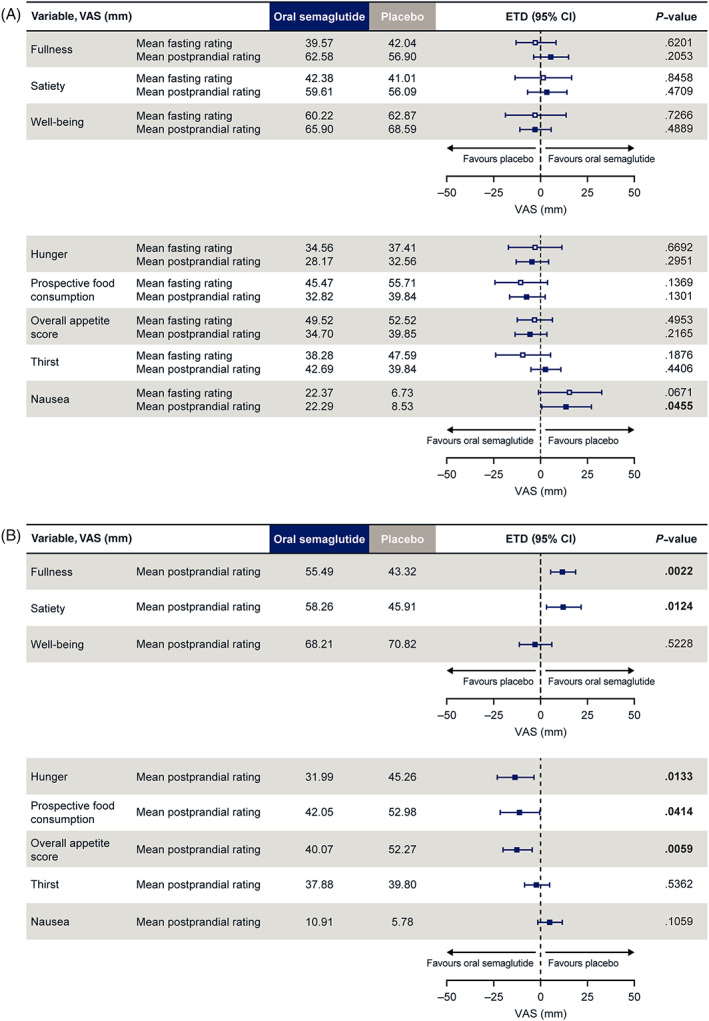
Following a standard breakfast, total daily ad libitum energy intake was significantly lower (38.9%) with oral semaglutide versus placebo in 13 evaluable subjects (estimated treatment difference, -5096.0 kJ; 95% CI -7000.0, -3192.1; P = .0001). After a fat-rich breakfast, there were significant differences in favour of oral semaglutide versus placebo for measures of satiety, hunger and for overall appetite score, with no significant differences following a standard breakfast. Fewer food cravings and better eating control were seen with oral semaglutide versus placebo. Overall, mean body weight decreased by 2.7 kg with oral semaglutide and 0.1 kg with placebo, mostly attributable to body fat mass loss.
After 12 weeks of treatment, ad libitum energy intake was lower with oral semaglutide versus placebo, resulting in reduced body fat mass, and was associated with increased satiety and fullness after a fat-rich breakfast, and improved eating control.
NCT02773381.
评估口服司美格鲁肽对2型糖尿病(T2D)患者能量摄入和食欲的影响。
在这项随机、双盲、安慰剂对照、两阶段交叉试验中,15名T2D患者接受了为期12周的治疗,先每日一次口服司美格鲁肽(剂量从3毫克逐步递增至7毫克再到14毫克,为期4周),随后服用安慰剂,或反之。在标准早餐后,通过随意午餐、晚餐和零食盒测量能量摄入。使用视觉模拟量表在标准早餐和高脂早餐后测量食欲评分。其他评估包括饮食和渴望控制(使用饮食控制问卷)以及体重和身体成分的变化。
在13名可评估的受试者中,标准早餐后,口服司美格鲁肽组的每日随意能量摄入显著低于安慰剂组(38.9%)(估计治疗差异为-5096.0千焦;95%置信区间为-7000.0,-3192.1;P = 0.0001)。高脂早餐后,在饱腹感、饥饿感和总体食欲评分方面,口服司美格鲁肽组与安慰剂组相比有显著差异,而标准早餐后无显著差异。与安慰剂相比,口服司美格鲁肽组的食物渴望更少,饮食控制更好。总体而言,口服司美格鲁肽组平均体重下降2.7千克,安慰剂组下降0.1千克,主要归因于体脂减少。
治疗12周后,口服司美格鲁肽组的随意能量摄入低于安慰剂组,导致体脂减少,且与高脂早餐后饱腹感和满足感增加以及饮食控制改善有关。
NCT02773381。