Brasil Leandro Schlemmer, Vieira Thiago Bernardi, Andrade André Felipe Alves, Bastos Rafael Costa, Montag Luciano Fogaça de Assis, Juen Leandro
Programa de Pós-Graduação em Zoologia, Universidade Federal do Pará, Belém, Pará, Brasil.
Laboratório de Ecologia e Conservação, Universidade Federal do Pará, Belém, Pará, Brasil.
Sci Rep. 2020 Nov 13;10(1):19777. doi: 10.1038/s41598-020-76833-5.
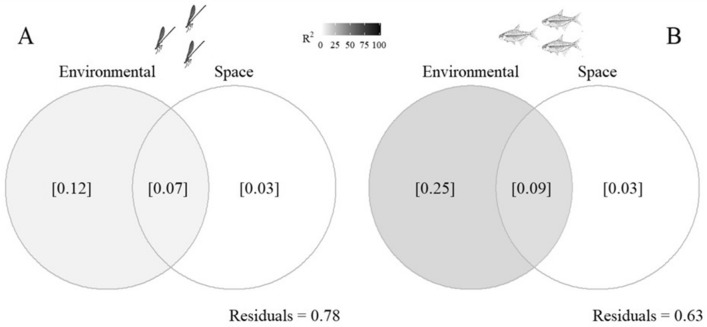
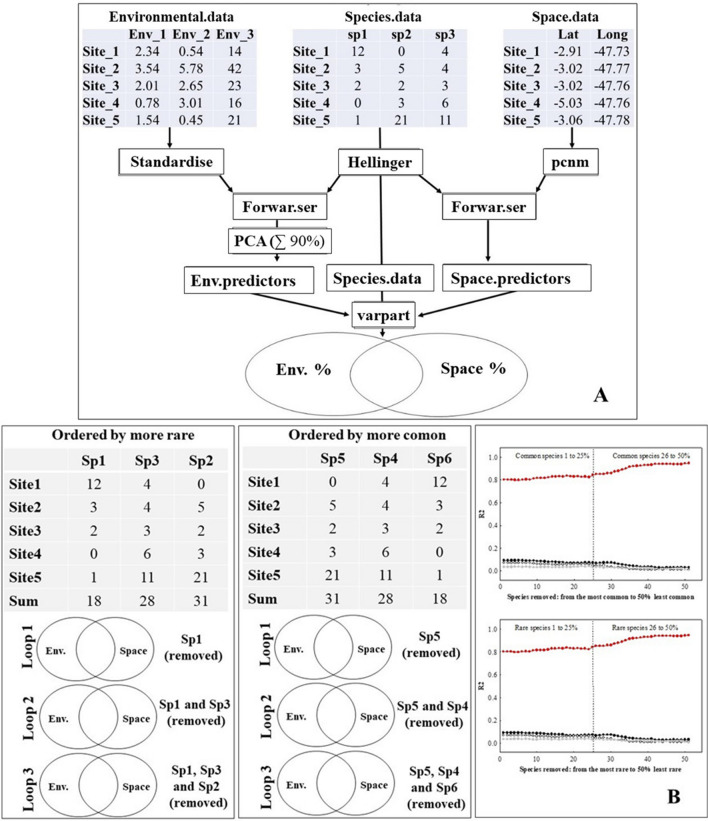
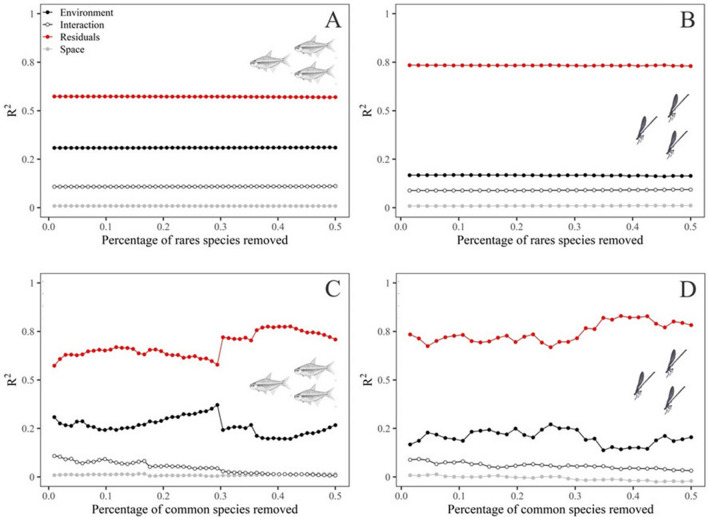
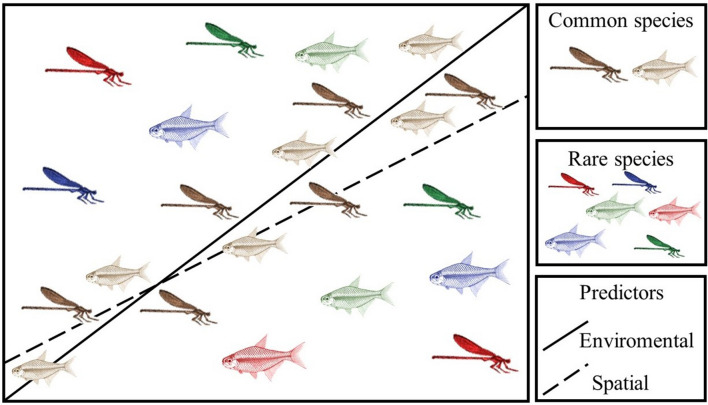
In community ecology, it is important to understand the distribution of communities along environmental and spatial gradients. However, it is common for the residuals of models investigating those relationships to be very high (> 50%). It is believed that species' intrinsic characteristics such as rarity can contribute to large residuals. The objective of this study is to test the relationship among communities and environmental and spatial predictors by evaluating the relative contribution of common and rare species to the explanatory power of models. Our hypothesis is that the residual of partition the variation of community matrix (varpart) models will decrease as rare species get removed. We used several environmental variables and spatial filters as varpart model predictors of fish and Zygoptera (Insecta: Odonata) communities in 109 and 141 Amazonian streams, respectively. We built a repetition structure, in which we gradually removed common and rare species independently. After the repetitions and removal of species, our hypothesis was not corroborated. In all scenarios, removing up to 50% of rare species did not reduce model residuals. Common species are important and rare species are irrelevant for understanding the relationships among communities and environmental and spatial gradients using varpart. Therefore, our findings suggest that studies using varpart with single sampling events that do not detect rare species can efficiently assess general distributional patterns of communities along environmental and spatial gradients. However, when the objectives concern conservation of biodiversity and functional diversity, rare species must be carefully assessed by other complementary methods, since they are not well represented in varpart models.
在群落生态学中,了解群落沿环境和空间梯度的分布情况非常重要。然而,研究这些关系的模型残差通常很高(>50%)。人们认为,物种的内在特征,如稀有性,可能导致较大的残差。本研究的目的是通过评估常见物种和稀有物种对模型解释力的相对贡献,来检验群落与环境和空间预测因子之间的关系。我们的假设是,随着稀有物种的去除,划分群落矩阵变异(varpart)模型的残差将会降低。我们分别使用了几个环境变量和空间过滤器作为varpart模型的预测因子,来分析109条和141条亚马逊河流中鱼类和蟌科(昆虫纲:蜻蜓目)群落的情况。我们构建了一个重复结构,在其中我们分别逐步去除常见物种和稀有物种。在重复去除物种之后,我们的假设并未得到证实。在所有情况下,去除高达50%的稀有物种并不会降低模型残差。使用varpart来理解群落与环境和空间梯度之间的关系时,常见物种很重要,稀有物种则无关紧要。因此,我们的研究结果表明,对于使用varpart且单次采样事件未检测到稀有物种的研究而言,它们可以有效地评估群落沿环境和空间梯度的一般分布模式。然而,当目标涉及生物多样性和功能多样性的保护时,稀有物种必须通过其他补充方法进行仔细评估,因为它们在varpart模型中没有得到很好的体现。