Center of Communicable Disease Research, Institute for Public Health, National Institutes of Health, Ministry of Health, Shah Alam, Selangor, Malaysia.
Pathology Department, Hospital Tawau, Ministry of Health Malaysia, Tawau, Sabah, Malaysia.
BMC Infect Dis. 2020 Nov 16;20(1):843. doi: 10.1186/s12879-020-05500-x.
Typhoid fever causes global morbidity and mortality and is a significant health burden, particularly in low- and middle-income countries. The direct fecal-oral route is the main transmission mode, but indirect environmental transmission could occur, particularly in urban settings. This study aimed to investigate the burden and trend of typhoid fever, reporting the coverage system between government and private practice and pattern of multidrug-resistant (MDR) typhoid cases in the urban Klang Valley area from 2011 to 2015.
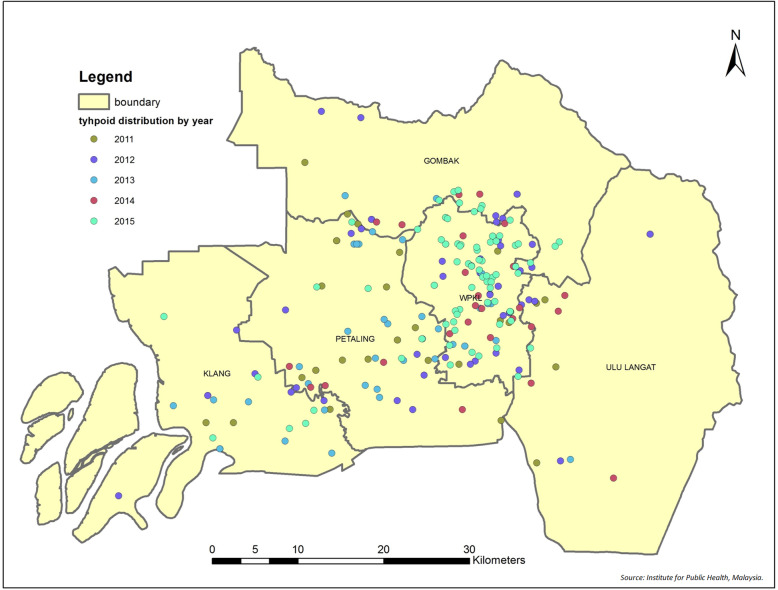
The data from a cross-sectional study retrieved from the e-Notifikasi System, a national reporting system for communicable diseases provided by the Disease Control Division, Ministry of Health Malaysia and secondary data of all the typhoid cases were obtained from the public and private hospitals and laboratories in Klang Valley. Descriptive analysis was performed to examine the sociodemographic characteristics, spatial mapping was conducted to examine trends, and the crude incidence rates of confirmed typhoid cases and percentage of reporting coverage were calculated. Significant differences between MDR and non-MDR Salmonella typhi were determined in the patient's sociodemographic characteristics, which were analyzed using χ test. P values < 0.05 were considered statistically significant.
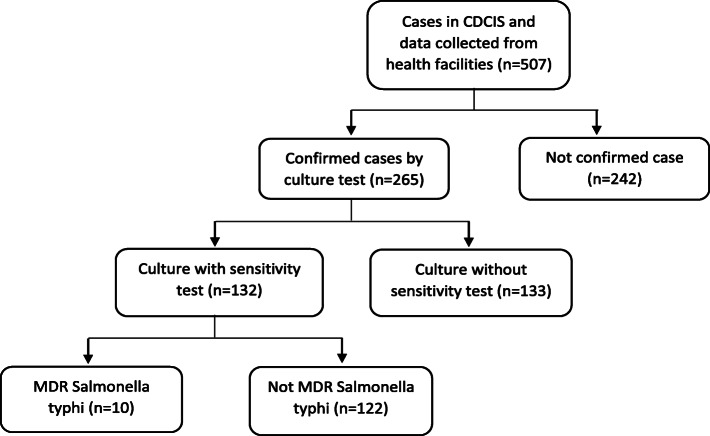
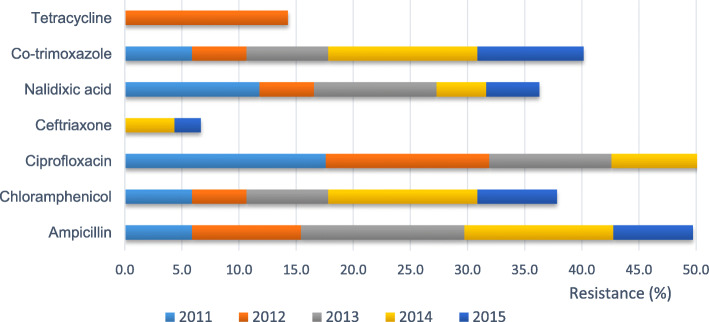
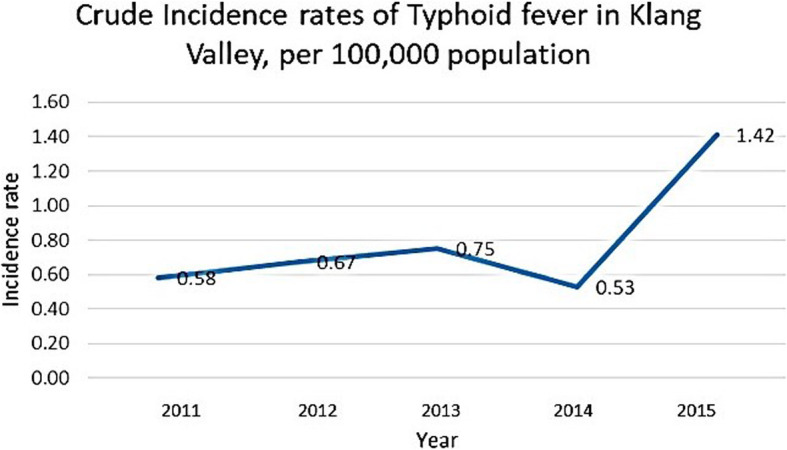
In total, 507 typhoid fever cases were reported in Klang Valley; however, only 265 cases were confirmed by culture tests. The crude incidence rates of confirmed cases were between 0.5 to 0.7 but peaked at 1.42 per 100,000 population in 2015. Most typhoid fever cases were observed among men (55.6%), individuals aged 21 to 30 years (27.6%), Malaysians (86.3%) and individuals of Malay ethnicity (52.1%). The reporting coverage of confirmed cases was 78.9% and non-reporting coverage of unconfirmed typhoid cases was 79.5%. The predictive value positive (PVP) was 89.3, and 7.5% were detected as MDR Salmonella typhi. Statistical significance was found in gender, citizenship and ethnicity regarding MDR Salmonella typhi (p = 0.004, p = 0.008 and p = 0.034, respectively).
The local transmission of typhoid is still prevalent in the Klang Valley despite rapid urbanization and development in recent years. These findings are essential for policy makers to plan and implement focused and effective preventative activities to curb typhoid infection in urban areas.
伤寒导致了全球的发病率和死亡率,是一个重大的健康负担,尤其是在低收入和中等收入国家。主要的传播途径是粪-口直接传播,但也可能发生间接的环境传播,尤其是在城市环境中。本研究旨在调查 2011 年至 2015 年期间,城市巴生谷地区伤寒的负担和趋势,报告政府和私人执业之间的覆盖系统以及多药耐药(MDR)伤寒病例的模式。
本研究的数据来自于横断面研究,从马来西亚卫生部疾病控制司提供的国家传染病报告系统电子通报系统中检索,从巴生谷的公立和私立医院和实验室获得了所有伤寒病例的二级数据。进行描述性分析以检查社会人口统计学特征,进行空间制图以检查趋势,并计算确诊伤寒病例的粗发病率和报告覆盖率。使用卡方检验分析 MDR 和非 MDR 伤寒沙门氏菌患者的社会人口统计学特征差异,P 值<0.05 被认为具有统计学意义。
在巴生谷共报告了 507 例伤寒病例,但仅通过培养试验确诊了 265 例。确诊病例的粗发病率在 0.5 至 0.7 之间,但在 2015 年达到了每 10 万人 1.42 例的峰值。大多数伤寒病例发生在男性(55.6%)、21 至 30 岁的个体(27.6%)、马来西亚人(86.3%)和马来族裔(52.1%)。确诊病例的报告覆盖率为 78.9%,未报告的非确诊伤寒病例的报告覆盖率为 79.5%。阳性预测值(PVP)为 89.3%,7.5%的病例检测为 MDR 伤寒沙门氏菌。MDR 伤寒沙门氏菌在性别、公民身份和种族方面存在统计学意义(p=0.004、p=0.008 和 p=0.034)。
尽管近年来城市化和发展迅速,但巴生谷地区的伤寒本地传播仍然很普遍。这些发现对于政策制定者规划和实施有针对性和有效的预防活动以遏制城市地区的伤寒感染至关重要。