Kanagawa Cancer Centre Hospital, Yokohama, Japan.
Department of Hepatobiliary and Pancreatic Oncology, National Cancer Center Hospital East, 6-5-1 Kashiwanoha, Kashiwa, 277-8577, Japan.
BMC Cancer. 2020 Nov 16;20(1):1105. doi: 10.1186/s12885-020-07365-4.
Biliary tract cancer (BTC) has a poor prognosis and lacks a standardized second-line therapy. Vascular endothelial growth factor (VEGF), fibroblast growth factor receptor (FGFR) 4, and platelet-derived growth factor receptor (PDGFR) are highly expressed in BTC. Therefore, lenvatinib (a known inhibitor of VEGF receptors 1-3, FGFRs 1-4, and PDGFR-α) was evaluated for second-line treatment of BTC.
In this single-arm, multicenter, open-label, phase 2 study, patients with BTC received lenvatinib 24 mg orally once daily in 28-day cycles. The primary endpoint was objective response rate (ORR). Secondary endpoints included overall survival (OS), progression-free survival (PFS), PFS rate at 12 weeks, disease control rate, clinical benefit rate, safety and pharmacokinetic profiles.
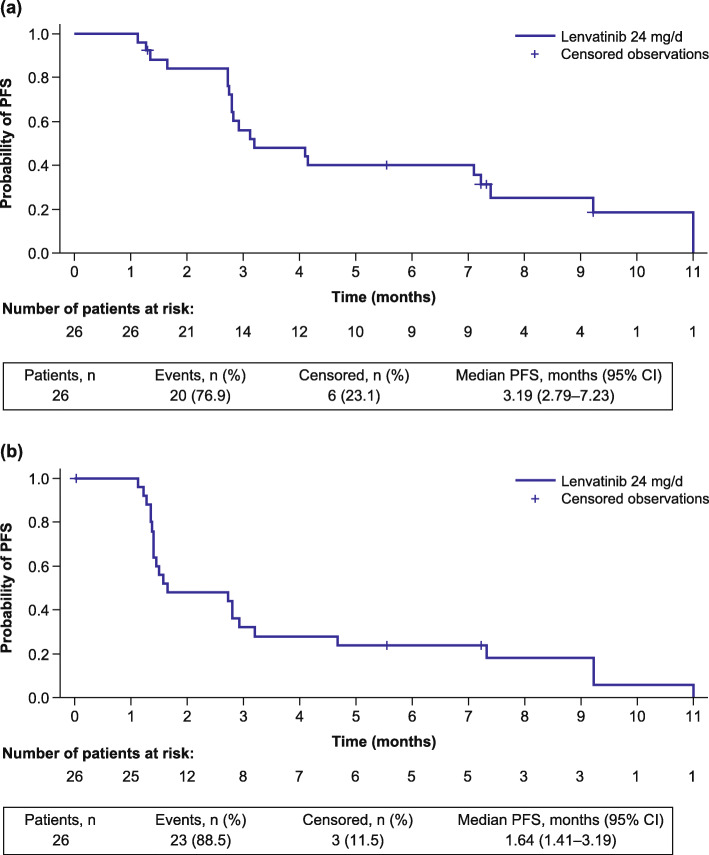
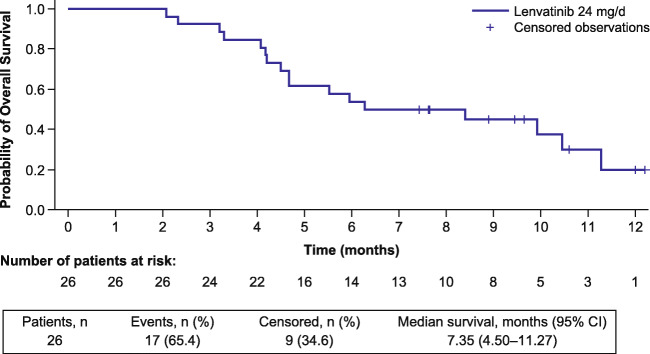
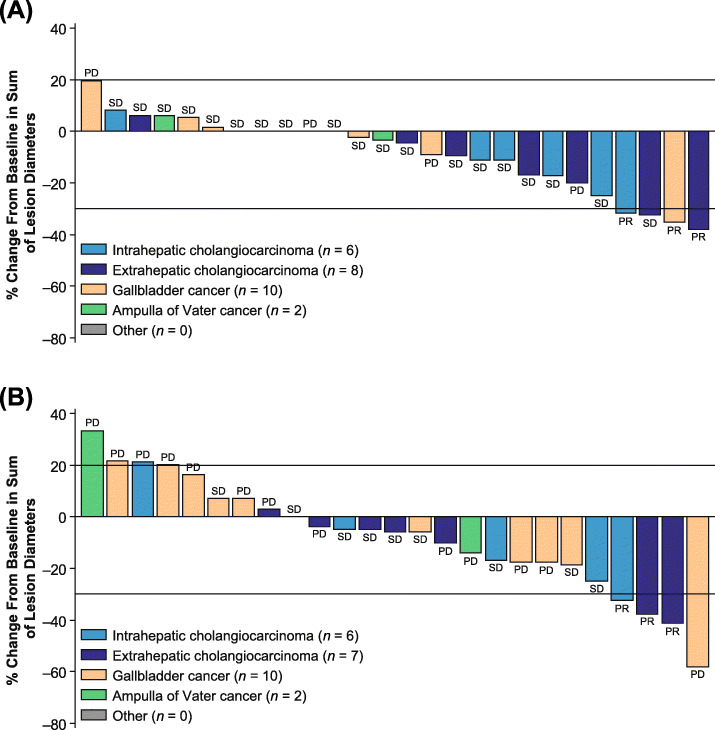
Twenty-six Japanese patients were enrolled and treated; 3 had a confirmed partial response per investigator assessment and per independent imaging review (IIR); ORR was 11.5% (90% confidence interval [CI]: 3.2-27.2). Median PFS was 3.19 months (95% CI: 2.79-7.23) per investigator assessment and 1.64 months (95% CI: 1.41-3.19) per IIR. Median OS was 7.35 months (95% CI: 4.50-11.27). Grade ≥ 3 treatment-emergent adverse events (TEAEs) occurred in 21 patients (80.8%) and included hypertension (n = 10 [38.5%]), proteinuria (n = 3 [11.5%]), palmar-plantar erythrodysesthesia (n = 3 [11.5%]), decreased appetite (n = 3 [11.5%]), and anemia (n = 3 [11.5%]). Two deaths occurred due to TEAEs between treatment initiation and 30 days after last dose, but neither were considered treatment related.
Lenvatinib demonstrated antitumor activity in BTC, with a tolerable safety profile, and should be further evaluated as potential second-line therapy for this difficult to treat population.
ClinicalTrials.gov NCT02579616 . Date of registration: October 19, 2015.
胆道癌(BTC)预后较差,缺乏标准化的二线治疗方法。血管内皮生长因子(VEGF)、成纤维细胞生长因子受体(FGFR)4 和血小板衍生生长因子受体(PDGFR)在 BTC 中高度表达。因此,仑伐替尼(一种已知的 VEGF 受体 1-3、FGFRs 1-4 和 PDGFR-α抑制剂)被评估用于 BTC 的二线治疗。
在这项单臂、多中心、开放标签、2 期研究中,BTC 患者接受仑伐替尼 24mg 口服,每日一次,28 天为一个周期。主要终点是客观缓解率(ORR)。次要终点包括总生存期(OS)、无进展生存期(PFS)、12 周时的 PFS 率、疾病控制率、临床获益率、安全性和药代动力学特征。
26 名日本患者入组并接受治疗;3 名研究者评估和独立影像学审查(IIR)确认部分缓解;ORR 为 11.5%(90%置信区间 [CI]:3.2-27.2)。研究者评估的中位 PFS 为 3.19 个月(95%CI:2.79-7.23),IIR 为 1.64 个月(95%CI:1.41-3.19)。中位 OS 为 7.35 个月(95%CI:4.50-11.27)。21 名患者(80.8%)发生≥3 级治疗相关不良事件(TEAEs),包括高血压(n=10[38.5%])、蛋白尿(n=3[11.5%])、手足红斑(n=3[11.5%])、食欲下降(n=3[11.5%])和贫血(n=3[11.5%])。在治疗开始至末次给药后 30 天内,有 2 例因 TEAEs 死亡,但均与治疗无关。
仑伐替尼在 BTC 中表现出抗肿瘤活性,安全性可耐受,应作为这种治疗困难人群的潜在二线治疗方法进一步评估。
ClinicalTrials.gov NCT02579616。注册日期:2015 年 10 月 19 日。