Division of General Surgery, Virgen del Rocío University Hospital, Av Manuel Siurot S/N, 41013, Seville, Spain.
University of Seville, Seville, Spain.
Sci Rep. 2020 Nov 16;10(1):19862. doi: 10.1038/s41598-020-74213-7.
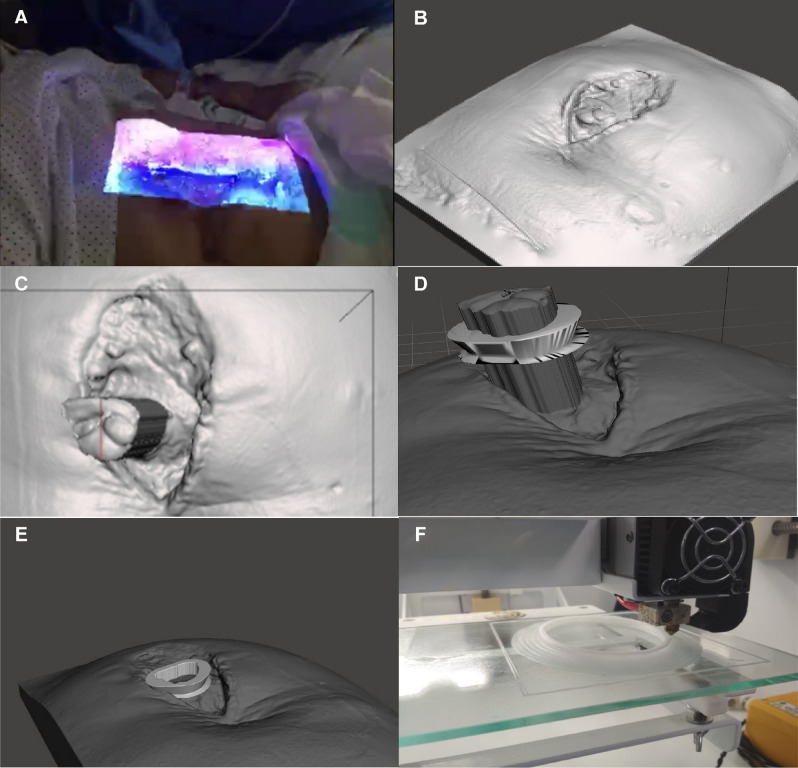
Enteroatmospheric fistulae are challenging clinical conditions that require surgical expertise and that can result in chronic debilitating conditions placing the patient in a vicious cycle characterized by non healing wounds and malnutrition. They are a complex entity that presents great variability depending on the number, shape, and size of the fistulous orifices, their debit, and the dimensions of the wound. This means that, at present, there is no device that adapts to the anatomical characteristics of each patient and manages to control the spillage of intestinal effluvium from the wound. The aim of this study is to describe the manufacturing technique and to assess the preliminary results of a custom device designed through bioscanner imaging and manufactured using 3D printing for use with negative pressure wound therapy (NPWT) in the management of enteroatmospheric fistula. A proof of concept is given, and the design of the device is presented for the first time. After obtaining images of each fistula with a bioscanner, a personalised device was designed for each patient by 3D printing shape of a prism and a hollow base, taking into account the dimensions of the fistulous area in order to perform a floating ostomy to isolate the wound from the debit enteric. The polycaprolactone (PCL) device was placed including inside the fistulous surface and surrounding it with the NPWT system in order to accelerate wound healing.
肠-皮肤瘘是具有挑战性的临床病症,需要外科专业知识,并且可能导致慢性衰弱状况,使患者陷入以伤口不愈合和营养不良为特征的恶性循环。它们是一种复杂的实体,具有很大的可变性,取决于瘘管或口的数量、形状和大小、它们的流量以及伤口的尺寸。这意味着,目前还没有一种设备能够适应每个患者的解剖学特征,并能够控制肠液从伤口溢出。本研究旨在描述一种定制设备的制造技术,并评估通过生物扫描仪成像设计并使用 3D 打印制造的、用于负压伤口治疗 (NPWT) 管理肠-皮肤瘘的初步结果。给出了一个概念验证,并首次展示了该设备的设计。通过生物扫描仪获取每个瘘管的图像后,通过 3D 打印棱柱和空心底座的形状为每个患者设计个性化设备,考虑到瘘管区域的尺寸,以便进行浮动造口术将伤口与进入的肠内容物隔离开来。将聚己内酯 (PCL) 设备放置在瘘管表面内部,并将其与 NPWT 系统一起使用,以加速伤口愈合。