Limnological Institute, University of Konstanz, Mainaustraße 252, 78464, Konstanz, Germany.
Department of Animal Ecology, Evolution and Biodiversity, Faculty of Biology and Biotechnology, Ruhr University Bochum, Universitaetsstraße 150, 44780, Bochum, Germany.
Sci Rep. 2020 Nov 16;10(1):19928. doi: 10.1038/s41598-020-77065-3.
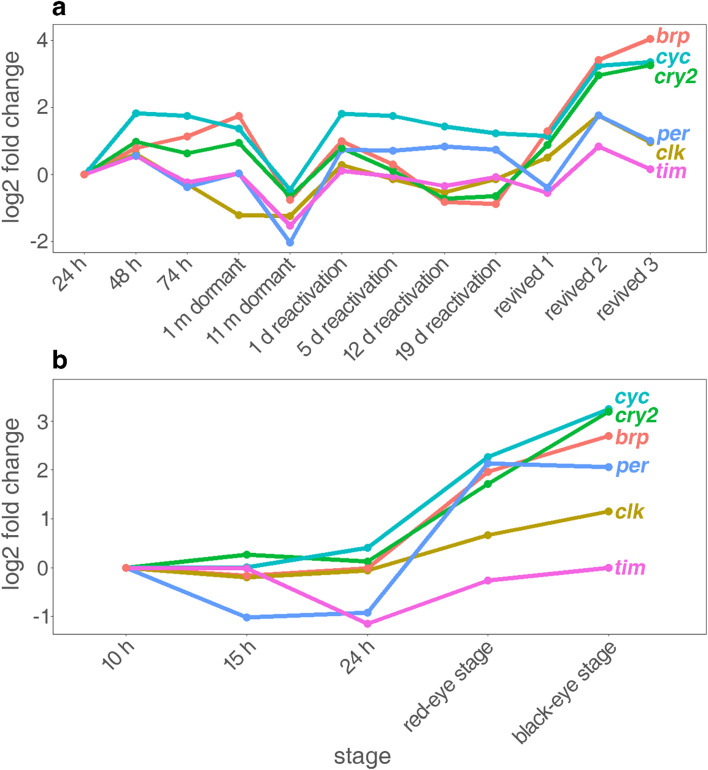
Diapause is a mechanism necessary for survival in arthropods. Often diapause induction and resurrection is light-dependent and therefore dependent on the photoperiod length and on the number of consecutive short-days. In many organisms, including the microcrustacean Daphnia magna, one functional entity with the capacity to measure seasonal changes in day-length is the circadian clock. There is a long-standing discussion that the circadian clock also controls photoperiod-induced diapause. We tested this hypothesis in D. magna, an organism which goes into a state of suspended animation with the shortening of the photoperiod. We measured gene expression of clock genes in diapause-destined embryos of D. magna in the initiation, resting and resurrection phases and checked it against gene expression levels of continuously developing embryos. We demonstrate that some genes of the clock are differentially expressed during diapause induction but not during its maintenance. Furthermore, the photoreceptor gene cry2 and the clock-associated gene brp are highly expressed during induction and early diapause, probably in order to produce excess mRNA to prepare for immediate resurrection. After resurrection, both types of embryos show a similar pattern of gene expression during development. Our study contributes significantly to the understanding of the molecular basis of diapause induction, maintenance and termination.
休眠是节肢动物生存所必需的一种机制。通常,休眠的诱导和复苏是依赖于光的,因此依赖于光周期的长度和连续短日的数量。在许多生物体中,包括小型甲壳类动物大型溞,一种具有测量日长季节性变化能力的功能实体是生物钟。长期以来,人们一直在讨论生物钟是否也控制光周期诱导的休眠。我们在大型溞中测试了这个假设,大型溞在光周期缩短时会进入休眠状态。我们测量了处于休眠状态的大型溞胚胎在休眠诱导、休眠和复苏阶段的生物钟基因的表达,并将其与连续发育胚胎的基因表达水平进行了比较。我们证明,一些生物钟基因在休眠诱导过程中差异表达,但在维持过程中不表达。此外,感光基因 cry2 和与生物钟相关的基因 brp 在诱导和早期休眠期间高度表达,可能是为了产生多余的 mRNA 为立即复苏做准备。复苏后,两种类型的胚胎在发育过程中表现出相似的基因表达模式。我们的研究对理解休眠诱导、维持和终止的分子基础做出了重要贡献。