Li Pengfan, Luo Yue, Wang Qi, Shu Shi, Chen Kanjun, Yu Donghai, Fan Chunxiang
Department of Traditional Chinese Medicine, Punan Hospital, Pudong New District, Shanghai 200125, China.
Department of Dermatology, Yueyang Hospital of Integrated Traditional Chinese and Western Medicine, Shanghai University of Traditional Chinese Medicine, Shanghai 200437, China.
Evid Based Complement Alternat Med. 2020 Nov 6;2020:2171587. doi: 10.1155/2020/2171587. eCollection 2020.
To evaluate the evidence for the efficacy and safety of acupuncture at Tianshu (ST25) for functional constipation (FC).
We systematically searched seven databases to identify randomized controlled trials of acupuncture at ST25 alone or in combination with conventional therapy in the treatment of FC. Risk ratios (RRs) and mean differences (MDs) were calculated using RevMan 5.3 with 95% confidence interval (CI).
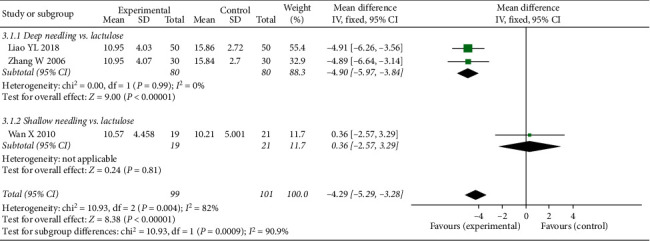
The study included ten trials with 1568 participants. Meta-analysis showed that the Cleveland Constipation Score (CCS) for deep needling was significantly lower than that for lactulose (deep needling with low-frequency dilatational wave: MD -0.58, 95% CI -0.94 to -0.22; deep needling with sparse wave: MD -3.67, 95% CI -6.40 to -0.94; deep needling with high-frequency dilatational wave: MD -3.42, 95% CI -5.03 to -1.81). Furthermore, CCS for shallow needling with high-frequency dilatational wave was lower than that for lactulose (MD -1.77, 95% CI -3.40 to -0.14). In addition, when deep needling was combined with high-frequency dilatational wave, the weekly frequency of spontaneous defecation (FSD) was significantly higher than that for lactulose (MD 1.57, 95% CI 0.93 to 2.21). Colonic Transit Time (CTT) scores were significantly higher when deep needling was combined with sparse wave (MD -14.36, 95% CI -18.31 to -10.41) or high-frequency dilatational wave (MD -11.53, 95% CI -19.25 to -3.81). The time of first defecation after treatment (TFD) of the shallow needling therapy was significantly longer than that of the lactulose (MD 13.67, 95% CI 5.66 to 21.67). The CCS 6 months after treatment (CCS6m) for deep needling was significantly lower than that for lactulose (MD -4.90, 95% CI -5.97 to -3.84). Moreover, the FSD 6 months after treatment (FSD6m) for shallow needling was significantly higher than that for lactulose (MD 0.49, 95% CI 0.02 to 0.97). The adverse event (AE) rate for lactulose was significantly higher than that achieved with the needling treatments, and this held true for both deep needling therapy (RR 0.41, 95% CI 0.23 to 0.72) and shallow needling therapy (RR 0.33, 95% CI 0.15 to 0.77).
The meta-analysis demonstrates that acupuncture at ST25 appears to be more effective than lactulose in the treatment of functional constipation. This was found to be especially true for deep needling with high-frequency dilatational wave, which had a greater impact on improving CCS, FSD, CTT, and CCS6m. Additionally, acupuncture at ST25 was shown to be safer than conventional treatment, with the rate of AE being significantly lower for both deep needling and shallow needling. The trial is registered with https://www.crd.york.ac.uk/prospero/(CRD42019141017)).
评估天枢穴(ST25)针刺治疗功能性便秘(FC)的疗效和安全性证据。
我们系统检索了七个数据库,以确定单独针刺ST25或联合传统疗法治疗FC的随机对照试验。使用RevMan 5.3计算风险比(RRs)和均值差(MDs),并给出95%置信区间(CI)。
该研究纳入了10项试验,共1568名参与者。荟萃分析表明,深刺组的克利夫兰便秘评分(CCS)显著低于乳果糖组(低频疏密波深刺:MD -0.58,95%CI -0.94至-0.22;疏波深刺:MD -3.67,95%CI -6.40至-0.94;高频疏密波深刺:MD -3.42,95%CI -5.03至-1.81)。此外,高频疏密波浅刺组的CCS低于乳果糖组(MD -1.77,95%CI -3.40至-0.14)。另外,深刺联合高频疏密波时,每周自发排便频率(FSD)显著高于乳果糖组(MD 1.57,95%CI 0.93至2.21)。深刺联合疏波或高频疏密波时,结肠传输时间(CTT)评分显著更高(疏波:MD -14.36,95%CI -18.31至-10.41;高频疏密波:MD -11.53,95%CI -19.25至-3.81)。浅刺疗法治疗后首次排便时间(TFD)显著长于乳果糖组(MD 13.67,95%CI 5.66至21.67)。深刺治疗后6个月的CCS(CCS6m)显著低于乳果糖组(MD -4.90,95%CI -5.97至-3.84)。此外,浅刺治疗后6个月的FSD(FSD6m)显著高于乳果糖组(MD 0.49,95%CI 0.02至0.97)。乳果糖的不良事件(AE)发生率显著高于针刺治疗组,深刺疗法(RR 0.41,95%CI 0.23至0.72)和浅刺疗法(RR 0.33,95%CI 0.15至0.77)均如此。
荟萃分析表明,针刺ST25治疗功能性便秘似乎比乳果糖更有效。对于高频疏密波深刺尤其如此,其对改善CCS、FSD、CTT和CCS6m有更大影响。此外,针刺ST25比传统治疗更安全,深刺和浅刺的AE发生率均显著更低。该试验已在https://www.crd.york.ac.uk/prospero/(CRD42019141017)注册。