• 文献检索
  • 文档翻译
  • 深度研究
  • 学术资讯
  • Suppr Zotero 插件Zotero 插件
  • 邀请有礼
  • 套餐&价格
  • 历史记录
应用&插件
Suppr Zotero 插件Zotero 插件浏览器插件Mac 客户端Windows 客户端微信小程序
定价
高级版会员购买积分包购买API积分包
服务
文献检索文档翻译深度研究API 文档MCP 服务
关于我们
关于 Suppr公司介绍联系我们用户协议隐私条款
关注我们

Suppr 超能文献

核心技术专利:CN118964589B侵权必究
粤ICP备2023148730 号-1Suppr @ 2026

文献检索

告别复杂PubMed语法,用中文像聊天一样搜索,搜遍4000万医学文献。AI智能推荐,让科研检索更轻松。

立即免费搜索

文件翻译

保留排版,准确专业,支持PDF/Word/PPT等文件格式,支持 12+语言互译。

免费翻译文档

深度研究

AI帮你快速写综述,25分钟生成高质量综述,智能提取关键信息,辅助科研写作。

立即免费体验

骨科领域的人工智能:是虚幻的希望还是并非如此?基于高德纳技术成熟度曲线的叙述性综述

Artificial intelligence in orthopaedics: false hope or not? A narrative review along the line of Gartner's hype cycle.

作者信息

Oosterhoff Jacobien H F, Doornberg Job N

机构信息

Department of Orthopaedic Surgery, Amsterdam UMC, University of Amsterdam, the Netherlands.

Department of Orthopaedic Surgery, Massachusetts General Hospital, Harvard Medical School, Boston, MA, USA.

出版信息

EFORT Open Rev. 2020 Oct 26;5(10):593-603. doi: 10.1302/2058-5241.5.190092. eCollection 2020 Oct.

DOI:10.1302/2058-5241.5.190092
PMID:33204501
原文链接:https://pmc.ncbi.nlm.nih.gov/articles/PMC7608572/
Abstract

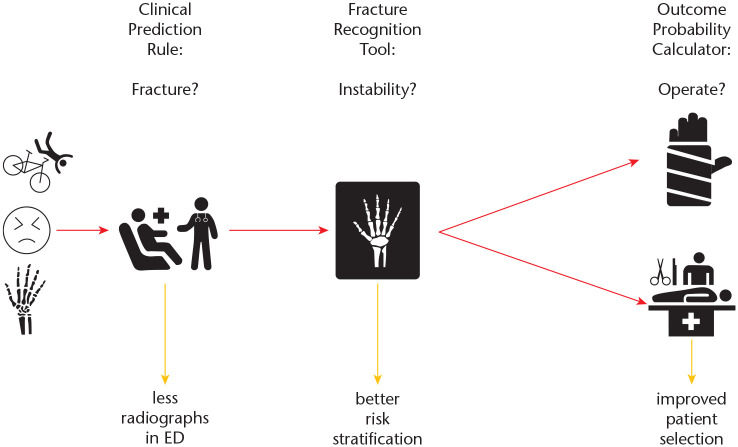
Artificial Intelligence (AI) in general, and Machine Learning (ML)-based applications in particular, have the potential to change the scope of healthcare, including orthopaedic surgery.The greatest benefit of ML is in its ability to learn from real-world clinical use and experience, and thereby its capability to improve its own performance.Many successful applications are known in orthopaedics, but have yet to be adopted and evaluated for accuracy and efficacy in patients' care and doctors' workflows.The recent hype around AI triggered hope for development of better risk stratification tools to personalize orthopaedics in all subsequent steps of care, from diagnosis to treatment.Computer vision applications for fracture recognition show promising results to support decision-making, overcome bias, process high-volume workloads without fatigue, and hold the promise of even outperforming doctors in certain tasks.In the near future, AI-derived applications are very likely to assist orthopaedic surgeons rather than replace us. 'If the computer takes over the simple stuff, doctors will have more time again to practice the art of medicine'. Cite this article: 2020;5:593-603. DOI: 10.1302/2058-5241.5.190092.

摘要

一般而言,人工智能(AI),尤其是基于机器学习(ML)的应用,有潜力改变医疗保健的范围,包括骨科手术。机器学习的最大优势在于它能够从实际临床应用和经验中学习,从而提高自身性能。骨科领域有许多成功的应用,但在患者护理和医生工作流程中的准确性和有效性方面,尚未得到采用和评估。近期围绕人工智能的炒作引发了人们的希望,即开发出更好的风险分层工具,以便在从诊断到治疗的后续所有护理步骤中实现骨科个性化。用于骨折识别的计算机视觉应用显示出了支持决策、克服偏差、处理大量工作量而不疲劳的良好结果,并且有望在某些任务中甚至超越医生。在不久的将来,人工智能衍生的应用很可能会辅助骨科医生,而不是取代我们。“如果计算机接管简单的工作,医生将再次有更多时间从事医学技艺。”引用本文:2020;5:593 - 603。DOI:10.1302/2058 - 5241.5.190092。

https://cdn.ncbi.nlm.nih.gov/pmc/blobs/9701/7608572/3d30ea030f96/eor-5-593-g005.jpg
https://cdn.ncbi.nlm.nih.gov/pmc/blobs/9701/7608572/e0d7ab892da8/eor-5-593-g001.jpg
https://cdn.ncbi.nlm.nih.gov/pmc/blobs/9701/7608572/5f8d09ff803c/eor-5-593-g002.jpg
https://cdn.ncbi.nlm.nih.gov/pmc/blobs/9701/7608572/482b5862bae7/eor-5-593-g003.jpg
https://cdn.ncbi.nlm.nih.gov/pmc/blobs/9701/7608572/da7a2bd0e84e/eor-5-593-g004.jpg
https://cdn.ncbi.nlm.nih.gov/pmc/blobs/9701/7608572/3d30ea030f96/eor-5-593-g005.jpg
https://cdn.ncbi.nlm.nih.gov/pmc/blobs/9701/7608572/e0d7ab892da8/eor-5-593-g001.jpg
https://cdn.ncbi.nlm.nih.gov/pmc/blobs/9701/7608572/5f8d09ff803c/eor-5-593-g002.jpg
https://cdn.ncbi.nlm.nih.gov/pmc/blobs/9701/7608572/482b5862bae7/eor-5-593-g003.jpg
https://cdn.ncbi.nlm.nih.gov/pmc/blobs/9701/7608572/da7a2bd0e84e/eor-5-593-g004.jpg
https://cdn.ncbi.nlm.nih.gov/pmc/blobs/9701/7608572/3d30ea030f96/eor-5-593-g005.jpg

相似文献

1
Artificial intelligence in orthopaedics: false hope or not? A narrative review along the line of Gartner's hype cycle.骨科领域的人工智能:是虚幻的希望还是并非如此?基于高德纳技术成熟度曲线的叙述性综述
EFORT Open Rev. 2020 Oct 26;5(10):593-603. doi: 10.1302/2058-5241.5.190092. eCollection 2020 Oct.
2
Meaningless Applications and Misguided Methodologies in Artificial Intelligence-Related Orthopaedic Research Propagates Hype Over Hope.人工智能相关的骨科研究中毫无意义的应用和误导性方法使炒作多于希望。
Arthroscopy. 2022 Sep;38(9):2761-2766. doi: 10.1016/j.arthro.2022.04.014. Epub 2022 May 10.
3
Machine Learning and Artificial Intelligence Applications to Epilepsy: a Review for the Practicing Epileptologist.机器学习与人工智能在癫痫中的应用:给癫痫科执业医师的综述
Curr Neurol Neurosci Rep. 2023 Dec;23(12):869-879. doi: 10.1007/s11910-023-01318-7. Epub 2023 Dec 7.
4
What Are the Applications and Limitations of Artificial Intelligence for Fracture Detection and Classification in Orthopaedic Trauma Imaging? A Systematic Review.人工智能在骨科创伤影像中骨折检测和分类的应用及局限性:系统评价。
Clin Orthop Relat Res. 2019 Nov;477(11):2482-2491. doi: 10.1097/CORR.0000000000000848.
5
Enabling Personalized Medicine in Orthopaedic Surgery Through Artificial Intelligence: A Critical Analysis Review.通过人工智能实现矫形外科的个性化医疗:批判性分析评论。
JBJS Rev. 2024 Mar 11;12(3). doi: e23.00232. eCollection 2024 Mar 1.
6
Sports Medicine and Artificial Intelligence: A Primer.运动医学与人工智能:入门指南。
Am J Sports Med. 2022 Mar;50(4):1166-1174. doi: 10.1177/03635465211008648. Epub 2021 Apr 26.
7
Artificial intelligence and computer vision in orthopaedic trauma : the why, what, and how.人工智能和计算机视觉在骨科创伤中的应用:原因、内容和方法。
Bone Joint J. 2022 Aug;104-B(8):911-914. doi: 10.1302/0301-620X.104B8.BJJ-2022-0119.R1.
8
AOA Critical Issues Symposium: Shaping the Impact of Artificial Intelligence within Orthopaedic Surgery.美国矫形外科医师学会重点问题研讨会:塑造人工智能在骨科手术中的影响力。
J Bone Joint Surg Am. 2023 Sep 20;105(18):1475-1479. doi: 10.2106/JBJS.22.01330. Epub 2023 May 12.
9
Artificial Intelligence, Machine Learning, and Surgical Science: Reality Versus Hype.人工智能、机器学习和外科科学:现实与炒作。
J Surg Res. 2021 Aug;264:A1-A9. doi: 10.1016/j.jss.2021.01.046. Epub 2021 Mar 18.
10
[Application and prospect of machine learning in orthopaedic trauma].[机器学习在骨科创伤中的应用与前景]
Zhongguo Xiu Fu Chong Jian Wai Ke Za Zhi. 2023 Dec 15;37(12):1562-1568. doi: 10.7507/1002-1892.202308064.

引用本文的文献

1
Methodology and development of a machine learning probability calculator: Data heterogeneity limits ability to predict recurrence after arthroscopic Bankart repair.机器学习概率计算器的方法与开发:数据异质性限制了关节镜下Bankart修复术后复发预测能力。
Knee Surg Sports Traumatol Arthrosc. 2025 Apr;33(4):1488-1499. doi: 10.1002/ksa.12443. Epub 2024 Sep 26.
2
The state of artificial intelligence in medical research: A survey of corresponding authors from top medical journals.人工智能在医学研究中的应用现状:对顶尖医学期刊通讯作者的调查。
PLoS One. 2024 Aug 23;19(8):e0309208. doi: 10.1371/journal.pone.0309208. eCollection 2024.
3

本文引用的文献

1
Is Deep Learning On Par with Human Observers for Detection of Radiographically Visible and Occult Fractures of the Scaphoid?深度学习在检测桡骨隐匿性和显性骨折方面与人类观察者相当吗?
Clin Orthop Relat Res. 2020 Nov;478(11):2653-2659. doi: 10.1097/CORR.0000000000001318.
2
A Machine Learning Algorithm to Predict the Probability of (Occult) Posterior Malleolar Fractures Associated With Tibial Shaft Fractures to Guide "Malleolus First" Fixation.一种用于预测与胫骨干骨折相关的(隐匿性)后踝骨折概率的机器学习算法,以指导“先固定外踝”。
J Orthop Trauma. 2020 Mar;34(3):131-138. doi: 10.1097/BOT.0000000000001663.
3
Lifecycle Regulation of Artificial Intelligence- and Machine Learning-Based Software Devices in Medicine.
Artificial intelligence assisted preoperative planning and 3D-printing guiding frame for percutaneous screw reconstruction in periacetabular metastatic cancer patients.
人工智能辅助术前规划及3D打印导向架在髋臼周围转移性癌患者经皮螺钉重建中的应用
Front Bioeng Biotechnol. 2024 Jul 29;12:1404937. doi: 10.3389/fbioe.2024.1404937. eCollection 2024.
4
A Scientometric Worldview of Artificial Intelligence in Musculoskeletal Diseases Since the 21st Century.21世纪以来肌肉骨骼疾病人工智能的科学计量学视角
J Multidiscip Healthc. 2024 Jul 9;17:3193-3211. doi: 10.2147/JMDH.S477219. eCollection 2024.
5
A survey of patient acceptability of the use of artificial intelligence in the diagnosis of paediatric fractures: an observational study.一项关于患者对人工智能在儿科骨折诊断中应用的可接受性的调查:一项观察性研究。
Ann R Coll Surg Engl. 2024 Nov;106(8):694-699. doi: 10.1308/rcsann.2024.0008. Epub 2024 Mar 13.
6
Systematic review of machine-learning models in orthopaedic trauma.骨科创伤中机器学习模型的系统评价
Bone Jt Open. 2024 Jan 16;5(1):9-19. doi: 10.1302/2633-1462.51.BJO-2023-0095.R1.
7
How AI May Transform Musculoskeletal Imaging.人工智能如何改变肌肉骨骼成像。
Radiology. 2024 Jan;310(1):e230764. doi: 10.1148/radiol.230764.
8
[Application and prospect of machine learning in orthopaedic trauma].[机器学习在骨科创伤中的应用与前景]
Zhongguo Xiu Fu Chong Jian Wai Ke Za Zhi. 2023 Dec 15;37(12):1562-1568. doi: 10.7507/1002-1892.202308064.
9
Reliability of artificial intelligence in predicting total knee arthroplasty component sizes: a systematic review.人工智能预测全膝关节置换术假体尺寸的可靠性:系统评价。
Eur J Orthop Surg Traumatol. 2024 Feb;34(2):747-756. doi: 10.1007/s00590-023-03784-8. Epub 2023 Nov 27.
10
Artificial Intelligence and Predictive Modeling in Spinal Oncology: A Narrative Review.脊柱肿瘤学中的人工智能与预测建模:一项叙述性综述。
Int J Spine Surg. 2023 Jun;17(S1):S45-S56. doi: 10.14444/8500. Epub 2023 May 10.
医学中基于人工智能和机器学习的软件设备的生命周期监管
JAMA. 2019 Dec 17;322(23):2285-2286. doi: 10.1001/jama.2019.16842.
4
Addressing Bias in Artificial Intelligence in Health Care.应对医疗保健领域人工智能中的偏见问题。
JAMA. 2019 Dec 24;322(24):2377-2378. doi: 10.1001/jama.2019.18058.
5
Machine Learning, Predictive Analytics, and Clinical Practice: Can the Past Inform the Present?机器学习、预测分析与临床实践:过去能否为当下提供借鉴?
JAMA. 2019 Dec 17;322(23):2283-2284. doi: 10.1001/jama.2019.17831.
6
How to Read Articles That Use Machine Learning: Users' Guides to the Medical Literature.如何阅读使用机器学习的文章:医学文献的用户指南。
JAMA. 2019 Nov 12;322(18):1806-1816. doi: 10.1001/jama.2019.16489.
7
Nonrandomized studies using causal-modeling may give different answers than RCTs: a meta-epidemiological study.使用因果建模的非随机研究可能会给出不同于 RCT 的答案:一项荟萃流行病学研究。
J Clin Epidemiol. 2020 Feb;118:29-41. doi: 10.1016/j.jclinepi.2019.10.012. Epub 2019 Nov 5.
8
Infographic. Can even experienced orthopaedic surgeons predict who will benefit from surgery when patients present with degenerative meniscal tears? A survey of 194 orthopaedic surgeons who made 3880 predictions.信息图。当患者出现退行性半月板撕裂时,即使是经验丰富的骨科医生能预测出谁将从手术中获益吗?一项对194名做出3880次预测的骨科医生的调查。
Br J Sports Med. 2020 May;54(9):556-557. doi: 10.1136/bjsports-2019-101502. Epub 2019 Oct 25.
9
Development and Internal Validation of Machine Learning Algorithms for Preoperative Survival Prediction of Extremity Metastatic Disease.开发和内部验证用于预测肢体转移性疾病术前生存的机器学习算法。
Clin Orthop Relat Res. 2020 Feb;478(2):322-333. doi: 10.1097/CORR.0000000000000997.
10
Natural Language Processing for the Identification of Surgical Site Infections in Orthopaedics.自然语言处理在骨科手术部位感染识别中的应用。
J Bone Joint Surg Am. 2019 Dec 18;101(24):2167-2174. doi: 10.2106/JBJS.19.00661.