National Institute of Biomedical Genomics, Kalyani, West Bengal, India.
J Leukoc Biol. 2021 Aug;110(2):357-374. doi: 10.1002/JLB.3A0120-001RRR. Epub 2020 Nov 17.
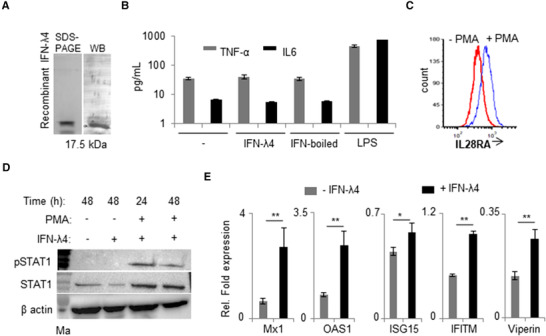
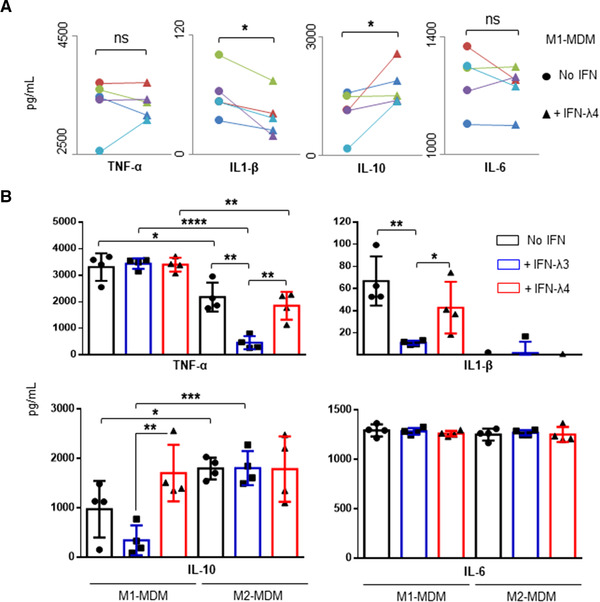
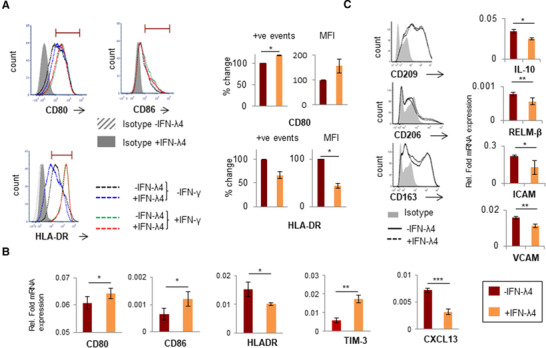
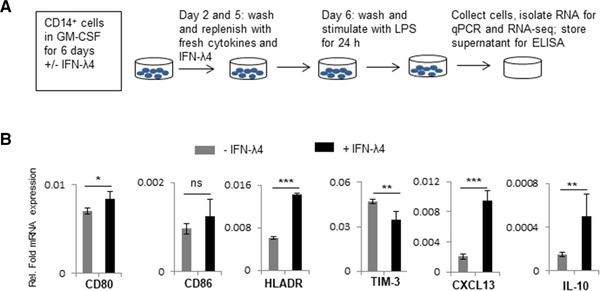
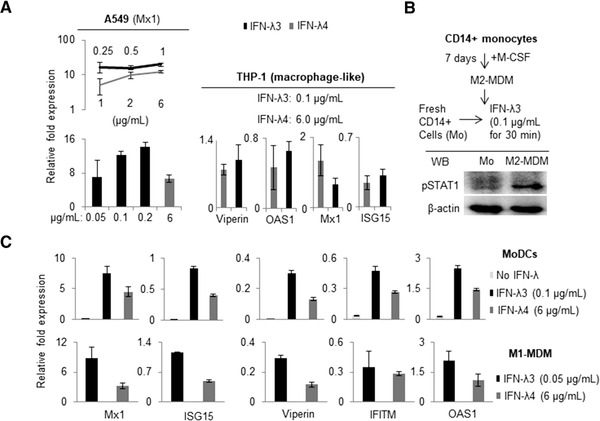
Human IFN-λ4 is expressed by only a subset of individuals who possess the ΔG variant allele at the dinucleotide polymorphism rs368234815. Recent genetic studies have shown an association between rs368234815 and different infectious and inflammatory disorders. It is not known if IFN-λ4 has immunomodulatory activity. The expression of another type III IFN, IFN-λ3, is also controlled by genetic polymorphisms that are strongly linked to rs368234815. Therefore, it is of interest to compare these two IFNs for their effects on immune cells. Herein, using THP-1 cells, it was confirmed that IFN-λ4 could affect the differentiation status of macrophage-like cells and dendritic cells (DCs). The global gene expression changes induced by IFN-λ4 were also characterized in in vitro generated primary macrophages. Next, human PBMC-derived CD14 monocytes were used to obtain M1 and M2 macrophages and DCs in the presence of IFN-λ3 or IFN-λ4. These DCs were cocultured with CD4 Th cells derived from allogenic donors and their in vitro cytokine responses were measured. The specific activity of recombinant IFN-λ4 was much lower than that of IFN-λ3, as shown by induction of IFN-stimulated genes. M1 macrophages differentiated in the presence of IFN-λ4 showed higher IL-10 secretion than those differentiated in IFN-λ3. Coculture experiments suggested that IFN-λ4 could confer a Th2-biased phenotype to allogenic Th cells, wherein IFN-λ3, under similar circumstances, did not induce a significant bias toward either a Th1 or Th2 phenotype. This study shows for the first time that IFN-λ4 may influence immune responses by immunomodulation.
人干扰素-λ4 仅在具有二核苷酸多态性 rs368234815 的 ΔG 变异等位基因的个体亚群中表达。最近的遗传研究表明,rs368234815 与不同的感染和炎症性疾病有关。目前尚不清楚 IFN-λ4 是否具有免疫调节活性。另一种 III 型 IFN,IFN-λ3 的表达也受与 rs368234815 强连锁的遗传多态性控制。因此,比较这两种 IFN 对免疫细胞的影响很有趣。在此,使用 THP-1 细胞,证实 IFN-λ4 可以影响巨噬细胞样细胞和树突状细胞(DC)的分化状态。还在体外生成的原代巨噬细胞中对 IFN-λ4 诱导的全基因表达变化进行了表征。接下来,使用人 PBMC 衍生的 CD14 单核细胞在 IFN-λ3 或 IFN-λ4 存在的情况下获得 M1 和 M2 巨噬细胞和 DC。这些 DC 与来自同种异体供体的 CD4 Th 细胞共培养,并测量其体外细胞因子反应。与 IFN-λ3 相比,重组 IFN-λ4 的特异性活性要低得多,这表现为诱导 IFN 刺激基因。在 IFN-λ4 存在下分化的 M1 巨噬细胞比在 IFN-λ3 存在下分化的巨噬细胞分泌更高水平的 IL-10。共培养实验表明,IFN-λ4 可以使同种异体 Th 细胞呈现 Th2 偏向表型,而在类似情况下,IFN-λ3 不会导致 Th1 或 Th2 表型偏向。本研究首次表明 IFN-λ4 可以通过免疫调节影响免疫反应。