Qayed Muna, Ahn Kwang Woo, Kitko Carrie L, Johnson Mariam H, Shah Nirali N, Dvorak Christopher, Mellgren Karin, Friend Brian D, Verneris Michael R, Leung Wing, Toporski Jacek, Levine John, Chewning Joseph, Wayne Alan, Kapoor Urvi, Triplett Brandon, Schultz Kirk R, Yanik Gregory A, Eapen Mary
Division of Pediatric Hematology/Oncology, Emory University School of Medicine, Atlanta, GA.
Children's Healthcare of Atlanta, Atlanta, GA.
Blood. 2021 Feb 18;137(7):983-993. doi: 10.1182/blood.2020009342.
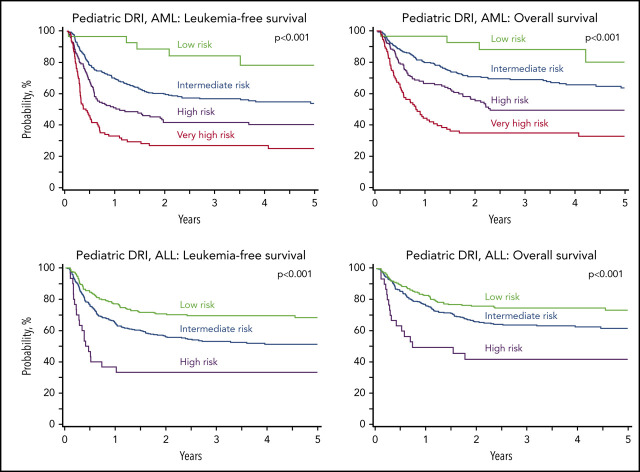
A disease risk index (DRI) that was developed for adults with hematologic malignancy who were undergoing hematopoietic cell transplantation is also being used to stratify children and adolescents by disease risk. Therefore, to develop and validate a DRI that can be used to stratify those with AML and ALL by their disease risk, we analyzed 2569 patients aged <18 years with acute myeloid (AML; n = 1224) or lymphoblastic (ALL; n = 1345) leukemia who underwent hematopoietic cell transplantation. Training and validation subsets for each disease were generated randomly with 1:1 assignment to the subsets, and separate prognostic models were derived for each disease. For AML, 4 risk groups were identified based on age, cytogenetic risk, and disease status, including minimal residual disease status at transplantation. The 5-year leukemia-free survival for low (0 points), intermediate (2, 3, 5), high (7, 8), and very high (>8) risk groups was 78%, 53%, 40%, and 25%, respectively (P < .0001). For ALL, 3 risk groups were identified based on age and disease status, including minimal residual disease status at transplantation. The 5-year leukemia-free survival for low (0 points), intermediate (2-4), and high (≥5) risk groups was 68%, 51%, and 33%, respectively (P < .0001). We confirmed that the risk groups could be applied to overall survival, with 5-year survival ranging from 80% to 33% and 73% to 42% for AML and ALL, respectively (P < .0001). This validated pediatric DRI, which includes age and residual disease status, can be used to facilitate prognostication and stratification of children with AML and ALL for allogeneic transplantation.
一种为接受造血细胞移植的血液系统恶性肿瘤成人患者开发的疾病风险指数(DRI),也正被用于按疾病风险对儿童和青少年进行分层。因此,为了开发并验证一种可用于按疾病风险对急性髓系白血病(AML)和急性淋巴细胞白血病(ALL)患者进行分层的DRI,我们分析了2569例年龄小于18岁、患有急性髓系白血病(AML;n = 1224)或淋巴细胞白血病(ALL;n = 1345)并接受造血细胞移植的患者。每种疾病的训练集和验证集通过1:1分配随机生成,并且为每种疾病推导了单独的预后模型。对于AML,根据年龄、细胞遗传学风险和疾病状态,包括移植时的微小残留病状态,确定了4个风险组。低风险(0分)、中风险(2、3、5分)、高风险(7、8分)和极高风险(>8分)组的5年无白血病生存率分别为78%、53%、40%和25%(P <.0001)。对于ALL,根据年龄和疾病状态,包括移植时的微小残留病状态,确定了3个风险组。低风险(0分)、中风险(2 - 4分)和高风险(≥5分)组的5年无白血病生存率分别为68%、51%和33%(P <.0001)。我们证实这些风险组可应用于总生存率,AML和ALL的5年生存率分别为80%至33%和73%至42%(P <.0001)。这种经过验证的儿科DRI,包括年龄和残留病状态,可用于促进AML和ALL患儿异基因移植的预后评估和分层。