Mhlongo Msizi I, Piater Lizelle A, Steenkamp Paul A, Labuschagne Nico, Dubery Ian A
Department of Biochemistry, University of Johannesburg, P.O. Box 524, Auckland Park, Johannesburg 2006, South Africa.
Department of Plant and Soil Sciences, University of Pretoria, Private Bag X20, Hatfield, Pretoria 0028, South Africa.
Metabolites. 2020 Nov 16;10(11):466. doi: 10.3390/metabo10110466.
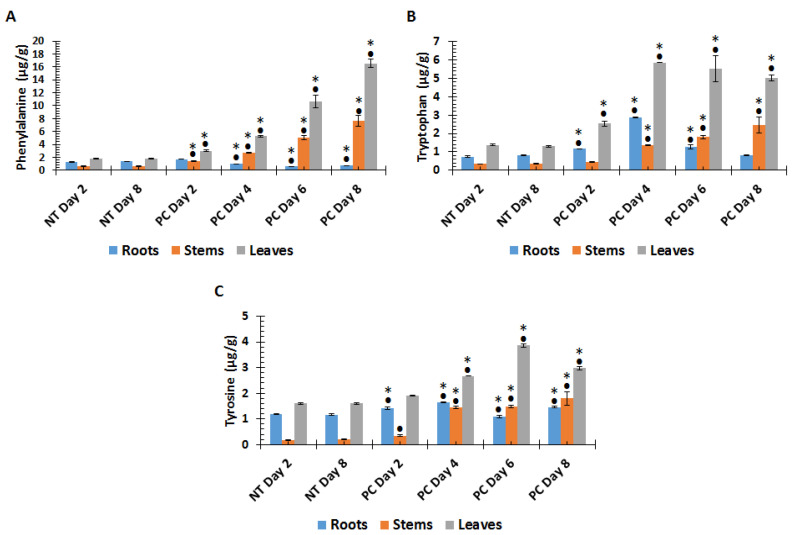
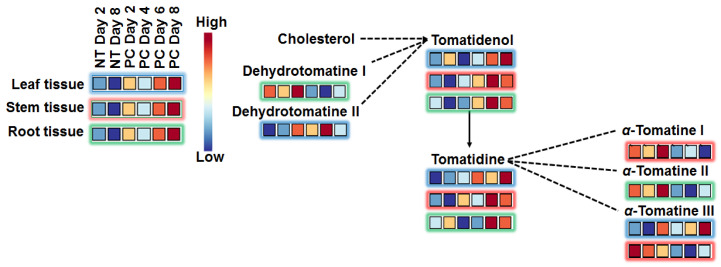
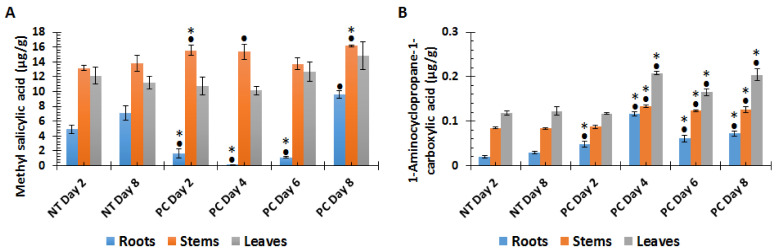
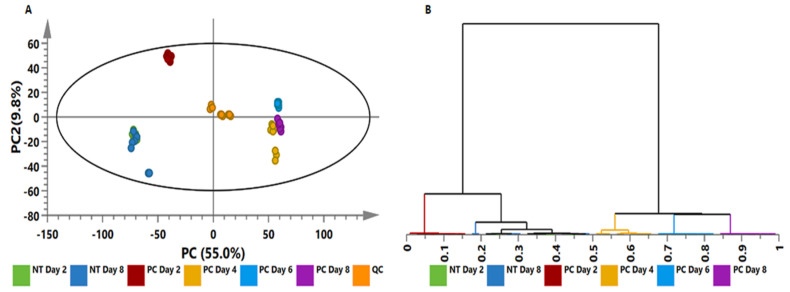
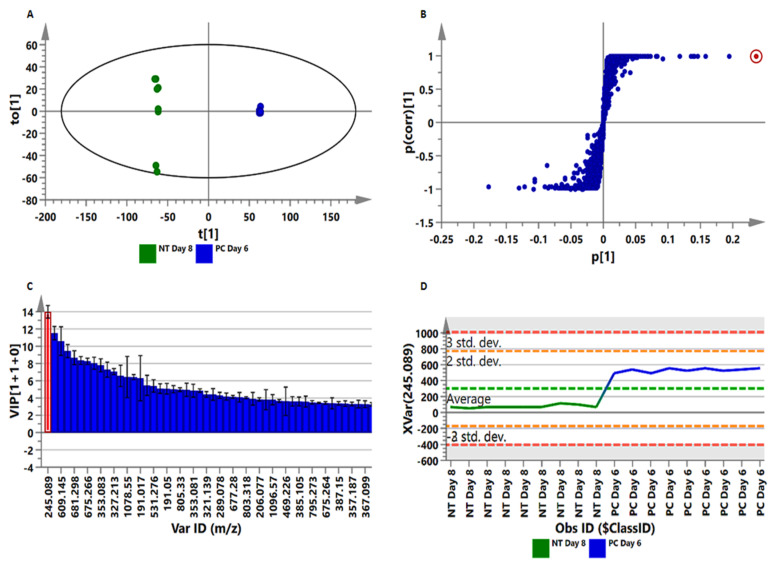
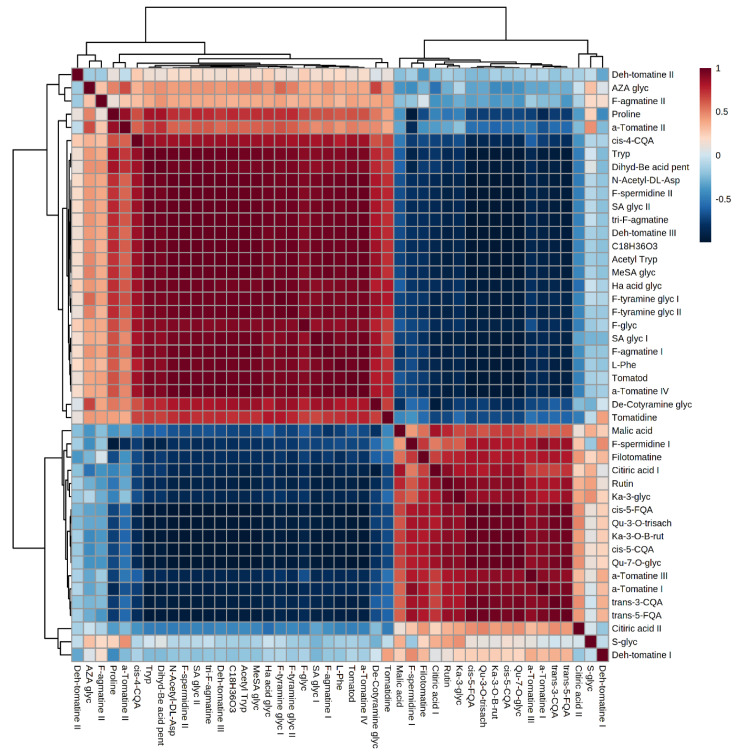
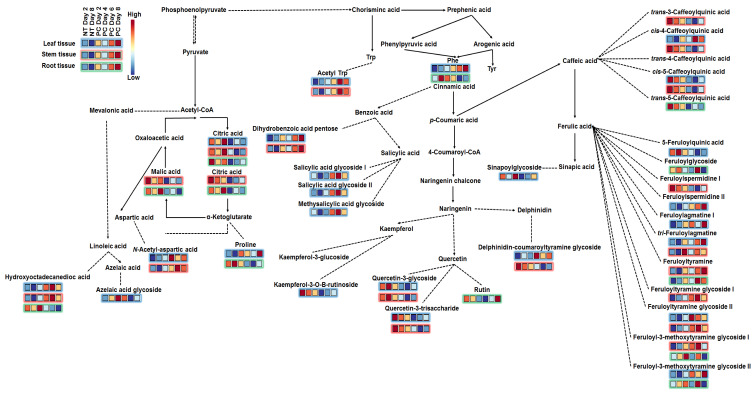
Pathogenic microorganisms account for large production losses in the agricultural sector. is an oomycete that causes blight and fruit rot in important crops, especially those in the Solanaceae family. infection is difficult to control due to genetic diversity, arising from sexual reproduction, and resistant spores that remain dormant in soil. In this study, the metabolomics of tomato plants responding to infection by were investigated. Non-targeted metabolomics, based on liquid chromatography coupled to mass spectrometry (LC-MS), were used with multivariate data analyses to investigate time-dependent metabolic reprogramming in the roots, stems, and leaves of stem-infected plants, over an 8 day period. In addition, phytohormones and amino acids were determined using quantitative LC-MS. Methyl salicylate and 1-aminocyclopropane-1-carboxylate were detected as major signalling molecules in the defensive response to . As aromatic amino acid precursors of secondary metabolic pathways, both phenylalanine and tryptophan showed a continuous increase over time in all tissues, whereas tyrosine peaked at day 4. Non-targeted metabolomic analysis revealed phenylpropanoids, benzoic acids, glycoalkaloids, flavonoids, amino acids, organic acids, and fatty acids as the major classes of reprogrammed metabolites. Correlation analysis showed that metabolites derived from the same pathway, or synthesised by different pathways, could either have a positive or negative correlation. Furthermore, roots, stems, and leaves showed contrasting time-dependent metabolic reprogramming, possibly related to the biotrophic vs. necrotrophic life-stages of the pathogen, and overlapping biotic and abiotic stress signaling. As such, the targeted and untargeted approaches complemented each other, to provide a detailed view of key time-dependent metabolic changes, occurring in both the asymptomatic and symptomatic stages of infection.
病原微生物给农业部门造成了巨大的生产损失。疫霉菌是一种卵菌,会导致重要作物,尤其是茄科作物发生疫病和果实腐烂。由于有性繁殖产生的遗传多样性以及在土壤中保持休眠状态的抗性孢子,疫霉菌感染难以控制。在本研究中,对番茄植株响应疫霉菌感染的代谢组学进行了研究。基于液相色谱-质谱联用(LC-MS)的非靶向代谢组学方法与多变量数据分析一起,用于研究茎部感染植株的根、茎和叶在8天时间内随时间变化的代谢重编程。此外,使用定量LC-MS测定了植物激素和氨基酸。水杨酸甲酯和1-氨基环丙烷-1-羧酸被检测为对疫霉菌防御反应中的主要信号分子。作为次生代谢途径的芳香族氨基酸前体,苯丙氨酸和色氨酸在所有组织中均随时间持续增加,而酪氨酸在第4天达到峰值。非靶向代谢组学分析表明,苯丙烷类、苯甲酸、糖苷生物碱、黄酮类、氨基酸、有机酸和脂肪酸是重编程代谢物的主要类别。相关性分析表明,源自同一途径或由不同途径合成的代谢物可能具有正相关或负相关。此外,根、茎和叶表现出不同的时间依赖性代谢重编程,这可能与病原体的活体营养型与死体营养型生活阶段以及重叠的生物和非生物胁迫信号有关。因此,靶向和非靶向方法相互补充,以详细了解感染无症状和有症状阶段发生的关键时间依赖性代谢变化。