Choi Jin Haeng, Kim Gimin, Lim Deok Won, Park Chandeok
Department of Astronomy, Yonsei University, Seoul 03722, Korea.
GNSS R&D Division, Korea Aerospace Research Institute, Daejeon 34133, Korea.
Sensors (Basel). 2020 Nov 16;20(22):6544. doi: 10.3390/s20226544.
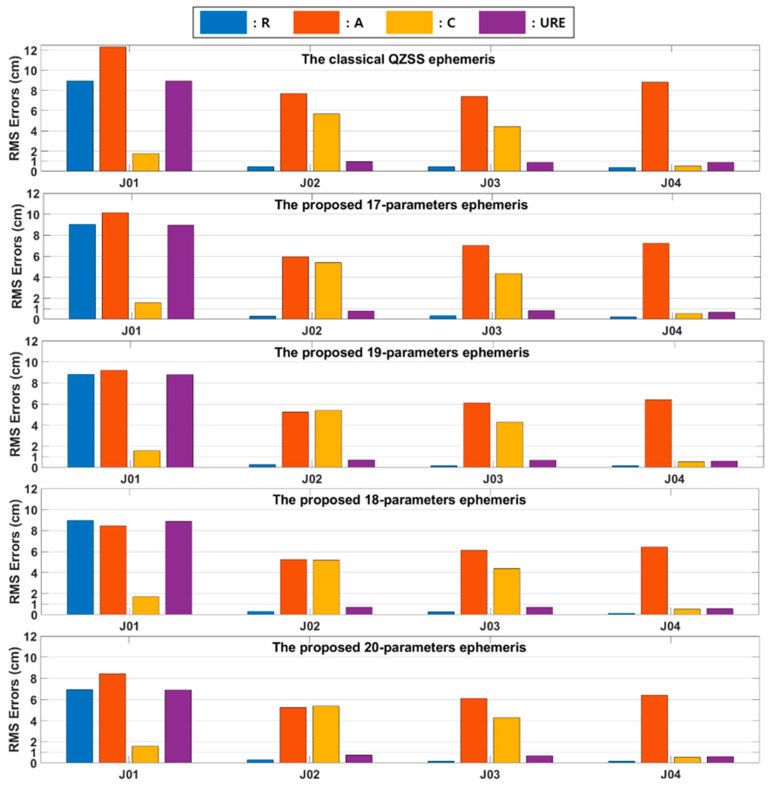
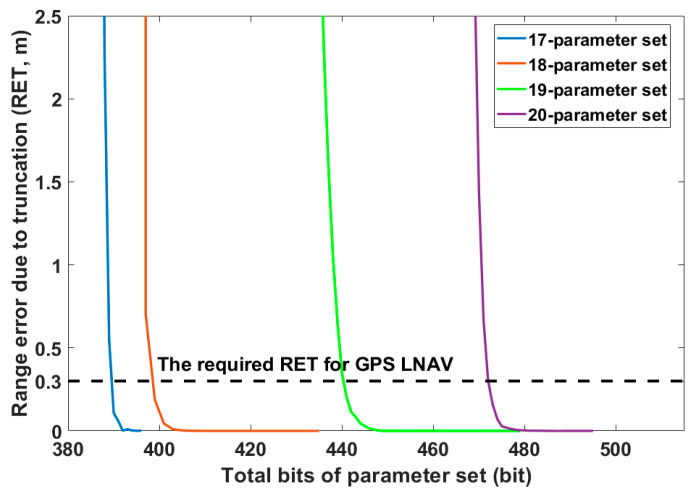
This paper proposes new sets of suitable broadcast ephemeris parameters for geosynchronous (GEO) and inclined geosynchronous (IGSO) navigation satellites (NSs). Despite the increasing number of GEO and IGSO NSs, global positioning system (GPS)-type ephemeris parameters are still widely used for them. In an effort to provide higher fit accuracy, we analyze a variety of broadcast ephemeris parameters for GEO and IGSO satellites along with their orbital characteristics and propose optimal sets of parameters. Nonsingular elements and orbital plane rotation are adopted for alleviating/avoiding the singularity issues of GEO satellites. On the basis of 16 parameters of GPS LNAV, we add one to four parameters out of 28 correction ones to determine optimal sets of ephemeris parameters providing higher accuracy. All possible parameter sets are tested with the least-square curve fit for four BeiDou GEOs and six BeiDou IGSOs. Their fit accuracies are compared to determine the optimal broadcast ephemeris parameters that provide minimum fit errors. The set of optimal ephemeris parameters depends on the type of orbit. User range error (URE) accuracies of the proposed optimal ephemeris parameters ensure results within 2.4 cm for IGSO and 3.8 cm for GEO NSs. Moreover, the experimental results present common parameter sets for both IGSO and GEO for compatibility and uniformity. Compared with four conventional/well-known sets of ephemeris parameters for BeiDou, our proposed parameters can enhance accuracies of up to 34.5% in terms of URE. We also apply the proposed optimal parameter sets to one GEO and three IGSO satellites of QZSS. The effects of fitting intervals, number of parameters, total bits, and orbit types on the fit accuracy are addressed in detail.
本文针对地球同步轨道(GEO)和倾斜地球同步轨道(IGSO)导航卫星(NS)提出了新的适用广播星历参数集。尽管GEO和IGSO NS的数量不断增加,但全球定位系统(GPS)类型的星历参数仍被广泛用于这些卫星。为了提供更高的拟合精度,我们分析了GEO和IGSO卫星的各种广播星历参数及其轨道特性,并提出了最佳参数集。采用无奇点元素和轨道平面旋转来缓解/避免GEO卫星的奇点问题。在GPS LNAV的16个参数的基础上,从28个校正参数中添加1至4个参数,以确定提供更高精度的最佳星历参数集。对所有可能的参数集进行最小二乘曲线拟合测试,对象为四颗北斗GEO卫星和六颗北斗IGSO卫星。比较它们的拟合精度,以确定提供最小拟合误差的最佳广播星历参数。最佳星历参数集取决于轨道类型。所提出的最佳星历参数的用户测距误差(URE)精度确保IGSO卫星的结果在2.4厘米以内,GEO NS卫星的结果在3.8厘米以内。此外,实验结果给出了IGSO和GEO的通用参数集,以实现兼容性和一致性。与北斗的四个传统/知名星历参数集相比,我们提出的参数在URE方面可将精度提高多达34.5%。我们还将所提出的最佳参数集应用于QZSS的一颗GEO卫星和三颗IGSO卫星。详细讨论了拟合间隔、参数数量、总比特数和轨道类型对拟合精度的影响。