From the Departments of Nuclear Medicine and Tracer Kinetics.
Urology, Graduate School of Medicine, Osaka University, Osaka, Japan.
Clin Nucl Med. 2021 Jan;46(1):49-51. doi: 10.1097/RLU.0000000000003400.
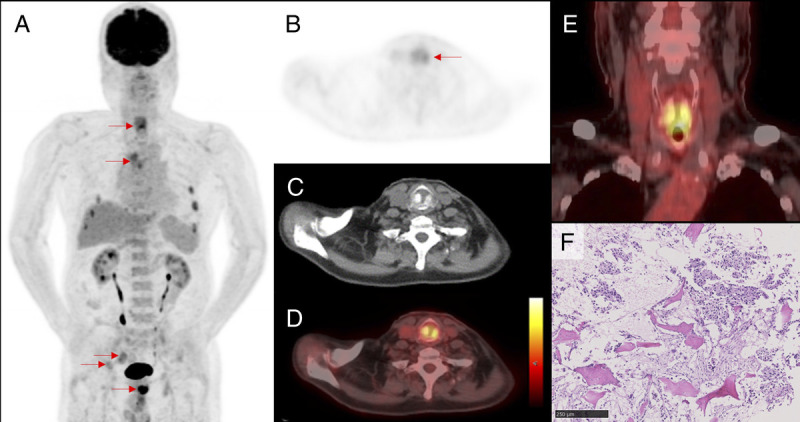
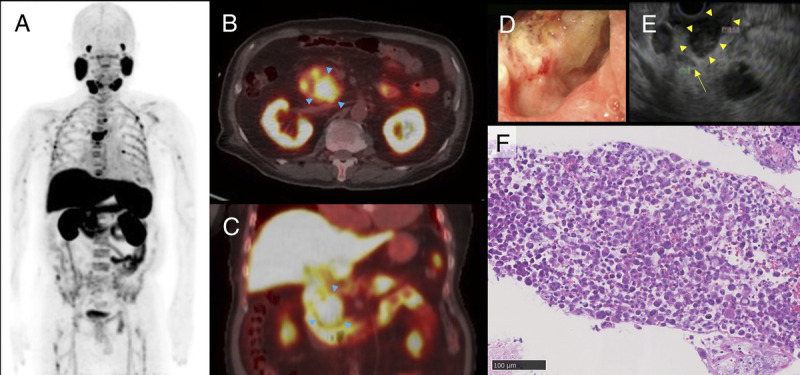
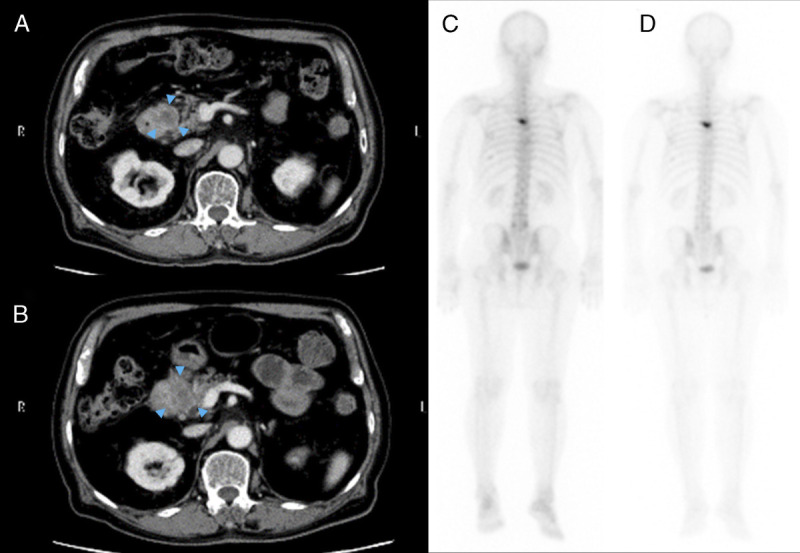
A 76-year-old man with dyspnea (initial prostate-specific antigen [PSA]: 216 ng/mL) underwent F-FDG PET/CT, with uptake in the prostate, lymph nodes, fifth thoracic vertebra (T5), and cricoid cartilage. A biopsy revealed prostate adenocarcinoma (Gleason score 4 + 5, cT4 N1 M1). On initiation of combined androgen blockade therapy, PSA value decreased. However, 4 years later, in a castration-resistant state (PSA 2.14 ng/mL), CT and bone scintigraphy revealed a duodenal tumor and T5 metastasis. F-prostate-specific membrane antigen-1007 PET/CT showed uptake in the already known T5 metastasis (SUVmax, 33.55) and even in the duodenal tumor (16.55). The latter was histologically diagnosed as duodenal adenocarcinoma.
一位 76 岁的男性患者因呼吸困难就诊(初始前列腺特异性抗原 [PSA]:216ng/mL),行 F-FDG PET/CT 检查,结果显示前列腺、淋巴结、第五胸椎(T5)和环状软骨摄取增加。活检显示前列腺腺癌(Gleason 评分 4+5,cT4N1M1)。开始联合雄激素阻断治疗后,PSA 值下降。然而,4 年后,患者处于去势抵抗状态(PSA 2.14ng/mL),CT 和骨扫描显示十二指肠肿瘤和 T5 转移。F-前列腺特异性膜抗原-1007 PET/CT 显示已知的 T5 转移(SUVmax,33.55)和十二指肠肿瘤(16.55)摄取增加。后者经组织学诊断为十二指肠腺癌。