Erasmus MC, University Medical Center Rotterdam, Rotterdam.
Isala Hospital, Zwolle, The Netherlands.
Int J Rehabil Res. 2021 Mar 1;44(1):32-37. doi: 10.1097/MRR.0000000000000443.
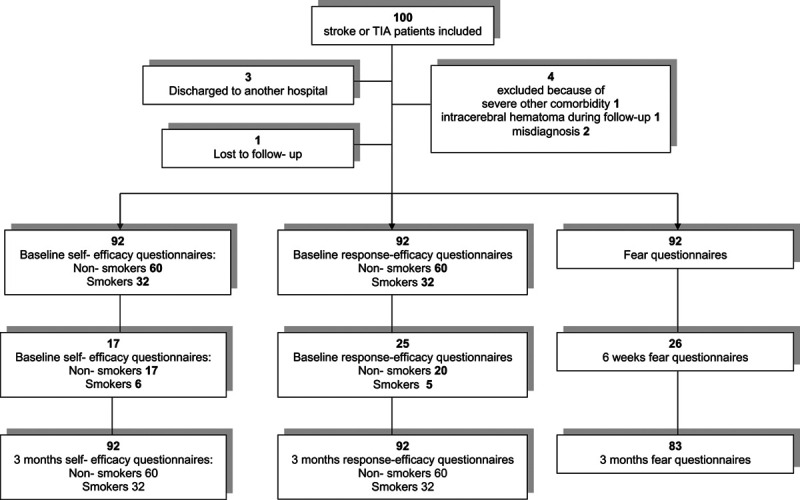
The optimal timing of an intervention to support health-related behavior after transient ischemic attack (TIA) or ischemic stroke is unknown. We aimed to assess determinants of patients' health-related intention to change over time. We prospectively studied 100 patients with TIA or minor ischemic stroke. Patients completed questionnaires on fear, response-efficacy (belief that lifestyle change reduces risk of recurrent stroke), and self-efficacy (patients' confidence to carry out lifestyle behavior) for behavior change, at baseline, 6 weeks and at 3 months after their TIA or ischemic stroke. We studied differences between these determinants at each visit by means of Wilcoxon signed-rank tests. Median self-efficacy score at baseline was 4.3 [interquartile range (IQ) 3.9-4.7], median fear 16 (IQ 7-21), and response-efficacy 10 (9-12). Fear was significantly higher at baseline than at 3 months (mean difference 2.0; 95% confidence interval: 0.78-3.9) and started to decrease after 6 weeks. No change in self-efficacy or response-efficacy was found. Since fear significantly decreased over time after TIA or ischemic stroke and self-efficacy and response-efficacy scores remained high, the optimal moment to start an intervention to support patients in health-related behavior change after TIA or ischemic stroke seems directly after the stroke or TIA.
干预以支持短暂性脑缺血发作(TIA)或缺血性卒中后与健康相关的行为的最佳时机尚不清楚。我们旨在评估患者健康相关意向随时间变化的决定因素。我们前瞻性研究了 100 例 TIA 或小面积缺血性卒中患者。患者在 TIA 或缺血性卒中后基线、6 周和 3 个月时完成了关于恐惧、反应效能(相信生活方式改变可降低复发性卒中风险)和自我效能(患者进行生活方式行为的信心)的问卷,用于行为改变。我们通过 Wilcoxon 符号秩检验研究了每个访视时这些决定因素之间的差异。基线时自我效能评分的中位数为 4.3[四分位距(IQR)3.9-4.7],恐惧中位数为 16(IQR 7-21),反应效能中位数为 10(9-12)。与 3 个月时相比,基线时恐惧明显更高(平均差异 2.0;95%置信区间:0.78-3.9),并在 6 周后开始下降。自我效能或反应效能均未发现变化。由于 TIA 或缺血性卒中后恐惧随时间显著下降,而自我效能和反应效能评分保持较高,因此开始支持 TIA 或缺血性卒中后患者健康相关行为改变的干预措施的最佳时机似乎直接在卒中或 TIA 后。