Payrató-Borràs Clàudia, Hernández Laura, Moreno Yamir
Laboratoire de Physique Théorique et Modélisation UMR08089 CNRS-CY Cergy-Paris University Cergy-Pontoise Cedex France.
Institute for Biocomputation and Physics of Complex Systems (BIFI) University of Zaragoza Zaragoza Spain.
Ecol Evol. 2020 Oct 22;10(21):11906-11921. doi: 10.1002/ece3.6663. eCollection 2020 Nov.
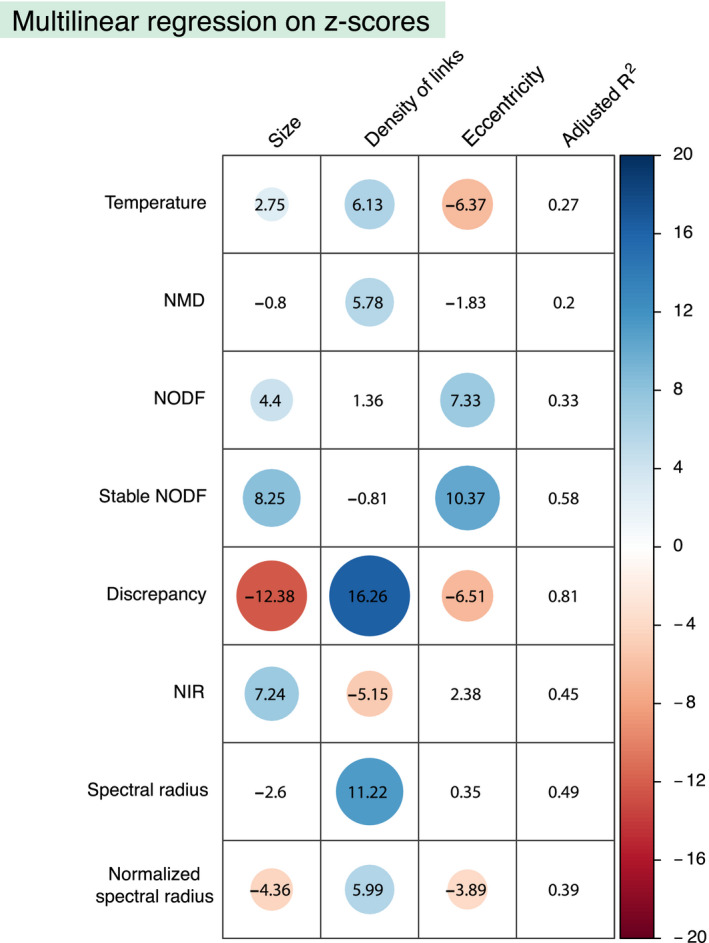
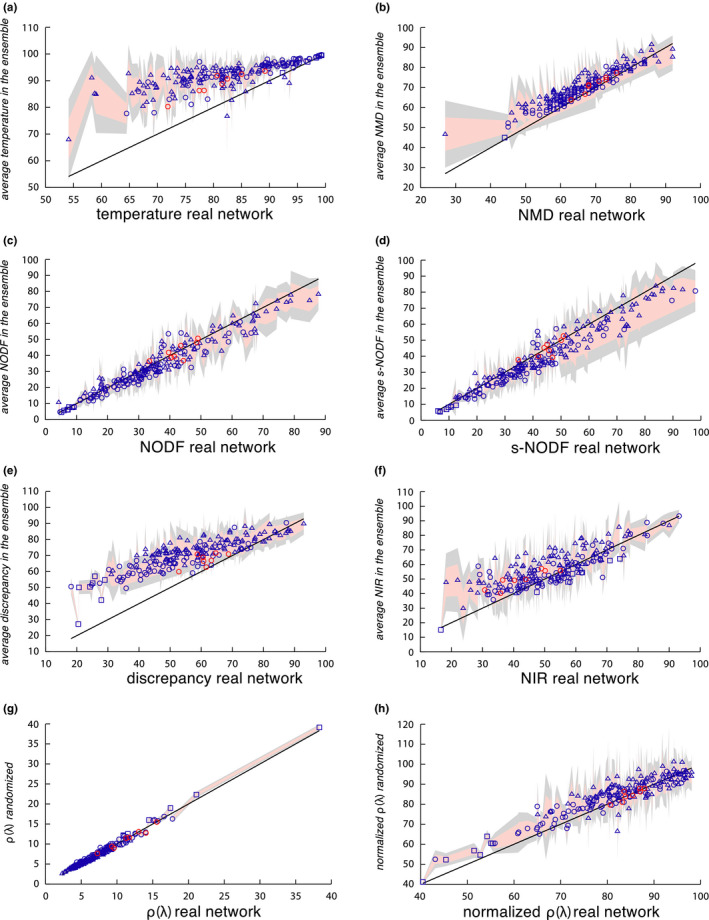
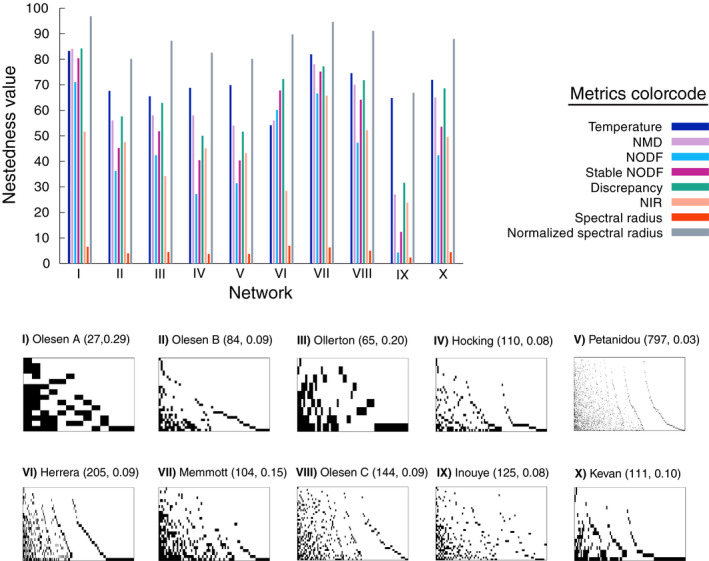
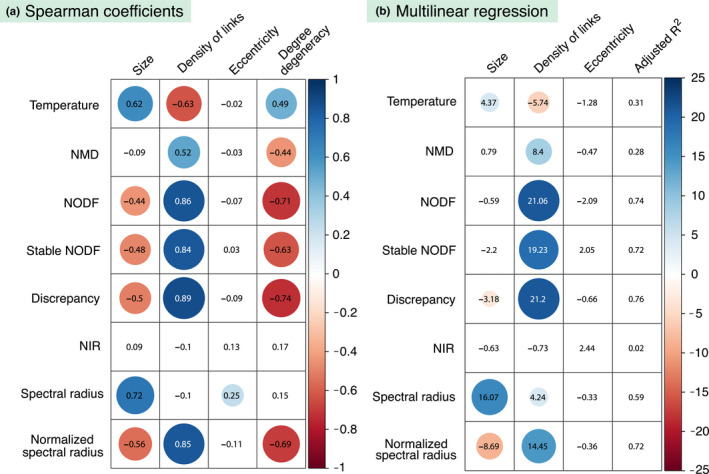
Nestedness is a property of interaction networks widely observed in natural mutualistic communities, among other systems. A perfectly nested network is characterized by the peculiarity that the interactions of any node form a subset of the interactions of all nodes with higher degree. Despite a widespread interest on this pattern, no general consensus exists on how to measure it. Instead, several nestedness metrics, based on different but not necessarily independent properties of the networks, coexist in the literature, blurring the comparison between ecosystems. In this work, we present a detailed critical study of the behavior of six nestedness metrics and the variants of two of them. In order to evaluate their performance, we compare the obtained values of the nestedness of a large set of real networks among them and against a maximum-entropy and maximum-likelihood null model. We also analyze the dependencies of each metrics on different network parameters, as size, fill, and eccentricity. Our results point out, first, that the metrics do not rank networks universally in terms of their degree of nestedness. Furthermore, several metrics show significant dependencies on the network properties considered. The study of these dependencies allows us to understand some of the observed systematic shifts against the null model. Altogether, this paper intends to provide readers with a critical guide on how to measure nestedness patterns, by explaining the functioning of several metrics and disclosing their qualities and flaws. Besides, we also aim to extend the application of null models based on maximum entropy to the scarcely explored area of ecological networks. Finally, we provide a fully documented repository that allows constructing the null model and calculating the studied nestedness indexes. In addition, it provides the probability matrices to build the null model for a large dataset of more than 200 bipartite networks.
嵌套性是一种在自然互利共生群落等多种系统中广泛观察到的相互作用网络的属性。一个完美嵌套的网络的特点是,任何节点的相互作用都构成所有度数更高节点相互作用的一个子集。尽管人们对这种模式普遍感兴趣,但对于如何衡量它并没有达成普遍共识。相反,基于网络不同但不一定独立属性的几种嵌套性指标在文献中共存,这使得生态系统之间的比较变得模糊。在这项工作中,我们对六种嵌套性指标及其其中两种指标的变体的行为进行了详细的批判性研究。为了评估它们的性能,我们比较了一大组真实网络之间以及与最大熵和最大似然零模型相比所获得的嵌套性值。我们还分析了每个指标对不同网络参数(如大小、填充度和偏心率)的依赖性。我们的结果首先指出,这些指标并不能根据网络的嵌套程度对网络进行普遍排序。此外,几个指标显示出对所考虑的网络属性有显著依赖性。对这些依赖性的研究使我们能够理解一些观察到的与零模型相比的系统性偏差。总之,本文旨在通过解释几种指标的功能并揭示它们的优缺点,为读者提供关于如何测量嵌套性模式的批判性指南。此外,我们还旨在将基于最大熵的零模型的应用扩展到生态网络中几乎未被探索的领域。最后,我们提供了一个有完整文档记录的资源库,该资源库允许构建零模型并计算所研究的嵌套性指标。此外,它还提供了概率矩阵,以便为一个包含200多个二分网络的大型数据集构建零模型。