Swavely Natalie R, Cullingsworth Zachary E, Nandanan Naveen, Speich John E, Klausner Adam P
Department of Surgery/Division of Urology, Virginia Commonwealth University School of Medicine, Richmond, VA, USA.
Department of Mechanical Nuclear Engineering, Virginia Commonwealth University School of Engineering, Richmond, VA, USA.
Transl Androl Urol. 2020 Oct;9(5):2138-2145. doi: 10.21037/tau-20-669.
The aim of this project was to develop an ex-vivo porcine bladder model to test the effects of increasing durations of acute ischemia on detrusor function.
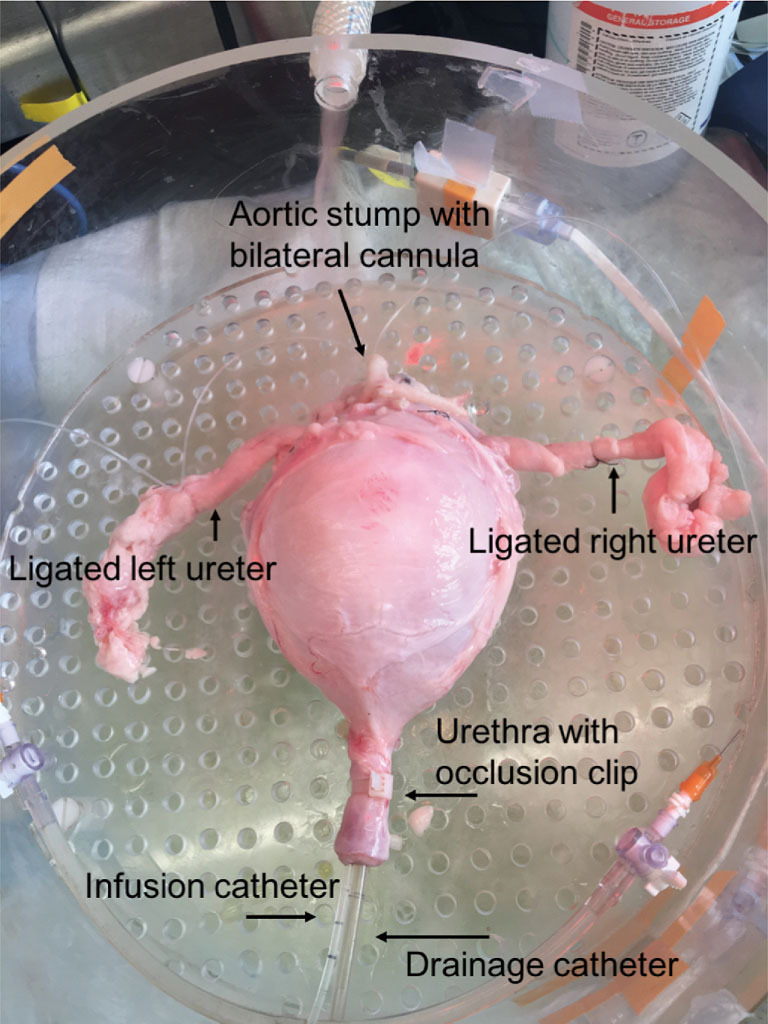
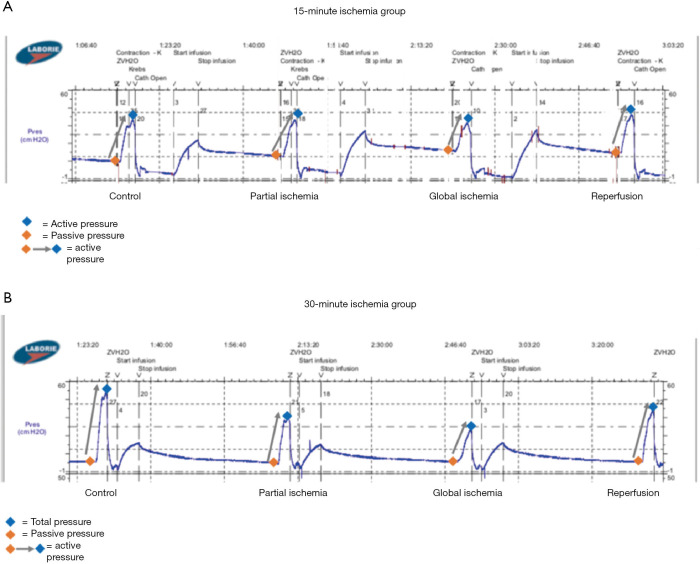
Porcine bladders were perfused through bilateral vesical arteries at physiologic flow (4 mL/min) and filled through a urethral catheter. Intravesical pressures were continuously recorded using standard urodynamics equipment. Bladder contractions, with simulated voiding, were induced by arterial infusion of KCl at 250 mL. Total, passive, and active pressures were recorded for each contraction and data were normalized to the control fill. Bladders underwent the following perfusion protocol by adjusting the arterial flow rates: Equilibration (4 mL/min), control (4 mL/min), partial ischemia (2 mL/min), global ischemia (0 mL/min) and reperfusion (4 mL/min). Perfusion periods were held for 15 min for one group and 30 min for another group of bladders.
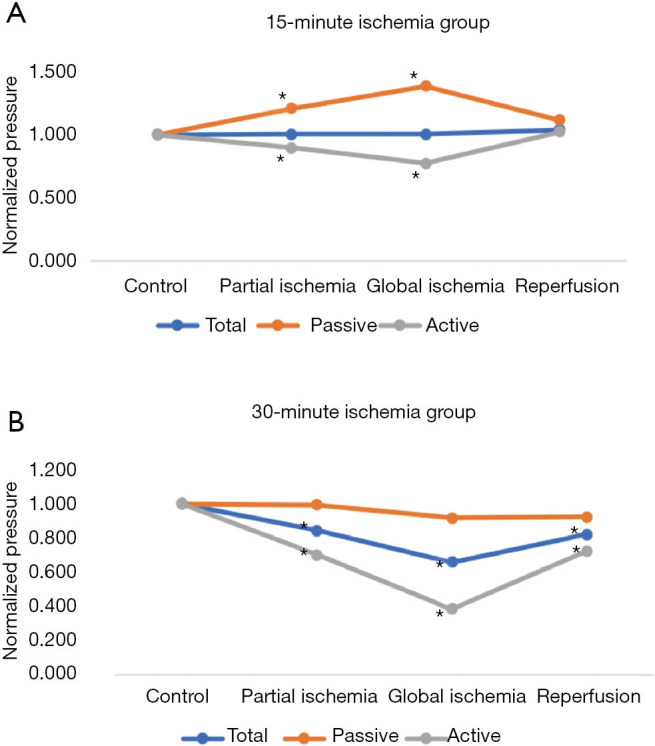
Porcine bladders (N=19) including 8 (15 min group) and 11 (30 min group) were used. With 15 min ischemia, passive pressure increased 39% (P=0.03) and the active pressure decreased 23% (P=0.002). Total pressure remained constant, identifying a compensated phase. Values returned to baseline with reperfusion. With 30 min ischemia, passive pressure remained unchanged. However, there was a decrease in total pressure 34% (P<0.001) and active pressure 61% (P<0.001), which incompletely recovered to baseline values, identifying a decompensated phase with incomplete recovery upon reperfusion.
In the porcine bladder, 15 min ischemia resulted in a compensated phase and 30 min ischemia resulted in a decompensated phase of detrusor function. This study provides mechanistic insight into the natural history of ischemia-mediated voiding dysfunction.
本项目的目的是建立一个体外猪膀胱模型,以测试急性缺血时间延长对逼尿肌功能的影响。
通过双侧膀胱动脉以生理流量(4毫升/分钟)对猪膀胱进行灌注,并通过尿道导管进行充盈。使用标准尿动力学设备连续记录膀胱内压。通过动脉输注250毫升氯化钾诱导膀胱收缩并模拟排尿。记录每次收缩时的总压力、被动压力和主动压力,并将数据标准化为对照充盈状态。通过调整动脉流速,膀胱经历以下灌注方案:平衡期(4毫升/分钟)、对照期(4毫升/分钟)、局部缺血期(2毫升/分钟)、全身缺血期(0毫升/分钟)和再灌注期(4毫升/分钟)。一组膀胱的灌注期为15分钟,另一组为30分钟。
使用了19个猪膀胱,其中8个(15分钟组)和11个(30分钟组)。缺血15分钟时,被动压力增加39%(P=0.03),主动压力降低23%(P=0.002)。总压力保持不变,表明处于代偿期。再灌注后数值恢复到基线。缺血30分钟时,被动压力保持不变。然而,总压力降低了34%(P<0.001),主动压力降低了61%(P<0.001),且再灌注后未完全恢复到基线值,表明处于失代偿期且再灌注后恢复不完全。
在猪膀胱中,15分钟缺血导致逼尿肌功能处于代偿期,30分钟缺血导致失代偿期。本研究为缺血介导的排尿功能障碍的自然病程提供了机制性见解。