Sun Yi, Li Gao, Zhu Wei, He Qiuyan, Liu Yongchang, Chen Xianshan, Liu Juan, Lin Jing, Han-Zhang Han, Yang Zheng, Lizaso Analyn, Xiang Jianxing, Mao Xinru, Liu Hao, Gao Yang
Department of Pathology, The Second Xiangya Hospital, Central South University, Changsha, China.
Department of Thoracic Surgery, Hainan General Hospital, Haikou, China.
Ann Transl Med. 2020 Oct;8(20):1290. doi: 10.21037/atm-20-5118.
The prevalence and types of fibroblast growth factor receptor () mutations vary significantly among different ethnic groups. The optimal application of FGFR inhibitors depends on these variations being comprehensively understood. However, such an analysis has yet to be conducted in Chinese patients.
We retrospectively screened the genomic profiling results of 10,582 Chinese cancer patients across 16 cancer types to investigate the frequency and distribution of aberrations.
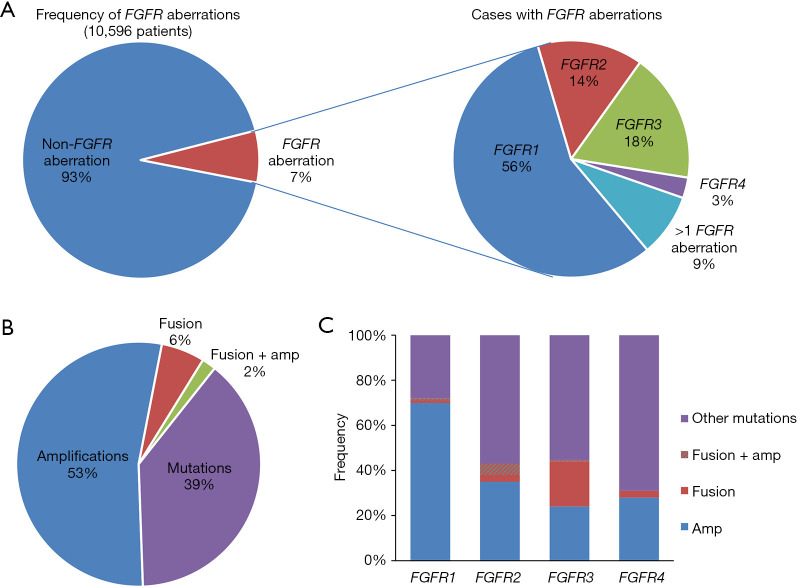
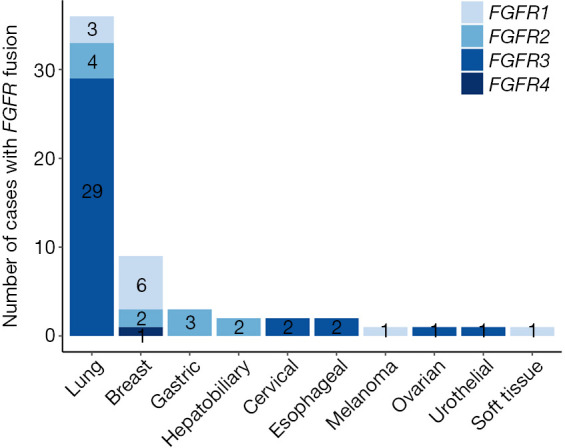
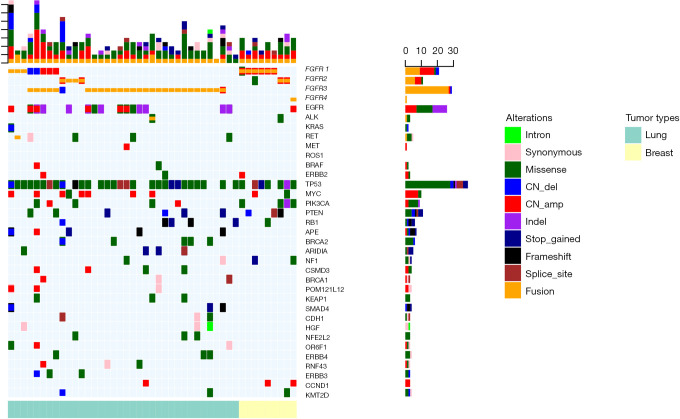
aberrations were identified in 745 patients, equating to an overall prevalence of 7.0%. A majority of the aberrations occurred on (56.8%), which was followed by (17.7%), (14.4%), and (2.8%). Further, 8.5% of patients had aberrations of more than 1 gene. The most common types of aberrations were amplification (53.7%), other mutations (38.8%), and fusions (5.6%). fusion and amplification occurred concurrently in 1.9% of the patients. aberrations were detected in 12 of the 16 cancers, with the highest prevalence belonging to colorectal cancer (CRC) (31%). Other -aberrant cancer types included stomach (16.8%), breast (14.3%), and esophageal (12.7%) cancer. Breast tumors were also more likely than other cancer types to have concurrent rearrangements and amplifications (P<0.001). In comparison with the public dataset, our cohort had a significantly higher number of aberrations in colorectal (P<0.001) and breast cancer (P=0.05).
Among the Chinese cancer patients in our study, the overall prevalence of aberrations was 7.0%. amplification was the most common genetic alteration in CRC, breast cancer, and lung cancer; while amplification was more commonly observed in gastric cancer than in other cancers in our cohort. Our study advances the understanding of the distribution of aberrations in various cancer types in the Chinese population, which will facilitate the further development of FGFR inhibitors.
成纤维细胞生长因子受体(FGFR)突变的患病率和类型在不同种族群体中存在显著差异。FGFR抑制剂的最佳应用取决于对这些差异的全面理解。然而,尚未对中国患者进行此类分析。
我们回顾性筛选了10582例中国癌症患者的16种癌症类型的基因组分析结果,以调查FGFR畸变的频率和分布。
在745例患者中发现了FGFR畸变,总体患病率为7.0%。大多数畸变发生在FGFR2(56.8%),其次是FGFR1(17.7%)、FGFR3(14.4%)和FGFR4(2.8%)。此外,8.5%的患者有超过1个FGFR基因的畸变。最常见的畸变类型是扩增(53.7%)、其他突变(38.8%)和融合(5.6%)。FGFR融合和扩增同时出现在1.9%的患者中。在16种癌症中的12种中检测到FGFR畸变,患病率最高的是结直肠癌(CRC)(31%)。其他FGFR畸变的癌症类型包括胃癌(16.8%)、乳腺癌(14.3%)和食管癌(12.7%)。与其他癌症类型相比,乳腺肿瘤也更有可能同时发生FGFR重排和扩增(P<0.001)。与公共数据集相比,我们的队列在结直肠癌(P<0.001)和乳腺癌(P=0.05)中的FGFR畸变数量显著更多。
在我们研究的中国癌症患者中,FGFR畸变的总体患病率为7.0%。FGFR2扩增是结直肠癌、乳腺癌和肺癌中最常见的基因改变;而在我们的队列中,FGFR1扩增在胃癌中比在其他癌症中更常见。我们的研究增进了对中国人群中各种癌症类型FGFR畸变分布的理解,这将有助于FGFR抑制剂的进一步开发。