Leon-Kabamba Ngombe, Ngatu Nlandu Roger, Muzembo Basilua Andre, Kakoma Sakatolo, Michel-Kabamba Nzaji, Danuser Brigitta, Luboya Oscar, Hirao Tomohiro
Department of Public Health, University of Kamina, Kamina, Congo.
Technical Medical College of Lubumbashi (ISTM-Lubumbashi), Lubumbashi, Congo.
Trop Med Infect Dis. 2020 Nov 17;5(4):171. doi: 10.3390/tropicalmed5040171.
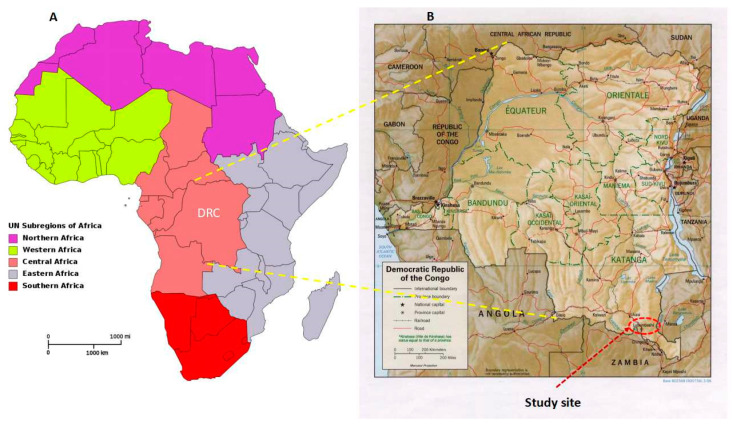
Environmental and occupational exposure to high dust levels are known to be associated with lung function impairment. We assessed the ambient air quality in the working environment and the respiratory health of female stone quarry workers in Lubumbashi, Democratic Republic of Congo (DRC) in a context of severe economic, security, and health crises.
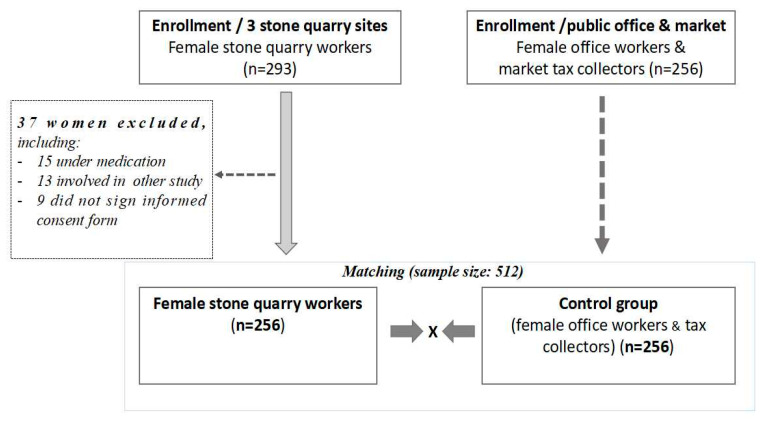
This was a case-control study conducted in three stone quarry sites. Participants were 256 dust-exposed female stone quarry workers matched to 256 unexposed female office workers and market tax collectors ( 512). They each answered a structured respiratory health questionnaire and underwent physical examination and a lung function test with the use of a spirometer and peak flow meter. Quality of ambient air in the working environment was assessed by means of a BRAMC air quality monitor (BR-AIR-329).
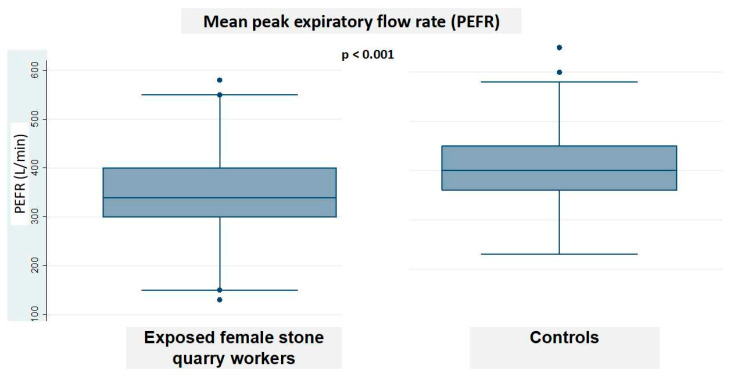
Results showed that exposed women did not use any personal protective equipment (PPE); in quarry sites, abnormally high levels of PM (205 13.2 μg/m vs. 31.3 10.3 μg/m in control sites; 0.001) and volatile organic compounds (VOC, 2.2 0.2 μg/m vs. 0.5 0.3 μg/m, respectively; 0.01) were found. Furthermore, respiratory complaints were more common among exposed women (32.4% vs. 3.5% in controls; 0.01), who had abnormal chest auscultation and reduced lung capacity than controls (mean PEFR: 344.8 2.26 and 405 67.7 L/s, respectively; 0.001 Conclusion. Findings from this study show that in the midst of severe crises in the DRC, women stone quarry workers are exposed to abnormally high levels of respiratory hazards, which contribute to impaired lung function. There is a need to regulate quarry work and improve the working conditions in quarry sites in the DRC.
已知环境和职业性接触高粉尘水平与肺功能损害有关。在刚果民主共和国卢本巴希面临严重经济、安全和健康危机的背景下,我们评估了工作环境中的空气质量以及女性采石场工人的呼吸健康状况。
这是一项在三个采石场进行的病例对照研究。参与者为256名接触粉尘的女性采石场工人,与256名未接触粉尘的女性办公室职员和市场税务员(共512人)进行匹配。她们每人都回答了一份结构化的呼吸健康问卷,并接受了体格检查以及使用肺活量计和峰值流量计进行的肺功能测试。通过BRAMC空气质量监测仪(BR-AIR-329)评估工作环境中的空气质量。
结果显示,接触粉尘的女性未使用任何个人防护设备(PPE);在采石场,发现PM(205±13.2μg/m³,对照场所为31.3±10.3μg/m³;P<0.001)和挥发性有机化合物(VOC,分别为2.2±0.2μg/m³和0.5±0.3μg/m³;P<0.01)水平异常高。此外,接触粉尘的女性中呼吸方面的主诉更为常见(32.4%,对照组为3.5%;P<0.01),她们的胸部听诊异常且肺容量低于对照组(平均呼气峰值流速分别为344.8±2.26和405±67.7L/s;P<0.001)。结论。本研究结果表明,在刚果民主共和国严重危机期间,女性采石场工人接触到异常高水平的呼吸危害,这导致了肺功能受损。刚果民主共和国需要对采石场工作进行监管并改善采石场的工作条件。