Department for Veterinary Clinical Science, Justus-Liebig-University, Frankfurter Strasse 112, D-35392, Giessen, Germany.
Arbeitskreis Wildbiologie e.V., Justus-Liebig-University, Giessen, Germany.
BMC Genet. 2020 Nov 19;21(1):126. doi: 10.1186/s12863-020-00950-3.
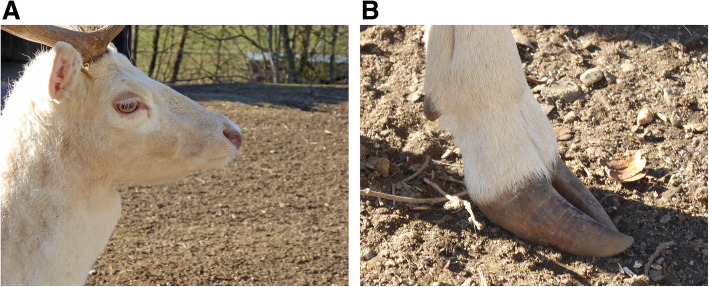
The coat colour of fallow deer is highly variable and even white animals can regularly be observed in game farming and in the wild. Affected animals do not show complete albinism but rather some residual pigmentation resembling a very pale beige dilution of coat colour. The eyes and claws of the animals are pigmented. To facilitate the conservation and management of such animals, it would be helpful to know the responsible gene and causative variant. We collected 102 samples from 22 white animals and from 80 animals with wildtype coat colour. The samples came from 12 different wild flocks or game conservations located in different regions of Germany, at the border to Luxembourg and in Poland. The genomes of one white hind and her brown calf were sequenced.
Based on a list of colour genes of the International Federation of Pigment Cell Societies ( http://www.ifpcs.org/albinism/ ), a variant in the MC1R gene (NM_174108.2:c.143 T > C) resulting in an amino acid exchange from leucine to proline at position 48 of the MC1R receptor protein (NP_776533.1:p.L48P) was identified as a likely cause of coat colour dilution. A gene test revealed that all animals of the white phenotype were of genotype CC whereas all pigmented animals were of genotype TT or TC. The study showed that 14% of the pigmented (brown or dark pigmented) animals carried the white allele.
A genome-wide scan study led to a molecular test to determine the coat colour of fallow deer. Identification of the MC1R gene provides a deeper insight into the mechanism of dilution. The gene marker is now available for the conservation of white fallow deer in wild and farmed animals.
赤鹿的毛色高度多变,即使在狩猎和野外,也经常能观察到白色的动物。受影响的动物并非完全白化,而是具有一些残余色素,类似于毛色非常淡的米色稀释。这些动物的眼睛和爪子有色素。为了便于此类动物的保护和管理,如果能了解相关基因和致病变体,将会很有帮助。我们收集了 22 只白色动物和 80 只野生毛色动物的 102 个样本。这些样本来自德国不同地区、卢森堡边境和波兰的 12 个不同的野生鹿群或狩猎保护区。我们对一只白色母鹿及其棕色幼鹿的基因组进行了测序。
根据国际色素细胞学会联合会(http://www.ifpcs.org/albinism/)的毛色基因列表,MC1R 基因(NM_174108.2:c.143T>C)的一个变体导致 MC1R 受体蛋白(NP_776533.1:p.L48P)第 48 位的氨基酸由亮氨酸变为脯氨酸,这被认为是毛色稀释的可能原因。基因测试显示,所有白色表型的动物均为 CC 基因型,而所有有色动物均为 TT 或 TC 基因型。研究表明,14%的有色(棕色或深色)动物携带白色等位基因。
全基因组扫描研究导致了一种分子测试,以确定赤鹿的毛色。MC1R 基因的鉴定为稀释机制提供了更深入的了解。该基因标记现已可用于野生和养殖赤鹿的白色个体的保护。