Sonntag Jesper, Landale Keith, Brorson Stig, Harris Ian A
Department of Orthopaedic Surgery, Nordsjaellands Hospital, University of Copenhagen, Hilleroed, Denmark.
Department of Orthopaedic Surgery, Tamworth Rural Referral Hospital, Tamworth, Australia.
Bone Jt Open. 2020 Sep 11;1(9):549-555. doi: 10.1302/2633-1462.19.BJO-2020-0093.R1. eCollection 2020 Sep.
The aim of this study was to investigate surgeons' reported change of treatment preference in response to the results and conclusion from a randomized contolled trial (RCT) and to study patterns of change between subspecialties and nationalities.
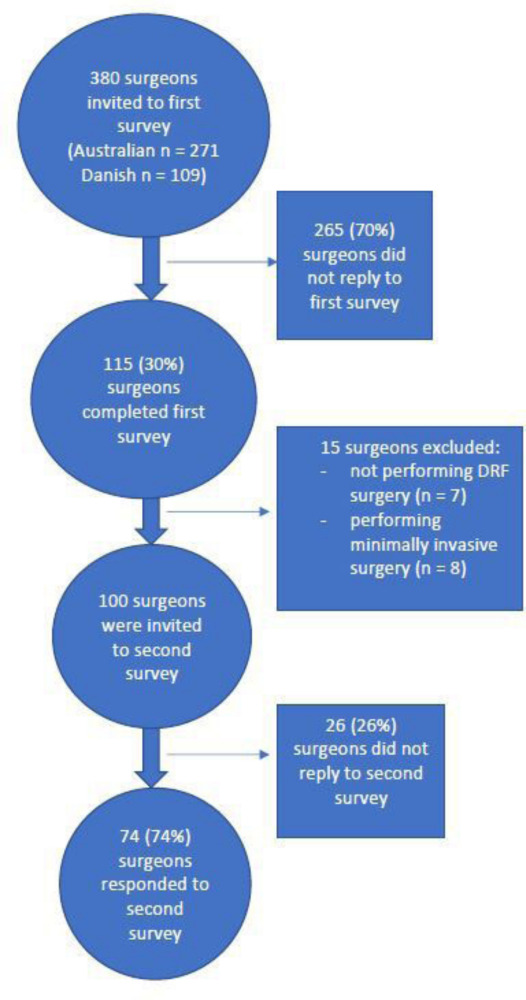
Two questionnaires were developed through the Delphi process for this cross-sectional survey of surgical preference. The first questionnaire was sent out before the publication of a RCT and the second questionnaire was sent out after publication. The RCT investigated repair or non-repair of the pronator quadratus (PQ) muscle during volar locked plating of distal radial fractures (DRFs). Overall, 380 orthopaedic surgeons were invited to participate in the first questionnaire, of whom 115 replied. One hundred surgeons were invited to participate in the second questionnaire. The primary outcome was the proportion of surgeons for whom a treatment change was warranted, who then reported a change of treatment preference following the RCT. Secondary outcomes included the reasons for repair or non-repair, reasons for and against following the RCT results, and difference of preferred treatment of the PQ muscle between surgeons of different nationalities, qualifications, years of training, and number of procedures performed per year.
Of the 100 surgeons invited for the second questionnaire, 74 replied. For the primary outcome, six of 32 surgeons (19%), who usually repaired the PQ muscle and therefore a change of treatment preference was warranted, reported a change of treatment preference based on the RCT publication. Of the secondary outcomes, restoring anatomy was the most common response for repairing the PQ muscle.
The majority of the orthopaedic surgeons, where a change of treatment preference was warranted based on the results and conclusion of a RCT, did not report willingness to change their treatment preference.Cite this article: 2020;1-9:549-555.
本研究旨在调查外科医生报告的因随机对照试验(RCT)的结果和结论而导致的治疗偏好变化,并研究不同亚专业和国籍之间的变化模式。
通过德尔菲法开发了两份问卷,用于本次外科治疗偏好的横断面调查。第一份问卷在RCT发表前发放,第二份问卷在发表后发放。该RCT研究了桡骨远端骨折(DRF)掌侧锁定钢板固定术中旋前方肌(PQ)的修复与否。总体而言,邀请了380名骨科医生参与第一份问卷,其中115人回复。邀请了100名医生参与第二份问卷。主要结局是有必要改变治疗方案的外科医生比例,这些医生随后报告在RCT之后治疗偏好发生了改变。次要结局包括修复或不修复的原因、支持和反对遵循RCT结果的原因,以及不同国籍、资质、培训年限和每年手术例数的外科医生对PQ肌的首选治疗方法的差异。
受邀参与第二份问卷的100名外科医生中,74人回复。对于主要结局,32名通常修复PQ肌且因此有必要改变治疗偏好的外科医生中,有6人(19%)报告基于RCT发表改变了治疗偏好。在次要结局中,恢复解剖结构是修复PQ肌最常见的理由。
大多数骨科医生,尽管基于RCT的结果和结论有必要改变治疗偏好,但并未报告愿意改变其治疗偏好。引用本文: 2020;1-9:549-555。