National Institute on Alcohol Abuse and Alcoholism, National Institutes of Health, Bethesda, MD, USA.
Center for Alcohol Research in Epigenetics, Department of Psychiatry, University of Illinois at Chicago, Chicago, IL, USA.
Brain Behav. 2021 Feb;11(2):e01961. doi: 10.1002/brb3.1961. Epub 2020 Nov 20.
Repeated exposure to high doses of alcohol triggers neuroinflammatory processes that contribute to craving and mood dysfunction in alcohol use disorder (AUD). The upregulation of the translocator protein (TSPO) is considered a biomarker of neuroinflammation, and TSPO ligands have been used as neuroimaging biomarkers of neuroinflammation. Epigenetic mechanisms are also implicated in neuroinflammatory responses to alcohol, and elevated expression of HDAC2 and HDAC6 has been reported in the brain of animals exposed to chronic alcohol.
The present study examined the transcriptional regulation of TSPO, HDAC2, and HDAC6 in human postmortem brain tissue from males previously diagnosed with AUD (n = 11) compared to age-matched nondependent males (n = 13) in four brain regions relevant to AUD: prefrontal cortex (PFC), nucleus accumbens (NAc), hippocampus (HPP), and amygdala (AMY).
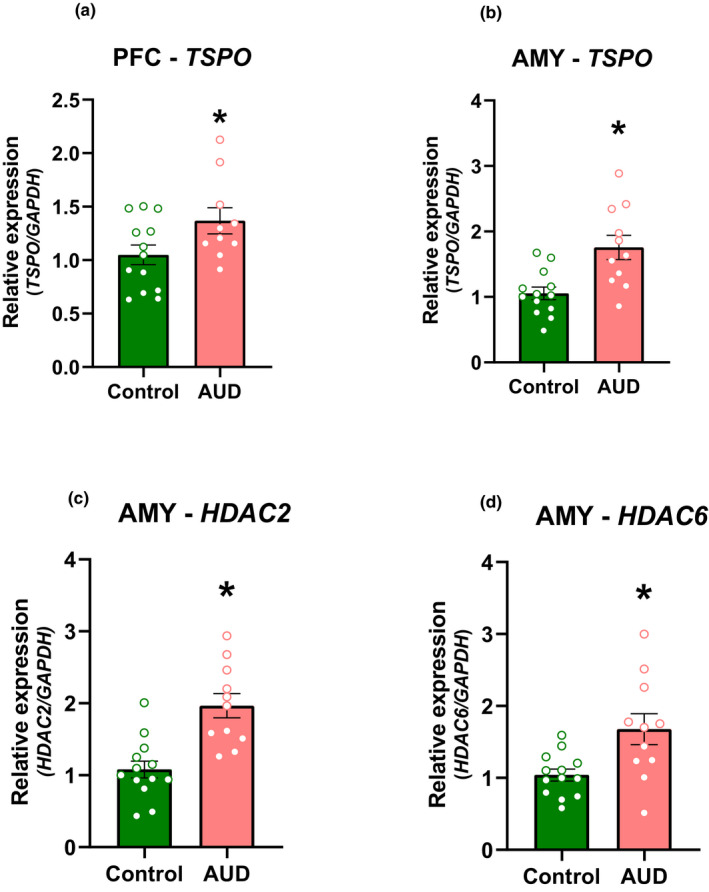
Translocator protein mRNA levels in AMY and PFC and HDAC2 and HDAC6 mRNA levels in AMY were upregulated in AUD compared to controls. In AMY, TSPO mRNA levels were positively associated with HDAC2 and HDAC6 mRNA levels, suggesting a possible regulation of TSPO by HDAC2 and HDAC6 in this brain region. In contrast, there were no group differences for TSPO, HDAC2, and HDAC6 in NAc and HPP.
Our study is the first to find upregulated TSPO mRNA levels in AMY and PFC in postmortem brains from AUD consistent with neuroinflammation, and in the amygdala, they implicate epigenetic regulation of TSPO by HDAC2 and HDAC6.
反复暴露于高剂量酒精会引发神经炎症过程,从而导致酒精使用障碍(AUD)中的渴望和情绪功能障碍。转位蛋白(TSPO)的上调被认为是神经炎症的生物标志物,并且 TSPO 配体已被用作神经炎症的神经影像学生物标志物。表观遗传机制也与酒精引起的神经炎症反应有关,并且在暴露于慢性酒精的动物的大脑中已经报道了 HDAC2 和 HDAC6 的表达升高。
本研究检查了 TSPO、HDAC2 和 HDAC6 在先前被诊断为 AUD(n=11)的男性与年龄匹配的非依赖男性(n=13)的人死后脑组织中的转录调节,在与 AUD 相关的四个脑区:前额叶皮层(PFC)、伏隔核(NAc)、海马(HPP)和杏仁核(AMY)。
与对照组相比,AUD 患者的 AMY 和 PFC 中的 TSPO mRNA 水平以及 AMY 中的 HDAC2 和 HDAC6 mRNA 水平上调。在 AMY 中,TSPO mRNA 水平与 HDAC2 和 HDAC6 mRNA 水平呈正相关,表明在该脑区 TSPO 可能受到 HDAC2 和 HDAC6 的调节。相比之下,在 NAc 和 HPP 中,TSPO、HDAC2 和 HDAC6 没有组间差异。
我们的研究首次发现 AUD 患者死后大脑的 AMY 和 PFC 中 TSPO mRNA 水平升高,与神经炎症一致,在杏仁核中,它们表明 HDAC2 和 HDAC6 对 TSPO 的表观遗传调节。