MRC Centre for Drug Safety Science, Department of Molecular and Clinical Pharmacology, The University of Liverpool, Liverpool, UK.
The Wolfson Centre for Personalised Medicine, Department of Molecular and Clinical Pharmacology, The University of Liverpool, UK.
Br J Clin Pharmacol. 2021 Jun;87(6):2572-2588. doi: 10.1111/bcp.14667. Epub 2020 Dec 14.
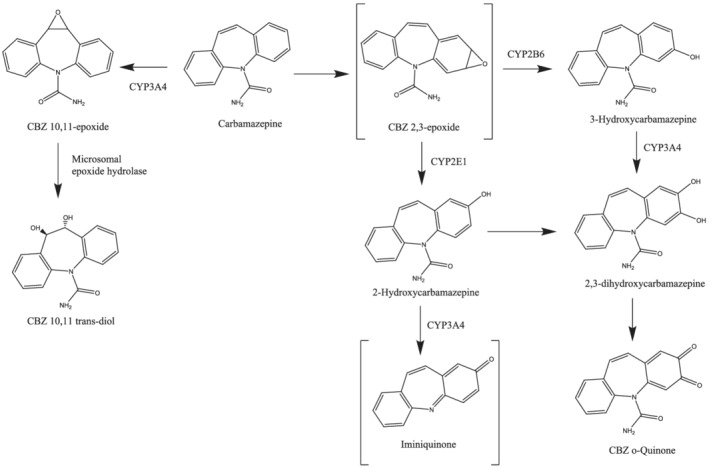
Carbamazepine can cause hypersensitivity reactions in ~10% of patients. An immunogenic effect can be produced by the electrophilic 10,11-epoxide metabolite but not by carbamazepine. Hypothetically, certain single nucleotide polymorphisms might increase the formation of immunogenic metabolites, leading ultimately to hypersensitivity reactions. This study explores the role of clinical and genetic factors in the pharmacokinetics (PK) of carbamazepine and 3 metabolites known to be chemically reactive or formed through reactive intermediates.
A combination of rich and sparse PK samples were collected from healthy volunteers and epilepsy patients. All subjects were genotyped for 20 single nucleotide polymorphisms in 11 genes known to be involved in the metabolism or transport of carbamazepine and carbamazepine 10,11-epoxide. Nonlinear mixed effects modelling was used to build a population-PK model.
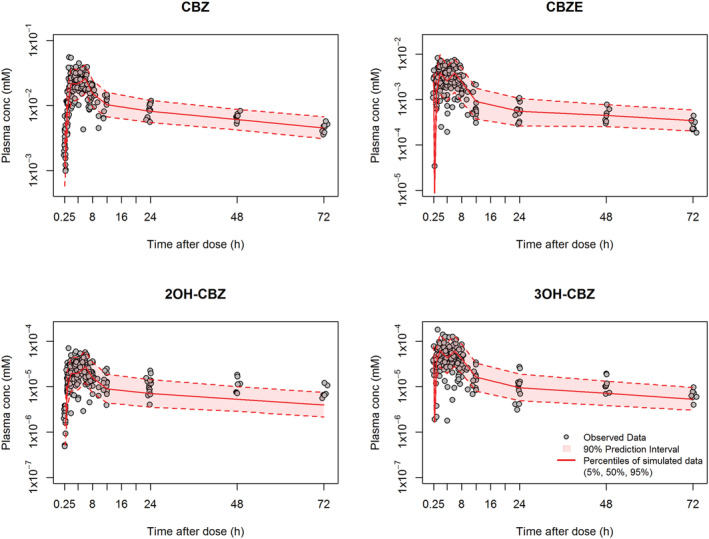
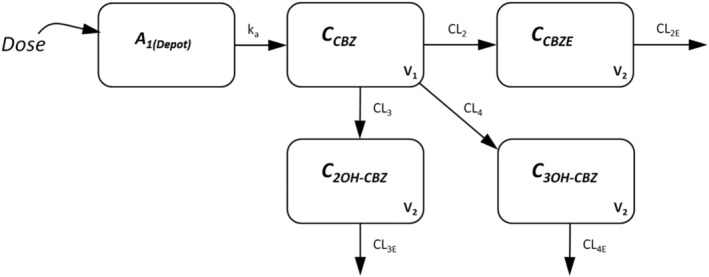
In total, 248 observations were collected from 80 subjects. A 1-compartment PK model with first-order absorption and elimination best described the parent carbamazepine data, with a total clearance of 1.96 L/h, central distribution volume of 164 L and absorption rate constant of 0.45 h . Total daily dose and coadministration of phenytoin were significant covariates for total clearance of carbamazepine. EPHX1-416G/G genotype was a significant covariate for the clearance of carbamazepine 10,11-epoxide.
Our data indicate that carbamazepine clearance was affected by total dose and phenytoin coadministration, but not by genetic factors, while carbamazepine 10,11-epoxide clearance was affected by a variant in the microsomal epoxide hydrolase gene. A much larger sample size would be required to fully evaluate the role of genetic variation in carbamazepine pharmacokinetics, and thereby predisposition to carbamazepine hypersensitivity.
卡马西平在约 10%的患者中会引起过敏反应。亲电 10,11-环氧化物代谢物可产生免疫原性效应,但卡马西平不会。假设某些单核苷酸多态性可能会增加免疫原性代谢物的形成,最终导致过敏反应。本研究探讨了临床和遗传因素在卡马西平及其 3 种已知具有化学反应性或通过反应性中间体形成的代谢物的药代动力学(PK)中的作用。
从健康志愿者和癫痫患者中采集丰富和稀疏的 PK 样本组合。对所有受试者进行 11 个基因中 20 个单核苷酸多态性的基因分型,这些基因已知参与卡马西平及其 10,11-环氧化物的代谢或转运。使用非线性混合效应模型构建群体 PK 模型。
总共从 80 名受试者中收集了 248 个观察结果。一个具有一级吸收和消除的 1 室 PK 模型最能描述母体卡马西平的数据,其总清除率为 1.96 L/h,中央分布容积为 164 L,吸收速率常数为 0.45 h -1 。总日剂量和苯妥英合用是卡马西平总清除率的显著协变量。EPHX1-416G/G 基因型是卡马西平 10,11-环氧化物清除率的显著协变量。
我们的数据表明,卡马西平清除率受总剂量和苯妥英合用的影响,但不受遗传因素的影响,而卡马西平 10,11-环氧化物清除率受微粒体环氧化物水解酶基因变异的影响。需要更大的样本量才能充分评估遗传变异在卡马西平药代动力学中的作用,从而预测卡马西平过敏的易感性。