Department of Finemechanics, Tohoku University, 6-6-01 Aramaki, Aoba-ku, Sendai 980-8579, Japan.
Ultrason Sonochem. 2021 Mar;71:105389. doi: 10.1016/j.ultsonch.2020.105389. Epub 2020 Nov 13.
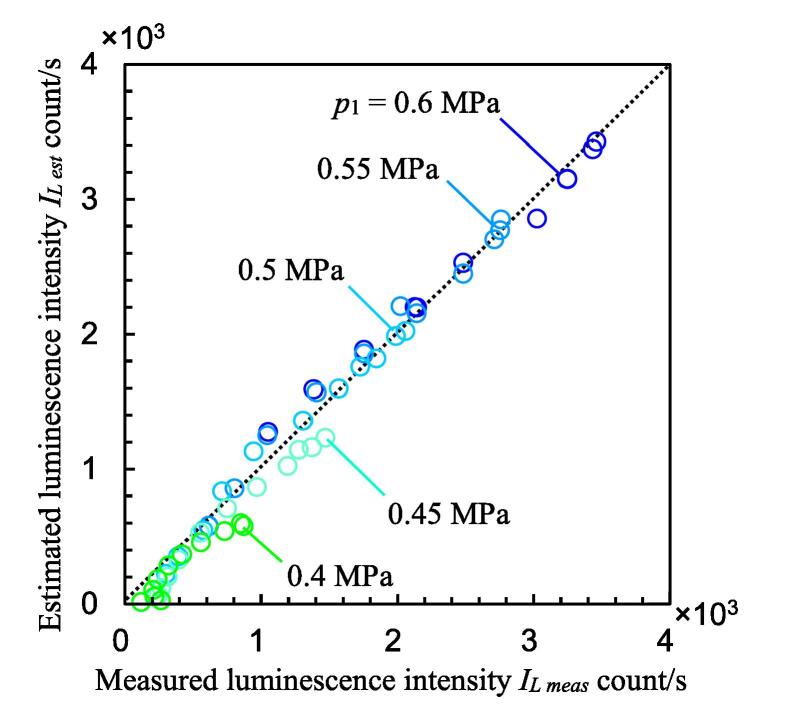
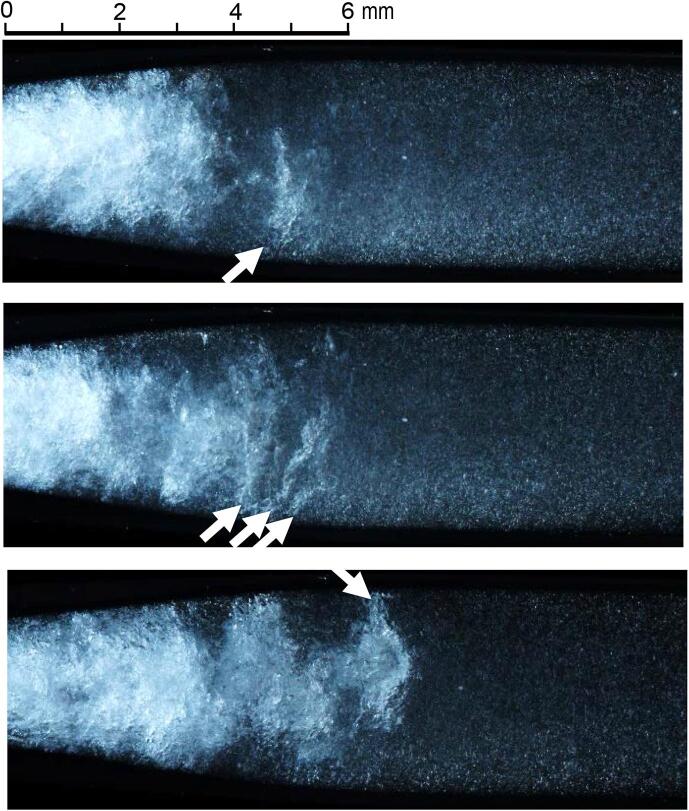
Hydrodynamic cavitation in a Venturi tube produces luminescence, and the luminescence intensity reaches a maximum at a certain cavitation number, which is defined by upstream pressure, downstream pressure, and vapor pressure. The luminescence intensity of hydrodynamic cavitation can be enhanced by optimizing the downstream pressure at a constant upstream pressure condition. However, the reason why the luminescence intensity increases and then decreases with an increase in the downstream pressure remains unclear. In the present study, to clarify the mechanism of the change in the luminescence intensity with cavitation number, the luminescence produced by the hydrodynamic cavitation in a Venturi tube was measured, and the hydrodynamic cavitation was precisely observed using high-speed photography. The sound velocity in the cavitating flow field, which affects the aggressive intensity of the cavitation, was evaluated. The collapse of vortex cavitation was found to be closely related to the luminescence intensity of the hydrodynamic cavitation. A method to estimate the luminescence intensity of the hydrodynamic cavitation considering the sound velocity was developed, and it was demonstrated that the estimated luminescence intensity agrees well with the measured luminescence intensity.
在文丘里管中,流体动力空化会产生发光现象,并且发光强度在某个空化数下达到最大值,该空化数由上游压力、下游压力和蒸汽压力定义。通过在恒定上游压力条件下优化下游压力,可以增强流体动力空化的发光强度。然而,发光强度随着下游压力的增加而先增加后减少的原因尚不清楚。在本研究中,为了阐明发光强度随空化数变化的机制,测量了文丘里管中流体动力空化产生的发光,并使用高速摄影术精确观察了流体动力空化。评估了影响空化强度的空化流场中的声速。发现旋涡空化的崩溃与流体动力空化的发光强度密切相关。开发了一种考虑声速的流体动力空化发光强度估算方法,并验证了该方法估算的发光强度与实测发光强度吻合良好。