Department of Clinical Science and Education, Södersjukhuset, Karolinska Institutet, Stockholm, Sweden.
Department of Anaesthesia and Intensive Care, Södersjukhuset, Stockholm, Sweden.
Crit Care. 2020 Nov 23;24(1):653. doi: 10.1186/s13054-020-03375-7.
A substantial proportion of critically ill COVID-19 patients develop thromboembolic complications, but it is unclear whether higher doses of thromboprophylaxis are associated with lower mortality rates. The purpose of the study was to evaluate the association between initial dosing strategy of thromboprophylaxis in critically ill COVID-19 patients and the risk of death, thromboembolism, and bleeding.
In this retrospective study, all critically ill COVID-19 patients admitted to two intensive care units in March and April 2020 were eligible. Patients were categorized into three groups according to initial daily dose of thromboprophylaxis: low (2500-4500 IU tinzaparin or 2500-5000 IU dalteparin), medium (> 4500 IU but < 175 IU/kilogram, kg, of body weight tinzaparin or > 5000 IU but < 200 IU/kg of body weight dalteparin), and high dose (≥ 175 IU/kg of body weight tinzaparin or ≥ 200 IU/kg of body weight dalteparin). Thromboprophylaxis dosage was based on local standardized recommendations, not on degree of critical illness or risk of thrombosis. Cox proportional hazards regression was used to estimate hazard ratios with corresponding 95% confidence intervals of death within 28 days from ICU admission. Multivariable models were adjusted for sex, age, body mass index, Simplified Acute Physiology Score III, invasive respiratory support, and initial dosing strategy of thromboprophylaxis.
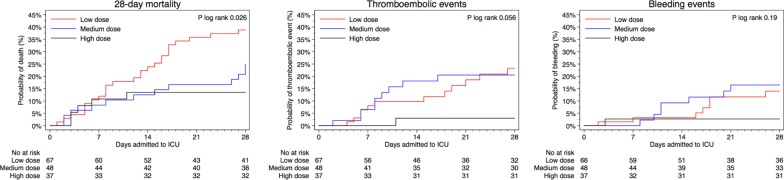
A total of 152 patients were included: 67 received low-, 48 medium-, and 37 high-dose thromboprophylaxis. Baseline characteristics did not differ between groups. For patients who received high-dose prophylaxis, mortality was lower (13.5%) compared to those who received medium dose (25.0%) or low dose (38.8%), p = 0.02. The hazard ratio of death was 0.33 (95% confidence intervals 0.13-0.87) among those who received high dose, and 0.88 (95% confidence intervals 0.43-1.83) among those who received medium dose, as compared to those who received low-dose thromboprophylaxis. There were fewer thromboembolic events in the high (2.7%) vs medium (18.8%) and low-dose thromboprophylaxis (17.9%) groups, p = 0.04.
Among critically ill COVID-19 patients with respiratory failure, high-dose thromboprophylaxis was associated with a lower risk of death and a lower cumulative incidence of thromboembolic events compared with lower doses.
Clinicaltrials.gov NCT04412304 June 2, 2020, retrospectively registered.
相当大比例的危重症 COVID-19 患者会发生血栓栓塞并发症,但目前尚不清楚较高剂量的血栓预防是否与较低的死亡率相关。本研究的目的是评估危重症 COVID-19 患者初始血栓预防剂量策略与死亡率、血栓栓塞和出血风险之间的关系。
在这项回顾性研究中,符合条件的是 2020 年 3 月和 4 月入住两家重症监护病房的所有危重症 COVID-19 患者。根据初始每日血栓预防剂量,患者分为三组:低剂量(2500-4500IU 那屈肝素或 2500-5000IU 达肝素)、中剂量(>4500IU 但<175IU/公斤体重那屈肝素或>5000IU 但<200IU/公斤体重达肝素)和高剂量(≥175IU/公斤体重那屈肝素或≥200IU/公斤体重达肝素)。血栓预防剂量基于当地标准化建议,而不是基于疾病严重程度或血栓形成风险。使用 Cox 比例风险回归估计从 ICU 入院起 28 天内死亡的风险比及其相应的 95%置信区间。多变量模型调整了性别、年龄、体重指数、简化急性生理学评分 III、有创性呼吸支持和初始血栓预防剂量策略。
共纳入 152 例患者:67 例接受低剂量、48 例中剂量和 37 例高剂量预防。各组间基线特征无差异。接受高剂量预防的患者死亡率(13.5%)低于接受中剂量(25.0%)或低剂量(38.8%)的患者,p=0.02。与接受低剂量预防的患者相比,接受高剂量预防的患者死亡风险比为 0.33(95%置信区间 0.13-0.87),接受中剂量预防的患者为 0.88(95%置信区间 0.43-1.83)。高剂量(2.7%)与中剂量(18.8%)和低剂量(17.9%)预防组相比,血栓栓塞事件更少,p=0.04。
在有呼吸衰竭的危重症 COVID-19 患者中,与低剂量相比,高剂量血栓预防与较低的死亡率和较低的血栓栓塞事件累积发生率相关。
Clinicaltrials.gov NCT04412304 2020 年 6 月 2 日,回顾性注册。